Japan Votes in Snap Election as PM Sanae Takaichi Seeks Strong Mandate
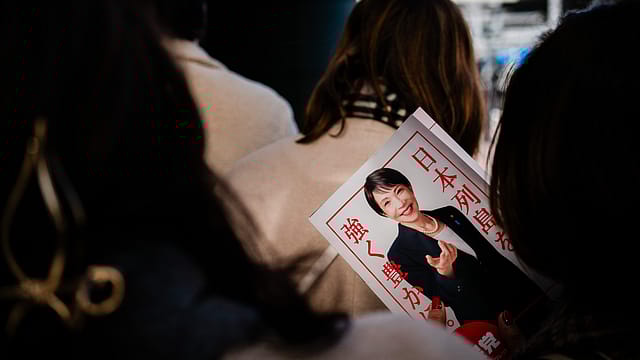
Voting began across Japan on Sunday in a snap general election called by Prime Minister Sanae Takaichi, who is seeking a fresh public mandate to press ahead with sweeping economic, security and immigration reforms alongside her new coalition partner.
Japan’s first female prime minister, who took office last October after being elected leader of the Liberal Democratic Party (LDP), has said she would “immediately resign” if her ruling bloc fails to secure a majority in the powerful 465-member House of Representatives.
The coalition comprises the LDP and the Japan Innovation Party, also known as Ishin.
Nearly 1,300 candidates are contesting the election. Of the total seats, 289 will be decided in single-seat constituencies, while 176 will be allocated through proportional representation across 11 regional blocs.

The Modi Years
02 Oct 2026 - Vol 05 | Issue 40
A Nation Rebuilt
Polls close at 8 pm local time, when broadcasters are expected to release projections based on exit polls.
Polls Point to Clear Majority for Takaichi-Led Bloc
Media surveys analysed by Kyodo News and AFP indicate a widening lead for the ruling bloc. Pre-election polls suggest the LDP and its coalition partner are on track to comfortably clear the 233 seats needed for a simple majority.
Some projections, offered cautiously because of undecided voters and harsh winter conditions, indicate the bloc could approach or even surpass 310 seats, the two-thirds threshold required to initiate constitutional revision ahead of a national referendum.
Ahead of the vote, the LDP held 198 seats, the Japan Innovation Party 34, and the main opposition Centrist Reform Alliance 167, according to Kyodo News.
The ruling camp entered the race with only a razor-thin majority, supported by independents, before parliament was dissolved late last month.
Heavy snowfall across wide parts of the country has raised concerns about voter turnout. Japan is holding a February general election for the first time in 36 years, a decision by Takaichi that has drawn criticism because severe winter conditions complicate campaigning.
Social media buzz and youth appeal bolster Takaichi’s campaign
“The future is something you have to build with your own hands,” Takaichi said in a YouTube campaign video that has attracted millions of views. “The LDP will lead the way,” she added.
Takaichi, 64, has defied early scepticism since her rise to the top. Once seen as an ultra-conservative outsider, the former heavy-metal drummer and admirer of Margaret Thatcher has cultivated an image that blends toughness with a playful public persona.
Her popularity has been amplified online, particularly among younger voters, with supporters sharing clips ranging from campaign speeches to her singing a K-pop song alongside South Korea’s president.
“I came just to have a look at her. I think she is amazing,” Yuka Ando, a 17-year-old high-school student, told AFP at a campaign event in Tokyo.
The election marks the first major test for the Centrist Reform Alliance, which was formed through a merger involving the Constitutional Democratic Party of Japan and Komeito.
End of LDP–Komeito Tie Reshapes Japan’s Political Landscape
The alliance is seeking to counter criticism that it was created purely for electoral advantage and hopes to attract voters uneasy with what it describes as Japan’s increasingly “right-leaning” political climate.
Despite the new alliance and the presence of a rising far-right, the opposition is widely seen as too fragmented to mount a serious challenge.
Komeito, backed by Japan’s largest lay Buddhist organisation Soka Gakkai, had been allied with the LDP for 26 years before the partnership ended in October.
The previous general election, held in October 2024, marked a turning point when the LDP under Takaichi’s predecessor lost its majority after that alliance collapsed.
The rising cost of living has dominated the campaign
With prices climbing faster than wages, households are under pressure, and Japan continues to struggle with sluggish economic growth.
The economy expanded by 1.1 per cent last year and is expected to grow by only 0.7 per cent in 2026, according to the International Monetary Fund.
Almost all parties have pledged to suspend or abolish the consumption tax on food products, though funding sources and timelines remain contentious amid concerns over Japan’s fiscal health.
Takaichi has promised to suspend the 8 per cent sales tax on food for two years. Soon after taking office, her government rolled out a 21.3 trillion yen stimulus package, about $136 billion, the largest since the COVID-19 pandemic.
The package focused heavily on cost-of-living relief, including energy bill subsidies, cash handouts and food vouchers.
Despite these measures, Takaichi has faced criticism over economic management. Japan’s public debt stands at more than twice the size of its economy, long-term bond yields have reached record levels, and the yen has fluctuated sharply in recent weeks.
Her decision to call a snap election has also delayed passage of the fiscal 2026 budget, originally expected by the end of March ahead of the April start of the financial year.
She has defended the move, saying she has yet to receive public backing for Japan’s “major policy shifts”, including her “responsible yet aggressive” fiscal approach and the formation of the new ruling coalition.
Security and foreign policy have also emerged as central campaign issues
Under Takaichi’s leadership, the government has rallied support for boosting military capabilities, emphasising what it describes as a worsening regional security environment.
She has pledged to revise defence and security policies by December, lift a ban on weapons exports and further move Japan away from its post-war pacifist principles.
Tensions with China have intensified following her remarks on a possible Taiwan contingency, in which she suggested Japan could intervene militarily if Beijing attempted to seize the island.
The comments prompted China to summon Japan’s ambassador, warn its citizens against travel to Japan, conduct joint air drills with Russia and return Japan’s last two pandas.
Immigration policy has been another flashpoint
Takaichi has adopted a hard line, a stance that has helped blunt momentum behind the populist Sanseito party. Immigration screening “has already become a little stricter, so that terrorists, and also industrial spies, cannot enter easily”, she said on Saturday.
“We must properly examine whether (foreigners) are paying taxes, whether they are paying their health insurance premiums,” she added.
Her platform also includes stricter requirements for foreign property owners and a cap on foreign residents.
Even if the ruling coalition secures a clear majority in the lower house, it still lacks control of the upper chamber.
As a result, cooperation from opposition parties will remain essential for passing legislation. For the LDP to advance its long-standing goal of constitutional revision, it would need at least 310 seats in the lower house to trigger the process.
(With inputs from ANI)