India, Malaysia Deepen Strategic Partnership with Focus on Security, Semiconductors and Trade
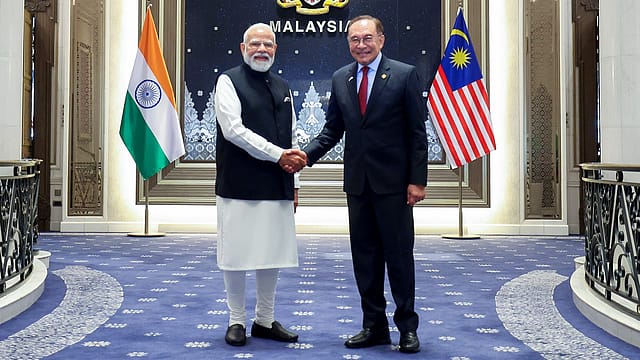
Prime Minister Narendra Modi’s two-day official visit to Malaysia has injected fresh momentum into efforts to translate the upgraded Comprehensive Strategic Partnership into concrete outcomes on the ground, with both sides announcing a raft of agreements and initiatives spanning security, trade, technology, culture and people-to-people ties.
Malaysian Prime Minister Anwar Ibrahim described his discussions with PM Modi as “very vital, very strategic and critical” for advancing bilateral relations.
Recalling the elevation of ties in 2024, he said both countries were fully committed to implementing the agreed decisions “in a speedy manner”.

Losing Memory
16 Oct 2026 - Vol 05 | Issue 42
The making of a medical and social emergency
“We consider this meeting and these exchanges very vital, very strategic and critical to advance and enhance relations between India and Malaysia,” PM Anwar said, pointing to long-standing ties since 1957 and “the deep historical ties, strong people-to-people linkages, and ever-expanding economic cooperation”.
PM Modi, in turn, characterised the India-Malaysia relationship as “special”, citing shared maritime interests, deep cultural linkages and a common commitment to democratic values.
No Compromise on Terror, Focus on Indo-Pacific and ASEAN Centrality
Reiterating India’s firm position on terrorism, he said, “Our message on terrorism is clear; no double standards, no compromise.”
He also underlined India’s commitment to ASEAN centrality, describing the Indo-Pacific as the world’s emerging growth engine and reaffirming India’s dedication to fostering development, peace and stability in the region alongside ASEAN.
“We remain committed, together with Asean, to development, peace, and stability across the Indo-Pacific. India prioritises Asean centrality,” he said.
The two leaders held extensive delegation-level talks in Kuala Lumpur, culminating in the exchange of 11 documents and a series of key announcements aimed at deepening cooperation across multiple sectors.
The documents included agreements and understandings on audio-visual co-production, disaster management cooperation, combating and preventing corruption, UN peacekeeping cooperation through an exchange of letters, semiconductor cooperation through an exchange of notes, the International Big Cats Alliance framework agreement, social security cooperation between the Employees’ State Insurance Corporation and Malaysia’s PERKESO, vocational education and training, security cooperation between the national security councils, health and medicine cooperation, and the report of the 10th Malaysia-India CEO Forum.
New Initiatives Announced Across Culture, Payments and Education
Beyond the signed documents, both sides announced several major initiatives, including the establishment of an Indian Consulate General in Malaysia, the creation of a dedicated Thiruvalluvar Centre at Universiti Malaya, and the institution of Thiruvalluvar Scholarships for Malaysian nationals.
The two countries also agreed on cross-border payments cooperation between NPCI International Payments Ltd and Malaysia’s PAYNET, and signed a memorandum of understanding between the University of Cyberjaya and India’s Institute of Training and Research in Ayurveda.
Defence and security cooperation featured prominently in the talks, with India and Malaysia deciding to strengthen collaboration in counter-terrorism, intelligence sharing and maritime security.
The Malaysian PM said the two sides would continue to expand collaboration in trade, investment, connectivity and defence.
The visit also saw both countries pledge to deepen their semiconductor partnership. “Along with AI and digital technologies, we will advance our partnership in semiconductors, health, and food security,” PM Modi said.
Malaysia ranks sixth globally in semiconductor exports, with the sector contributing around 25 per cent of its gross domestic product, according to Malaysian government figures.
Cultural linkages were also highlighted during the visit
Addressing a joint press statement after witnessing the signing of agreements, PM Modi noted the “shared love for the Tamil language” between the two countries, pointing to its vibrant presence in Malaysia’s schools, media and cultural life.
“Shared love for the Tamil language also connects India and Malaysia. In Malaysia, the strong and living presence of Tamil can be seen in education, media and cultural life. I am confident that with today’s Audio Visual Agreement, film and music, especially Tamil films, will bring our hearts closer,” he said.
On Sunday, PM Modi also met Indian National Army veteran Jeyaraj Raja Rao in Kuala Lumpur and conveyed the gratitude of all Indians for the INA’s courage, legacy and sacrifice.
“We remain forever indebted to Netaji Subhas Chandra Bose, the brave women and men of the INA, whose valour helped shape India’s destiny,” he said in a social media post, adding that it was “very special” to meet Rao.
“His life is marked by immense courage and sacrifice. Listening to his experiences was very inspiring,” he said.
Outlining the road ahead, PM Anwar said the two countries would continue to deepen collaboration across a wide spectrum, including trade and investment, semiconductor and digital economy, trade in local currency, connectivity, energy, agriculture, food, security, defence, education, healthcare, tourism, culture and people-to-people exchanges.
PM Modi arrived in Kuala Lumpur on Saturday to a grand red-carpet reception, with the Malaysian PM receiving him at the airport, signalling renewed momentum in bilateral ties.
On the second day of the visit, he received a ceremonial welcome and Guard of Honour at the Perdana Putra building.
The visit marked his third trip to Malaysia and his first since bilateral ties were elevated to a Comprehensive Strategic Partnership in 2024.
(With inputs from ANI)