Openomics 2026: The Performance State
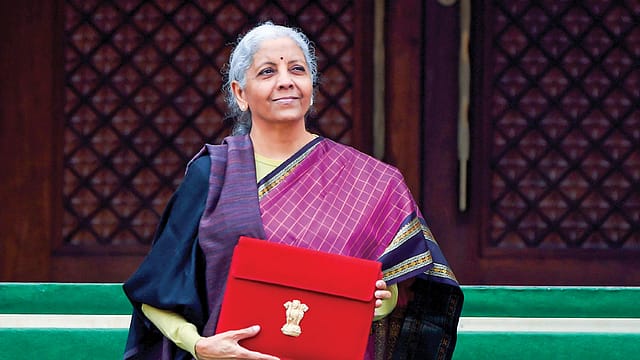
WITHIN 48 HOURS OF UNION FINANCE MINISTER Nirmala Sitharaman presenting her ninth consecutive—and record-setting—Union Budget for 2026-27, the geopolitical backdrop shifted decisively in India’s favour: POTUS blinked. Consequently, the US took a step back from the brink, signalling an end to the recent trade standoff with New Delhi. Following a telephonic conversation with Prime Minister Narendra Modi, US President Donald Trump announced on Truth Social, his preferred social media platform, that the US would slash tariffs on Indian exports to 18 per cent from the prevailing level of 50 per cent.
Coincidence or otherwise, the timing could not have been more consequential for the Indian economy. The US climbdown de-risked Sitharaman’s Budget, almost overnight. With external trade contributing an estimated 40-45 per cent of India’s national income, easing tariff pressures from its largest strategic partner could provide a meaningful lift to exports—and offer a welcome tailwind to economic growth next year, currently forecast to grow at around 7 per cent. Further, the imminent inking of a trade deal with the US—after the “mother of all deals” signed with the European Union (EU)—would unequivocally amplify India’s newfound willingness to open up its economy to pursue free trade within guardrails.
Nonetheless, the tariff rollback is a reminder that India’s rise will not occur in a vacuum. External alignments will continuously shift, sometimes in India’s favour, and sometimes against it. The big question is whether the Indian economy can acquire the desired capacity in earnest and quickly to turn such geopolitical moments into durable economic advantage—to realise its audacious ambition to become a developed economy by 2047.
It is against this shifting backdrop that Budget 2026 must be read. It is not the usual annual exercise in fiscal arithmetic. Instead, it is a strategic document crafted for a post-globalisation world—one where trade can be weaponised, technology can be denied, and economic resilience is as important as growth.
The intellectual basis for this Budget is provided in the Economic Survey, which was released on Friday, January 30. This year’s Economic Survey—probably the first that is totally aligned with the contours of a Union Budget—candidly sets out the constraints and then optimistically threads the strategy India needs to pursue. Hence, it is the companion document without which this year’s Budget sounds like it has no purpose. This is rare, as normally the survey reflects the indulgences of the resident Chief Economic Advisor (CEA) in the finance ministry within the confines of a template that has changed but little in decades.

Read along with the survey, the Budget’s emphasis on acquiring industrial depth—by investing and growing future sectors like biopharma, semiconductors, critical minerals—is not merely about generating growth.
Instead, it is about securing India’s sovereignty in a world where access is contested and self-reliance is strategic. And the mantra to achieve this is through exports—which explains the slew of free trade agreements (FTAs), all of them with developed countries, inked by India in the last five years—which forces domestic industry to adopt manufacturing discipline and muscle that will enable Indian goods to compete at the global level and simultaneously develop the manufacturing backbone within the country.
The Economic Survey summed it up best: “Transition (India) from strategic resilience—the ability to absorb shocks and preserve stability towards (achieving) strategic indispensability--the ability to become a source of reliability, capability, and value for others.”
Over the last five years, India has demonstrated its resilience by not only absorbing shocks but also thriving. Beginning 2020, with the once-in-a-century Covid-19 pandemic, the world has been subjected to an unprecedented round of back-to-back shocks. Most countries have wilted under this pressure. Not India. It survived and thrived.
Therefore, Sitharaman’s latest Budget, at its core, should be seen as an attempt to prepare India for that world: to build industrial depth, scale capability, and convert national aspiration into developed-economy performance. In short, it is a wager on 2047, which among other things will cement the legacy of someone who many initially believed to be an ‘Accidental FM’.
Undoubtedly, the finance minister is also signalling, not for the first time for the Bharatiya Janata Party (BJP)-led National Democratic Alliance (NDA) under Prime Minister Narendra Modi, that the annual Budget is no longer the sole piece of economic policy. Instead, more happens outside the Budget now and actually complements it to craft a larger economic narrative for the country—another very important departure from the past.
The Opportunity
Significantly, unlike her predecessors, Sitharaman had the space and time to showcase this blueprint because she was not burdened with the task of firefighting some kind of macroeconomic crisis. In the past, a finance minister would be inevitably focused on either taming raging inflation or reviving economic growth. This constant firefighting meant that a finance minister rarely had room to sit down with the prime minister and plan a long-term vision. Ironically, the workman-like Budget presentation sans big-bang moves to steer the economy out of a corner ended up disappointing the stock markets.
If anything, this time, Sitharaman has enjoyed the luxury of a ‘Goldilocks’ macroeconomic backdrop made up of benign retail inflation of less than 2 per cent and economic growth trending 7 per cent-plus. Even more remarkable is that this has been achieved against an extremely inclement global geopolitical backdrop.
In these circumstances, most countries are struggling to realise even one metric, leave alone both.
On the other hand, the Indian economy, despite daunting odds, is repeatedly surprising on the upside. This year the performance has been all the more exceptional, given the rapidly worsening global circumstances—especially with Trumpnomics and Tantrumps running amok.
A fortnight ago, the National Statistics Office (NSO) confirmed that this trend endures when it shared the first advance estimates for growth in 2025-26. It showed that the economy will grow by 7.4 per cent in the current fiscal, beating the Reserve Bank of India’s (RBI) forecast of 7.3 per cent. Retail inflation, which has been plumbing record lows, is estimated at 1.33 per cent in December.
The big takeaway was that investment continues to show strength as well as momentum. The official measure of investment, gross fixed capital formation, or GFCF, is estimated to grow at 7.8 per cent— up from 7.1 per cent in 2024-25. However, the worrying question is whether the private sector has joined the party: they have been absent since 2011 and continued to be spooked by growing global uncertainty— it is to be hoped they realise that uncertainty is the new normal of geopolitics.
In their absence, the government has been leading the rally in investments. Capex by the government has grown by a staggering six times in the last decade. Given that the share of government in total capital expenditure pales in front of private sector investment, this is not sustainable. Neither is it fiscally prudent, nor is the idea of a single engine powering the economy ideal.
To be sure, analysts believe that the pick-up in GFCF that is forecast implies that the private sector has resumed investing. Unfortunately, this is unlikely to be uniform and will be restricted to sectors that have been de-risked by the government through a step-up in their capital investments.
In short, the first impression of a seemingly strong one-two punch for growth, provided by services and buoyant investment, is not uniform. The finance minister, going by the Budget, was clearly aware, and therefore did not hesitate to bump up government capex once again in this year’s Budget.
It is in this context that the forecast for agriculture is worrying. Agriculture is projected to grow at 3.1 per cent in 2025-26, which is still positive, but a significant dip from the growth of 4.6 per cent recorded last year. This is surprising, given that last year’s monsoon was above normal and initial growth projections were therefore optimistic. Given that agriculture continues to employ one out of two people in the country’s labour force, while accounting for less than a fifth of the country’s economy, this is a point of concern—both economically and politically. The problem with India’s agrarian sector is that it is screaming for reforms. However, the inherited political economy as well as the lack of a trust quotient between the powerful farmer lobby of North India and the government is proving to be a dampener.
Fiscal Stability
Undoubtedly, it was the ability of Sitharaman to contain the runaway growth in fiscal deficit and thereby government debt that contributed to securing macroeconomic stability, particularly retail inflation—thereby providing her the room to explore a long-term strategic fix for the Indian economy.
Her most consequential fiscal achievement over the past five years was to prove that consolidation need not come at the cost of growth. At a time when post-pandemic governments across the world struggled to reconcile deficit reduction with economic recovery, India restored fiscal balance while sustaining—and even expanding— public investment through a calibrated strategy that prioritised capital formation over consumption.
At the heart of this approach was a decisive reorientation of expenditure. Rather than cutting spending indiscriminately, the government transformed the quality of spending by shifting resources away from revenue expenditure and towards productive capital outlays. Revenue expenditure was moderated from 13.6 per cent of GDP in FY22 to 10.9 per cent in FY25, creating fiscal space to scale up public investment. Capital expenditure rose from a pre-pandemic average of 1.7 per cent of GDP to roughly 3 per cent in the post-pandemic years. When grants-in-aid for asset creation are included, “effective capital expenditure” reached nearly 4 per cent of GDP in FY25—a sharp structural pivot towards infrastructure-led growth.
This was reinforced by subsidy rationalisation. Major subsidies declined from 1.9 per cent of GDP in FY22 to an estimated 1.1 per cent in FY26, achieved through better targeting and curbing leakages via the Direct Benefit Transfer (DBT) framework—which used an individual’s Jan Dhan bank account, Aadhaar and Mobile (JAM) to triangulate the beneficiary. DBT alone is estimated to have generated cumulative savings of `3.48 lakh crore over the last decade—underscoring how technology-enabled welfare reform can support fiscal discipline.
Consolidation was also made possible by resilient revenue mobilisation. Revenue receipts rose from a pre-pandemic average of 8.5 per cent of GDP to 9.1 per cent in the post-pandemic period, driven by strong tax buoyancy and base expansion—especially the growth in tax filers in the middle-tax bracket.
The Growing Middle
Income-tax data from the last decade reveals that the cohort of salaried individuals falling in the two income tax slabs of `10-15 lakh and `15-20 lakh has grown by a staggering 600 per cent.
In 2014, these two tax slabs were a near exclusive club of salaried taxpayers. Nine years later, no longer. When you look at them in absolute terms, it is a crowded club today and is emerging as the growth engine of New India.
This trading up of the middle cohort of the salaried is signalling a fundamental pivot, especially with respect to formalisation and wealth creation in the Indian economy. As a result, the geometry of India’s salary taxpayer is gradually transforming from a pyramid to a bulging diamond.
Anecdotally we have several other proxy data points confirming this makeover. Take for example, the exponential growth in demat accounts and assets under the management of mutual funds— for example, the footprint of SBI Funds now extends to every pincode in India.
In turn, this trend holds profound implications for the consumer economy— the growing trend of premiumisation of consumer goods is a good example of what newly acquired purchasing power combined with raging aspirations can achieve.
Further, keeping in mind the impending delimitation of seats in Parliament, the proportion of MPs elected from urban constituencies is bound to grow— thereby expanding the political heft of the middle classes.
Unfortunately, structural constraints, especially friction, tax overreach, and regulatory overkill are cramping the ability of the aspirational classes. Worse, they are forcing them to adopt jugaad or patchwork fixes, which has prompted Modi to coin the phrase “Zero Defect” to goad Indian manufacturing to undertake a pivot. This is premised on walking the talk on the ease of doing business.
The Export Mantra
NDA believes this can be overcome by developing export capability across the value chain. This in turn depends on the—woefully short—economic capacity at the state, firm and individual level to deliver goods and services of global standards. This strategy of forcing the country to develop export capability is implicit in the FTAs inked over the last five years, all of which are with developed countries.
This year’s Economic Survey provides the intellectual cover for this strategy. Export capability, it argues, is not merely as an outcome of growth, but as a vital disciplining mechanism for both firms and the state. Exports function as an objective, external stress test of competitiveness—one that cannot be softened by negotiation, regulatory discretion, or administrative protection. In contrast to sheltered domestic activities, where firms can often survive through what the survey calls “negotiated shelter”, the global marketplace demands execution over persuasion. Success or failure is binary.
This disciplining power flows first from the presence of non-negotiable benchmarks. In domestic markets, profitability can sometimes be sustained even when productivity lags, aided by protection, administrative mediation, or informal accommodation.
Export-oriented manufacturing permits no such escape. Firms are benchmarked against global standards of cost, quality, reliability, and timeliness— standards that cannot be negotiated away. Even small frictions compound rapidly into lost orders and broken supply-chain relationships, forcing firms into a continuous process of upgrading simply to survive.
This logic also underpins the Economic Survey’s distinction between intelligent swadeshi and crude protectionism. Import substitution, it argues, must not be judged by the absence of imports but by the creation of export capability. Export orientation becomes the litmus test of whether domestic capability is genuinely being developed. Without exposure to global competition—and without a credible exit for underperformers—state support risks entrenching inefficiency, creating ‘zombie’ firms that persist on permanent protection. Learning-by-doing may justify temporary inefficiency, but such support must be timebound and performance-linked, with export readiness serving as proof that learning is translating into national capability.
Crucially, export capability disciplines not only firms but the state itself. Manufacturing for global markets is embedded in complex supply chains and depends on reliable ports, power quality, logistics, and predictable administration. Weaknesses in these systems become quickly and visibly apparent in export performance. Poor infrastructure or slow clearances cannot be concealed when delivery schedules are missed or costs spike. In this sense, export manufacturing ‘calls forth’ state capacity by making governance failures immediately costly rather than politically manageable.
The Economic Survey further links export capability to durable external and currency strength. Historically, countries that developed “hard currencies” did so through sustained export competitiveness, not through dependence on volatile capital inflows. Export earnings are earned repeatedly through performance, while portfolio flows are conditional and reversible, responding to global risk sentiment. Rapidly building manufacturing export capability is therefore presented as the only proven route for late-industrialising economies to achieve lasting external stability.
Finally, the survey draws lessons from the East Asian “entrepreneurial state”, particularly Japan and South Korea. Their industrial policies were never unconditional. Protection and subsidies were tightly linked to export targets and measurable performance, with the state exercising ruthless exit when firms failed to meet external benchmarks. This ensured constant reallocation of resources towards efficiency and scale. Export discipline, in this framework, was not a byproduct of industrial policy—it was its central organising principle.
Laudable while this strategy is, the ground reality rails against India’s capability of pulling it off. A recent study published by the Centre for Social and Economic Progress (CSEP), a Delhi-based think-tank, captures these gaps in India’s capability.
The competitiveness index developed by CSEP to compare India and its peers, including Malaysia, Vietnam, Thailand, and Indonesia—all of whom are the China-plus-one countries—was revealing. Not only do India and Indonesia rank at the bottom among the five countries, even individually, with the exception of regulatory quality and demand conditions, the scores are worrying.
On firm strategy and rivalry, India’s score is in single digits, suggesting that there is high firm concentration and hence little or no competition. For example, if you look at airlines and telecom— the fastest growing sectors—it is mostly a duopoly. It is only in the consumer goods space that you see some rivalry.
To be fair to the Economic Survey, it candidly acknowledges the challenge of overcoming these odds. Its cup half-full philosophy suggests that the task is difficult, but not impossible.
“In a world defined by uncertainty, it is not the most controlling states that will succeed, but those that learn fastest, adapt most intelligently, and retain the confidence to correct course. India has the institutional foundations to do so. The task now is to align mindset, incentives, and accountability with that possibility,” the survey noted.
Taking the cue as it were, Budget 2026 seeks to align domestic capability with external opportunity. Sitharaman has laid out a blueprint to evolve the government into what may be called a performance state: one that moves beyond the politics of entitlement to empowerment and to eventually enable capability, execution, and outcomes.
Another consequential shift is the recognition that India’s 2047 ambition will be won or lost in its cities. The Sixteenth Finance Commission’s unprecedented push towards urban local governments is not just a fiscal adjustment. It is an admission that India cannot become a developed economy with under-governed, under-financed, and under-capacitated cities.
The tough ask now shifts from the finance minister’s announcements to the states’ implementation and the cities’ capacity. The next two decades will test whether the country can finally master the discipline of delivery.
The world will not pause while India prepares. Geopolitics will not wait while institutions mature. Similarly, developed status will not automatically accrue because POTUS blinked or a Budget promised. It will come about only if India comes together as a collective and throws itself at the task ahead, relentlessly, year after year.
That is the bold wager of this Budget.
Pioneering a Geopolitical Fiscal Strategy
■ The Union Budget for 2026-27, presented by Finance Minister Nirmala Sitharaman on February 1, 2026, marks a pivotal shift in the nation’s fiscal paradigm. For the first time, the Budget explicitly weaves geopolitical considerations into its core framework, transforming it from a mere economic blueprint into a strategic tool for navigating global uncertainties.
■ Traditionally, Indian Budgets have focused on domestic growth, welfare, and fiscal prudence. However, amid escalating tensions—such as US tariffs, trade imbalances with China, and fragile supply chains—the 2026 Budget prioritises resilience, self-reliance, and strategic positioning. This “geopolitical Budget” allocates resources not just for growth but to bolster India’s sovereignty in critical domains like defence, energy, and technology, ensuring the country thrives in a multipolar world.
■ Energy security emerges as a major geopolitical pillar, reflecting lessons from global disruptions like the Russia- Ukraine conflict. The Budget extends basic customs duty exemptions for nuclear power projects until 2035, expanding them to all capacities, and introduces a `20,000 crore scheme for Carbon Capture Utilisation and Storage (CCUS).
■ By exempting imports for lithium-ion cells and critical minerals processing, it aims to reduce dependence on foreign suppliers, particularly China, which dominates global battery and rare earth markets.
■ The establishment of Rare Earth Corridors in states like Odisha and Andhra Pradesh further emphasises strategic self-reliance, positioning India as a counterweight in the global scramble for resources essential for renewables and electronics.
■ This move not only secures supply chains but also enhances India’s bargaining power in international alliances, such as the Quad.
■ In technology and manufacturing, the Budget’s geopolitical thrust is evident in initiatives like Semiconductor Mission 2.0 and tax holidays for data centres until 2047. Amid US-China tech wars and capital flight from India, these measures aim to attract foreign investment and build domestic capabilities in seven strategic sectors, including semiconductors and rare earths.
■ For example, customs duty reductions on marine, leather, and textiles boost exports, countering US penal tariffs and addressing the widening trade deficit with China.
■ The Biopharma Shakti Mission complements this by fostering innovation in biotechnology, reducing vulnerabilities in pharmaceuticals exposed during the Covid-19 period.
■ These steps align with recent FTAs, like the India-EU agreement, to diversify trade and mitigate risks from protectionism.
■ Another cornerstone of the geopolitical orientation is the substantial hike in defence spending, reflecting the government’s response to heightened security threats, including the aftermath of Operation Sindoor— a brief but intense conflict with Pakistan in 2025 that underscored the need for enhanced military capabilities.
■ The Ministry of Defence has been allocated a record `7.85 lakh crore for fiscal 2026-27, marking a 15.19 per cent increase over the Budget Estimates of fiscal 2025-26 (`6.81 lakh crore). This allocation represents approximately 2 per cent of the estimated GDP and 14.67 per cent of the Union government’s total expenditure, making it the highest among all ministries. The emphasis on capital expenditure is particularly pronounced, with `2.19 lakh crore earmarked, a 21.84 per cent surge from the previous year.
■ Of this, `1.85 lakh crore is dedicated to capital acquisitions, funding the procurement of next-generation fighter aircraft, ships and submarines, unmanned aerial vehicles (UAVs), drones, smart and lethal weapons, specialist vehicles, and other advanced platforms. Additionally, the Defence Research and Development Organisation (DRDO) receives `29,100 crore, with a focus on indigenous technology development to support self-reliance in defence manufacturing. Revenue expenditure stands at `5.53 lakh crore, including `1.71 lakh crore for pensions and `1.58 lakh crore for operational readiness, such as spares, ammunition, and maintenance.
■ This strategic boost addresses ongoing border disputes with China, Indo-Pacific instability, and the lessons from recent conflicts, enabling rapid troop mobilisation and deterrence. For instance, enhanced funding supports border infrastructure like high-speed rail corridors (for example, Mumbai-Pune and Delhi-Varanasi) which serve dual economic and military purposes, facilitating swift logistics in contested regions.
■ Yet fiscal prudence underpins the budgetary strategy, with the deficit targeted at 4.3 per cent of GDP and debt-to-GDP at 55.6 per cent, signalling stability to global investors.
■ Notably, the absence of funding for Iran’s Chabahar port highlights strained ties, redirecting resources towards domestic priorities amid Middle East volatility. Capital expenditure of `12.2 lakh crore sustains infrastructure momentum, while AI and digital reforms position India as a global hub.
■ In essence, Budget 2026 redefines India’s fiscal policy as a geopolitical instrument, blending economic ambition with strategic foresight. By prioritising defence, energy autonomy, and tech self- sufficiency, it equips India to withstand external shocks and assert influence globally. This approach, while ambitious, could propel India towards ‘Viksit Bharat’ by 2047, but its success hinges on execution amid unpredictable world events.
Nirmala’s Navarasa
■ Nirmala Sitharaman may not possess the political heft of an Arun Jaitley. Or the intellectual flair of P Chidambaram. Or even the seasoned independence of Pranab Mukherjee. With a larger-than-life prime minister and a hands-on Prime Minister’s Office (PMO), she has often been in the limelight but not the spotlight. Yet she is quietly etching her name into the annals of Indian history as a trailblazer. Not just in terms of the distinction of presenting nine consecutive Union Budgets, but in cementing an approach of conservative calibration sans populist pitfalls.
■ In a political landscape dominated by charisma and legacy, Sitharaman’s legacy is one of quiet competence. Her approach was methodical and results-oriented. Hugely underrated, she is Rahul Dravid, the solid, reliable batsman, often overshadowed by flashier stars. In politics, Sitharaman is the anchor, delivering consistent performance without the spotlight-seeking drama. Like Dravid anchoring innings amid star-studded line-ups, she has provided the stability India needs, proving that true impact often comes from those who let their work speak loudest.
■ In an era when global uncertainties loom large, she stands out as perhaps the only finance minister who hasn’t had to endure sleepless nights over fiscal deficits, runaway inflation, or sluggish growth.
■ Unlike her predecessors who grappled with crises like the 2008 financial meltdown or the 1991 balance-of-payments emergency, Sitharaman has steered the economy through geopolitical tensions, energy shocks, and trade disruptions with a steady hand, emphasising structural reforms in taxation, banking, and infrastructure.
■ During her tenure, India has had robust economic recovery post-Covid, maintaining average GDP growth rates above 7 per cent, keeping inflation largely within the 4-6 per cent target band set by RBI, and steadily reducing the fiscal deficit from pandemic highs to under 5 per cent of GDP by 2026.
■ This pattern of understated excellence defines her entire career. As India’s first full-time woman defence minister from 2017 to 2019, she broke barriers in a male-dominated domain, overseeing key modernisation efforts, such as the induction of Rafale fighter jets, promoting indigenous defence production under Make in India, and advancing gender inclusivity by opening more roles for women in the armed forces.
■ Since 2019, as finance minister, she has overseen transformative changes, including the shift to paperless budgets (using a bahi-khata tablet), corporate tax cuts to spur investment, and massive infrastructure spending under the National Infrastructure Pipeline. Her handling of the economy during the pandemic—through stimulus packages worth over `30 lakh crore—helped India emerge as one of the fastest-growing major economies.
■ The overarching macroeconomic approach aims for sustained high GDP growth of around 6.5-7.5 per cent annually, with real growth projected at 6.8-7.2 per cent for 2026-27 and nominal growth at 10 per cent. Inflation is managed moderately, targeting around 3 per cent, through supply-side reforms in agriculture and logistics. Priorities include boosting employment via skilling, manufacturing, and entrepreneurship, alongside building economic resilience.
Key Macroeconomic Strategies
■ Sitharaman’s Budgets evolved from crisis response to long-term reforms. The early ones (2019-20 to 2021-22) featured stimulus packages, privatisation, and infrastructure support amid Covid-19. From 2022-23 onwards, the emphasis shifted to productivity, competitiveness, and inclusion.
■ Growth acceleration relies on high-potential sectors like manufacturing, with initiatives scaling strategic areas, championing MSMEs, and promoting energy security. Youth-driven growth (Yuva Shakti) is advanced through skilling, entrepreneurship, and innovation to achieve sustained 7 per cent-plus real GDP growth.
■ Infrastructure serves as a core growth engine. Public capital expenditure (capex) has risen secularly—from `2 lakh crore in 2014-15 to `12.2 lakh crore in 2026-27 (about 4.4 per cent of GDP when including effective capex of `17 lakh crore). This funds high-speed rail, freight networks, urban economic regions, and waterways. Production-Linked Incentive (PLI) schemes, introduced in 2022-23, continue to drive manufacturing, with recent Budgets adding risk guarantees for private developers and support for container and seaplane manufacturing.
■ Sectoral reforms emphasise self-reliance (Atmanirbhar Bharat and Make in India). Tax incentives, customs duty rationalisation, and reduced import dependencies bolster domestic production. Green initiatives, such as carbon capture in 2026- 27, and digital advancements, like AI and data centres, act as force multipliers. Employment efforts include enhancements to PM-Kisan, MGNREGS, youth skilling, and labour code implementation for formalisation.
■ The 2026-27 Budget frames priorities around growth, capacity-building, and universal access. Past measures supported agriculture reforms, women-led development, middle-class tax relief, and vulnerable sections.
Key Fiscal Strategies
■ Fiscal policy remains prudent, moving from deficit-financed stimulus during Covid (peaking at 9.2 per cent in 2020-21) to steady consolidation without sacrificing growth. The approach favours reforms over populism.
■ Fiscal consolidation targets lower deficits: 4.9 per cent in 2024-25 (revised), 4.4 per cent in 2025-26, and 4.3 per cent in 2026-27. This is supported by buoyant tax revenues (direct taxes up 11.4 per cent in 2026- 27) and restrained revenue expenditure growth (6.6 per cent). Non-debt receipts are estimated at `36.5 lakh crore, with total expenditure at `53.5 lakh crore.
■ Debt management uses a new anchor: the debt-to-GDP ratio, targeted at 50±1 per cent by 2030-31. It declines from 56.1 per cent in 2025-26 to 55.6 per cent in 2026- 27, freeing resources from interest payments (around 37 per cent of revenue receipts) for priorities.
■ Revenue optimisation includes corporate tax cuts (to 22 per cent in 2019-20), a new personal tax regime (2023-24), and safe harbours for IT services (2026- 27). GST remains buoyant despite lower projected growth (3 per cent in 2026-27) due to rationalisation. Expenditure prioritises capex over subsidies, with states receiving `1.4 lakh crore in grants and 41 per cent tax devolution.
■ Risk mitigation incorporates buffers for global volatility, including energy security and financial reforms. Defence capex surged to `2.2 lakh crore in 2026- 27 (up 22 per cent), underscoring strategic needs.
Evolution across Budgets
■ 2019-20 to 2021-22: Crisis management with stimulus, tax cuts, and health/infrastructure focus.
■ 2022-23 to 2024-25: Recovery with PLI schemes, digital push, and tax relief.
■ 2025-26 to 2026-27: Maturity phase with fiscal tightening, manufacturing revival, and green reforms amid global slowdowns.
■ Overall, Sitharaman’s Budgets have positioned India as a resilient economy. Capex has crowded in private investment, reforms have improved ease of doing business, and fiscal discipline has ensured stability despite external shocks. Challenges remain in job creation and state finances, but the consistent strategy has supported steady growth and long-term ambition.
■ Sitharaman’s nine Budgets, a la Navarasa, encompass the full spectrum of fiscal experience: post-pandemic recovery, structural reforms, and inclusive growth while navigating global uncertainties such as trade fragmentation and geopolitical risks. The number 9 being the last single digit—the end of one cycle before rebirth into 10—stands as a pinnacle of continuity and conviction: reforms over rhetoric, action over ambivalence, people over populism. It completes one purposeful cycle of fiscal discipline (with fiscal deficit targeted at 4.3 per cent of GDP) while igniting the spark of rebirth towards Viksit Bharat.