How a Fast-Moving Wildfire Emptied Two Canadian Towns Overnight
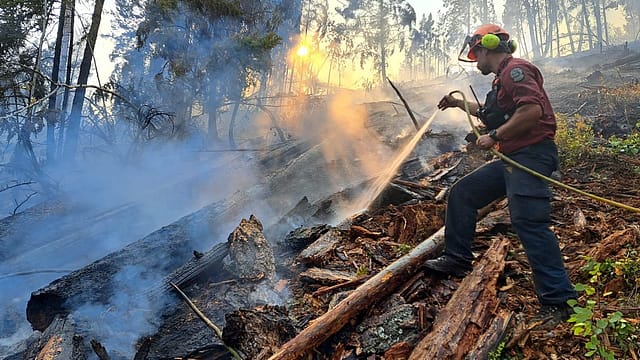
It took less than a night for an ordinary summer evening in British Columbia's wine country to turn into a mass evacuation.
Around 5:30 pm on Friday, a wildfire was reported in the Bald Range, northwest of Summerland. Within just three hours, it had exploded to nearly 50 square kilometres, fuelled by tinder-dry forests, strong winds and soaring temperatures. By the next day, the fire had more than doubled in size to over 100 square kilometres, becoming one of the fastest-growing wildfires Canada has seen this season.
The speed of the blaze left authorities with little choice.
Evacuation orders were issued for the entire town of Summerland, home to roughly 12,000 residents, and nearby Peachland, where another 8,000 people were forced to leave. More than 20,000 people packed essentials, loaded pets into cars and fled through smoke-filled roads, while emergency crews raced to knock on doors before flames reached neighbourhoods.

Rise of the Pivotal Power
18 Sep 2026 - Vol 05 | Issue 38
The BRICS declaration is a strategic victory for Modi
For many, there wasn't enough time.
Entire neighbourhoods around Faulder, Meadow Valley and Garnet Valley were overrun. Rescue teams pulled trapped residents from danger, while helicopters evacuated people from areas cut off by advancing flames. Authorities have confirmed widespread structural damage, and police are investigating the death of an 80-year-old woman linked to the wildfire.
The wildfire has also pushed British Columbia into a broader emergency.
The province has declared a state of emergency as more than 100 wildfires burn across British Columbia, with nearly half classified as "out of control." Premier David Eby described the Bald Range blaze as so intense that it generated its own weather system, producing towering smoke columns and lightning, while flames consumed 100-foot trees within minutes.
The region under threat is not just another stretch of forest.
The Okanagan Valley is Canada's best-known wine-producing region, dotted with vineyards, orchards and tourism-dependent towns. Highways have been shut, power outages reported and drinking-water advisories issued in some communities, adding another layer of disruption beyond the immediate fire zone.
Ottawa has now stepped in.
Prime Minister Mark Carney has pledged full federal assistance, while Emergency Management Minister Eleanor Olszewski approved British Columbia's request for emergency support to provide shelter and accommodation for thousands of displaced residents. Canada's Government Operations Centre has been activated to coordinate relief efforts with provincial authorities.
Fighting the fire, however, has proved unusually difficult.
Dense smoke, turbulence and extreme fire behaviour have limited aerial operations, forcing crews to deploy night-vision helicopters so firefighting can continue after sunset. International firefighters from Australia, New Zealand and Mexico have also joined Canadian crews as officials warn that hot, dry weather could keep the fire active for days.
The disaster was not entirely unexpected.
Months before the fire, British Columbia's wildfire agency had warned that the Okanagan region faced above-average drought conditions and forecast an especially severe fire season driven by prolonged heat and below-normal rainfall. Local authorities had also carried out fuel-reduction projects around Summerland and Peachland to lower wildfire risk, underscoring just how extreme the current conditions have become.
The Bald Range wildfire is no longer just a local emergency. It has become another sign of a changing wildfire reality in North America, where fires are spreading faster, burning hotter and leaving authorities with shrinking windows to protect lives. For thousands of residents now sheltering away from home, the question is no longer how quickly the fire grew, but whether there will still be a home to return to.
(With inputs from ANI)