India and China Hold the Line
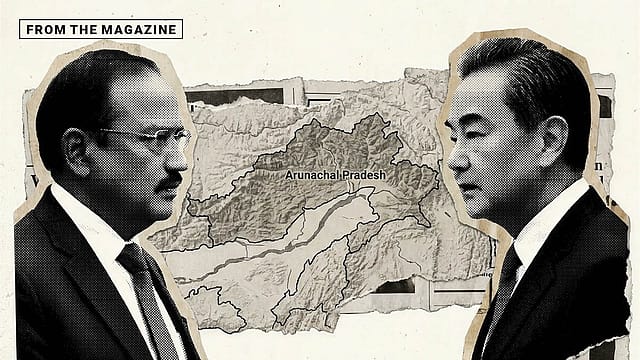
Following reports of intrusions along the Line of Actual Control (LAC) in Arunachal Pradesh and the Indian Ministry of External Affairs statement that standoffs occur when Chinese troops “divert” from agreed patrolling patterns, China said it has strictly abided by mutually accepted border management routines. “China hopes India will work in the same direction to jointly implement understandings reached by both sides and take concrete steps to maintain peace and tranquility in the border areas,” said Chinese foreign ministry spokesperson Guo Jiakun.
The Chinese October 26 statement came in the wake of a controversy triggered by outgoing Indo-Tibetan Border Police chief Shatrujeet Singh Kapur’s remarks about face-offs having taken place at several locations in Arunachal Pradesh and that they were, in fact, continuing. This set off a sharp debate with a section of commentators seeing Kapur’s comments as an “admission” of the People’s Liberation Army (PLA) incursions and Congress President Mallikarjun Kharge promptly waded in, saying the Modi government must stop giving “clean chits” to China. Guo’s remarks can be read as a denial of the MEA’s observations but they can also indicate a desire to continue to work on implementing the eight-point consensus announced after National Security Advisor Ajit Doval’s meeting with Chinese Foreign Minister Wang Yi on August 25 that includes advancing discussions on an early and substantial harvest on boundary delimitation and border management. The MEA statement had, while accepting LAC standoffs, said both sides continue to use diplomatic and military mechanisms and had agreed to improve understanding of border areas. The MEA iterated that tranquility on the border is essential for bilateral ties.
Kapur did not just speak of LAC intrusions. He pronounced that as India would not be able to match China’s conventional military prowess, it would be best to develop options like drones and went on to offer his take on the war in Ukraine, on Russia and Iran. China’s military might is obvious, but numbers are not all that count. In Arunachal Pradesh, the LAC runs through thick vegetation, deep defiles and remote passes. In any case, forward deployment of troops and a readiness to slug it out as happened at Galwan on June15-16, 2020, has adequately demonstrated India’s resolve not to back down.
One of the friction points Kapur referred to is the sensitive border post of Maja near Taksing and this is not the first time that there has been a face-off here. Though he took charge of ITBP less than a year ago, Kapur would be aware of the background as well as efforts to address the situation through discussions, such as the first ever corps commander-level meeting on September 6 in the Eastern Sector. Vacha was designated as a meeting point in keeping with the outcomes of the Doval and Wang talks that saw a convergence on the need for better border management.
Kapur’s unfiltered comments kicked up a heated debate about military preparedness, border tensions and whether the Modi government was underplaying the incidents. But the storm will pass, and as things stand, both India and China are looking to keep relations on an even keel. This does not mean China may not look to test India, particularly after India standardised Maja and 26 other places on official Survey of India maps. A push here and there all feeds into the broader Chinese negotiation strategy.
According to persons familiar with the LAC dynamics, Arunachal Pradesh may be the greater focus of Chinese activity after the lengthy face-off in Ladakh that lasted close to five years. The recent incidents of violent protests against the proposed Siang Upper Multipurpose Project (SUMP) are partly a fallout of local concerns but not just that. There is a design in the manner in which protests spring up against developmental projects such as SUMP or the Ken-Betwa river-linking scheme.
In the case of SUMP, there are bearings on national security as the project is urgently needed to secure India against both flooding and reduced water flows due to the giant Medog dam China is building on the bend of the Brahmaputra before it enters India. The SUMP will generate 11,200MW of power and help manage downstream flows in India. The resistance to even a pre-feasibility report being conducted underlines the need for the state and Central governments to reach out to local populations as estimates being bandied about 27 villages and more than a lakh displaced are unsubstantiated and might well be part of motivated propaganda.
The larger question remains developing a consistent and sturdy response to border intrusions and managing diplomacy to protect India’s interests. The Indian Army has been doing just this, carefully plotting points of access and weakness all along the Western, Middle and Eastern Sectors of the LAC. The situation in Arunachal Pradesh is particularly challenging given that the vegetation and geographies create blind spots not easy to monitor or access. Even the road to the Maja border post was completed not too long ago in December 2022, and often enough videos of alleged intrusions or tents are not easy to verify.
The trigger for the tensions that led to clashes at Galwan that resulted in the death of 20 Indian soldiers—the PLA never verified its casualties—was most possibly a road China felt posed a ‘threat’ to its interests. It is typical of Chinese thinking that India’s moves to bolster border infrastructure can be considered an ‘unfriendly’ act, the assumption being that Beijing’s views and interests be accorded precedence. Over the past 15 years, India has been changing the lay of the land, bending the odds more in its favour and this has been grudgingly acknowledged, if not accepted, by China.
The recent tensions in Arunachal Pradesh, the commander-level talks and the larger imperative of India-China relations are all parts of a complex political-military jig-saw. The Indian bottom line remains unaltered—peace on the borders is non-negotiable and any local adventurism is for the Chinese leadership to curb as results rather than explanations matter.