One Hundred Years of Insecurity
World War I is not over.
On December 26, 1915 Abdulaziz bin Abdul Rahman bin Faisal al Saud, more familiar as Ibn Saud, then ruler of Najd and Al-Ahsa and devotee of the radical 18th-century Islamic preacher Muhammad Abdul Wahhab, signed his first treaty with the outside world.
Sir Percy Cox signed the pact on behalf of the mighty British Empire at Darin on the coastal island of Tarut.
Ibn Saud’s emirate became a British protectorate in return for a loan of £20,000, a stipend of £5,000 a month, and weapons to fight the Caliph of Islam, the Sultan of the Ottoman Empire, who had declared a jihad against Britain, France and Russia while joining Germany and the Austro-Hungarian Empire, or the Central Powers of Eurasia.
That pact in 1915 determined the political geography of the region that exists till today. The autonomy of other British protectorates, like Kuwait, Qatar and the Trucial States (now the UAE), was guaranteed, which is why they are now independent states. Aden, as a principal British port, was obviously out of Saudi reach.
The British did not offer anything out of generosity, which was not a known virtue of their empire. In 1915 the British were desperate for help, wherever they could find it, against the Ottoman Empire under the Sultan of Turkey, who was also the only Caliph in the Muslim world. The Caliph’s call for a jihad meant, in theory, that all Muslims were duty-bound by their religion to go to war against the British and French, including in Arabia, which was part of the Ottoman realm.
By early 1915 the British, to their utter astonishment, had been humiliated by Turkey. The much-vaunted British navy, sent to conquer Istanbul (or Constantinople, as the Western powers insisted on calling the Ottoman capital), was defeated in the Gallipoli peninsula. A year later, the British army, reinforced with Indian troops, was destroyed at Kut al-Amara on April 29, 1916 after a siege of 147 days. Over 13,000 British and Indian troops under Major General Charles Townshend surrendered.
Britain and France lured leaders of Arab principalities scattered across the desert with a promise of independence which they never intended to keep. Their deceit was recorded in a famous secret document, the Sykes-Picot Agreement, which divided the Arab lands between the British and French empires as either colonies or neo-colonies once the war against the Ottomans had been won. Ibn Saud did not know of such machinations during the war, but he had a better understanding than his peers of the long arm of history.
The British had a second Arab ally, Hussein bin Ali al-Hashimi, Sharif and Emir of Mecca, descendant of the Prophet Muhammad’s family, and higher in status than Ibn Saud. Sharif Hussein launched what his British accomplice, the dashing adventurer TE Lawrence, who styled himself Lawrence of Arabia, advertised as the Great Arab Revolt. After 1918, Hussein made a politically fatal mistake. With the Ottoman Caliph abolished, he claimed the mantle of Caliph, as the independent ruler of Arabia and custodian of the two holy mosques, Prophet Abraham’s Masjid al-Haram in Mecca and Prophet Muhammad’s Masjid al-Nabawi in Medina.
The British, having suffered the tribulations of dealing with one Caliph, were never going to sanction a replacement. Hussein was defused, while his more compliant son Faisal bin Hussein bin Ali al-Hashimi was sent as King of Iraq, or Mesopotamia, which he ruled from August 1921 till his death in 1933. In a parallel move, the British encouraged Ibn Saud, who advanced from Najd, captured Mecca and Medina by December 1925, unified Hejaz, Najd, Al-Ahsa, Asir and became the ruler of Arabia, except for British protectorates. He knew the limits set by London. Britain recognised his government through the Treaty of Jeddah in 1927, signed by Prince Faisal bin Abdulaziz on behalf of his father Ibn Saud. The British plenipotentiary was Sir Gilbert Clayton.
The treaty paved the way for the transfer of Arabia to the Saud family. On September 23, 1932 Arabia was renamed Saudi Arabia. It is one of very few countries named after a person, but since Amerigo Vespucci was a Florentine navigator, whose only role was to convince Spain and Portugal that Columbus had discovered a new continent rather than India, Americans paid no further attention to him.
Hussein bin Ali’s family, having been taught the price of dreams and virtues of obedience, were replanted in Iraq and the new principality of Transjordan, now Jordan. While Jordan remains with the family, Iraq turned into a volcanic epicentre of what might be described, loosely, as republican nationalism in the Arab world. On July 14, 1958 its ruler Faisal II was killed along with most of the royal family in a rebellion led by Abdul-Karim Qasim (Abd al-Karīm Qāsim).
This dramatic event reinforced the twin objectives of Saudi security policy: the defence of Saudi territory and protection of the Saud family.
American interest in Saudi Arabia was perfunctory till March 3, 1938, when petroleum was discovered. The British guarantee was gradually transferred to the Americans after they became the pre-eminent world power in the 1950s, but it took a crisis to make de facto de jure. In August 1990 Iraq’s Saddam Hussein captured Kuwait and announced that it had become the nineteenth province of Iraq. This threatened the Western equilibrium, and the ruling clans of the Arab world. America signed a military pact with King Fahd before America’s response, Operation Desert Shield, permitting half-a-million American and coalition troops on Saudi soil for the war against Saddam Hussein, who was defeated and then destroyed, to the relief of Saudi Arabia and the Gulf.

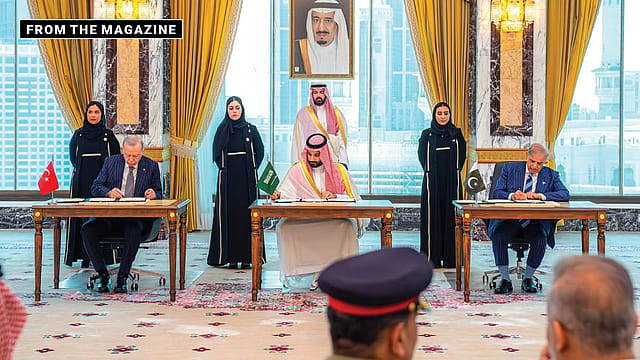
There is a direct line of logic across a century from Darin to the Mecca pact of 2026, with one variation. Pakistan and Turkey, both military allies of America, have been designated to fill the vacuum caused by the ebb of American power in the region. This ebb is a direct consequence of American setbacks in the war which President Donald Trump and Israeli Prime Minister Benjamin Netanyahu started on the last day of February this year against Iran, the only country in the region now willing to challenge Israel’s geopolitical domination.
The last war fought by Arab states against Israel was in 1973, which ended in a significant but not comprehensive victory for the Egypt-led alliance. Since then America’s effort has been consistent: to neutralise the Arab threat to Israel through degrees of accommodation, starting with the Camp David Accords signed by Anwar Sadat and Menachem Begin with Jimmy Carter as witness. The only Arab country outside the American umbrella, Syria, was neutered. This has left Palestinian hopes for a separate state blowing uncertainly in the wind.
Arab states pay lip service to Palestine at the United Nations and in talk shops, but their expansive armies and high defence budgets are not meant to deliver a Palestinian state. Camp David effectively chained Egypt. The logical culmination of Western diplomacy, combined with a shift in Arab states which now want economic prosperity and gradual social reform on their way towards the Dubai model instead of spending political capital on Palestine, was the Abraham Accords, signed on September 15, 2020 between Israel, the UAE and Bahrain. This was far more than a limited trilateral understanding for an increase in tourism, kosher restaurants in Dubai or the attempt by a UAE company to buy into a football team in Jerusalem.
The Abraham Accords were meant to inspire economic cooperation and integration across the hurdles of history and geography, prevent a fourth existential war between Arab nations and Israel, and ameliorate an inherent flaw in Camp David. Camp David stopped war but could not initiate the momentum for sustainable peace, which was only possible through an interdependent regional economy.
The most dramatic change in the last decade has been the transformation of Saudi Arabia under its present young, de facto ruler Crown Prince Mohammed bin Salman, who has broken taboos and reimagined his country into a mega tourist, sport, tech and economic destination.
Three years ago, there was such optimism that Prime Minister Narendra Modi proposed an India-Middle East-Europe Economic Corridor (IMEC) to link India, the UAE, Saudi Arabia, Israel, Italy, Greece and Europe, a modern variation of ancient trade routes which made Indian goods the most expensive products in Rome’s markets in the time of Julius Caesar. Saudi Arabia was connected to Haifa, the largest of Israel’s three principal ports on the Mediterranean with a natural deepwater harbour. It was a coherent economic bridge with the Gulf as a fulcrum, and a possible offshoot from the UAE to Iran and Central Asia.
If Iran had still been ruled by the Pahlavi dynasty it would have cooperated in this change, but the Pahlavi dynasty was overthrown in 1979 by a popular revolution inspired by Imam Khomeini.
Iran has been tested through two invasions in the last two years. In 2025, Iran’s response to sustained American-Israeli bombardment was uncertain. This year, Iran shook American military self-confidence and shattered the faith of Arab neighbours in the American umbrella. The Saudis, unable to deal even with the Houthis, who do not even possess a conventional army, have turned to Turkey and Pakistan. They will never depend on Turkey as much as they do on Pakistan. Among other factors the Turkish armed forces are not available for hire, as are Pakistan’s. Pakistan is a nuclear power. As early as 1999, the Saudi Prince Sultan bin Abdulaziz visited Pakistani nuclear facilities, which was followed 26 years later by a Strategic Mutual Defense Agreement. Pakistan’s limitations, however, must also be evident to Riyadh. The country is in meltdown. On October 27 alone the Baloch rebels claimed that they had killed 80 Pakistani troops while Afghans shelled Pakistan across the disputed border. The economy is threadbare. The Pakistani elite, particularly the business-bureaucracy cabal, has begun to panic, and is deserting the country for destinations in Europe.
In an amusing twist to the tale, a story appeared after the infructuous talks between Mecca-pact nations and Iran that Iran had suggested that the Saudis buy out the Houthis instead of fighting them. The sum suggested was apparently a billion dollars. In the 1930s, suitcases full of British cash for potentates were called by bureaucrats with a tight-lipped sense of humour “King George’s cavalry”. The king might be different, but the cavalry could be the same.
(MJ Akbar is the author of, among several titles, Tinderbox: The Past and Future of Pakistan. His latest book is After Me, Chaos: Astrology in the Mughal Empire)