The Era of Forever Wars: The Price of an Exploding Middle East
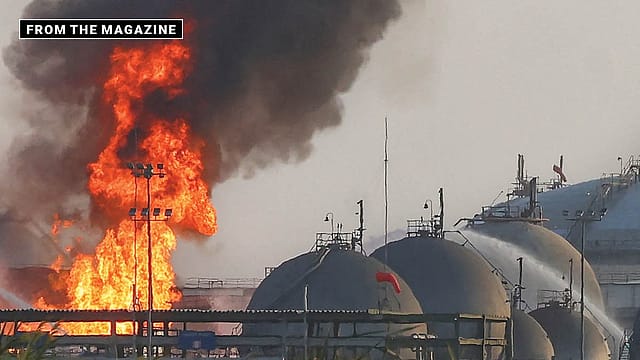
There is no sign that the war in West Asia is ending even as the Ukraine conflict spreads into Russian territories with mounting attacks on Russia’s economic assets. There is a strong likelihood that after the US mid-term elections, hostilities against Iran will begin again. But these are also ‘strange’ wars in that while they continue to spread within their geographic zones, there are no signs of their turning into wider conflicts involving an increasing number of countries. Their economic effects, however, have caused havoc on a global scale.
Poor countries in Africa and elsewhere have borne the brunt of food price increases that have never really stabilised after the war began in Ukraine. After the start of the war in West Asia, countries in South Asia such as Sri Lanka, Bangladesh and the Maldives requested India to share oil products as global supplies became scarce. India, too, has been hit with “imported inflation” since 2022. First, it was the stretched supply lines for fertilisers and other commodities imported from Russia. By the time that situation eased a bit, the West Asia crises arrived. India managed to avert the worst but at a cost. The government absorbed the shock of increased commodity prices in both cases. Even this year (2026-27), the government had forked out `70,000 crore in fertiliser subsidies by the middle of the year, almost 40 per cent of the budgeted amount for subsidies as global prices of these commodities continued to gallop. This is some four years after the crisis in Ukraine.
The economic assumptions that informed the government when it presented the Union Budget 2026-27 on February 1 unravelled within a month. These problems were, of course, not due to government actions. On February 28, global crude oil price (Brent) stood at $71 per barrel. Five days later, that shot up to $83 per barrel. Today, eight months after the start of the conflict, that price stands anywhere from $110 to $113. In April, the Reserve Bank of India (RBI) had assumed crude oil prices at $85 in 2026-27 and $75 in 2027-28. In the latest iteration of the central bank’s Monetary Policy Report of October, these prices have been revised upwards to $95 for the second half of 2026-27 and $85 in 2027-28.
Yet this is the world that India has found itself navigating for the past eight months and has, so far, managed to steer without serious economic and political dislocations. India is not alone in facing this situation. Unlike past wars on a global scale, this time round “middling powers” like India, Canada and Finland, to mention three remarkably diverse ones, are faring better. Unlike the past when such powers could be coerced, this time they have displayed remarkable nimbleness in making the best of a tough situation.
What is the nature of the conflicts and crises that India faces globally? What effects will it have on middle powers, and more specifically, on India? It is important to understand the current conflicts by negative delineation first. In simple words, what these conflicts are not about.
Western analysts fashionably describe the current global situation as a “polycrisis”. The term, coined by Adam Tooze, professor of history at Columbia University, is meant to convey a series of global crises that interact with each other, leading to cascading—systemic—effects that ultimately precipitate a breakdown. These crises not only include political ones, such as the conflicts in Ukraine and West Asia, but also climate and other crises (such as the Covid-19 pandemic) that are global in nature.
Other analysts, such as journalist Gideon Rachman, point to the “linkages” between the Ukraine and the West Asian conflicts. Rachman noted: “At present, these regional conflicts in Europe, Middle East and Asia are largely distinct. But they are beginning to overlap.” (‘Ukraine, Iran and how regional wars go global,’ Financial Times, July 27.)
Three months later, it is not clear if these conflicts have interacted with each other and spread to other theatres. The conflict in the Strait of Hormuz and Iran has spread to the southwestern flank of Arabia where Houthi rebels in Yemen now routinely target key infrastructure in Saudi Arabia. The latter is unable to either confront the Houthis or contain them.
The current round of the conflict started at February-end when the US and Israel launched a series of military operations that targeted Iran’s leadership. The clear aim of the military offensive being “regime change” in Iran. This is in contrast to the 12-Day War last year from June 13 to 24. The aim of that war was to put an end to Iran’s nuclear weapons programme, including the destruction of its nuclear facilities.
The other conflict in West Asia, between Israel and its neighbours, occupies its own distinct zone, in the Levant and not Arabia proper. This was the dismantling of Iran’s proxies in Lebanon (Hezbollah) and Syria over a period. These conflicts are linked to Iran’s strategy in the wider West Asian region where it has used proxies to attack Israel. This strategy has ended with Israel and the US taking the war to Iran proper. The sporadic Israeli forays into Lebanon to tackle Lebanese groups ranged against Israel are more in the nature of counterinsurgency than a war proper even if these were linked to Iran’s strategy and ambitions in the region.

The conflict in Ukraine pre-dates what is happening in West Asia anywhere from three to four years, depending on when one dates the start of the offensive against Iran. There have been no linkages between that conflict and flashpoints elsewhere in the world. Iran and Russia have cooperated in sharing drone technology, especially the earlier variants of the Shahed drones, some materiel and, probably, some Russian help in war-related intelligence. But these hardly make for linkages between the two conflicts. There are four other countries in the Black Sea littoral, the key zone of the war, and it is telling that none of these countries has been entangled in the conflict with Russia. A drone or two, some minor incursion or some other transgression may have taken place in Romania, but Bucharest is no way close to a war with Russia even if it keeps on making noises now and then.
Analysts may sound alarmed but these conflicts have a global effect via their haemorrhaging economic effects on almost all countries, including the US, but they are not the stuff of a world war. For one, while these conflicts now span different continents by one measure—the stuff of a world war—viewed closely, they are located in the Eurasian Rimland, with the one in Ukraine at the edge of the Eurasian Heartland. The Heartland and Rimland distinction, made originally by the British geographer Halford Mackinder and later refined by American strategic analyst Nicholas Spykman, demarcates Eurasia into two broad regions. The Rimland, as the name suggests, is the arc that spans the broad region from Karelia (in Finland) all the way to the Russian Far-East and includes countries as diverse as India and China. The Heartland is Russia proper along with bits and parts of Europe. None of the current conflicts has touched any other continent, unlike the last World War. The geographic extent of conflict is just one part of the misleading claim of an imminent global conflagration.
Unlike previous global conflicts, there are no bloc rivalries at work today. If anything, the usual roles have been upended. In the Cold War and until very recently, it was the US and Russia that were at loggerheads while Europe pleaded for peace. Today, the US under Donald Trump is trying to somehow wean Russia away from the war with Ukraine even as Europe finances and arms Kyiv. Europe is allegedly preparing for its defence but viewed from a Russian perspective, its actions are borderline offensive.
Then, there is the absence of that classic ingredient of world wars: economic rivalries of firms and conglomerates rising to the level of nation-states. These countries then slug it out to get the upper hand. It is another matter that each of the two World Wars in the 20th century left the countries that began the wars, along with others, in a worse shape than before they participated in these wars.
A look at the global economic situation shows that far from “inter-imperial rivalries” dictating the course of events, the world finds itself in a different situation. The pre-eminent economic power now sources an exceptionally large fraction of its industrial supplies and consumer goods from the No 2 economic power. If the past were guide, this would have created friction and paved the way for conflict. Instead of war, there is stalemate: China finds it increasingly hard to export its goods to Western countries, especially the US, where consumers have buying power, even as it sits on a gigantic pile of inventories that span a range of items. The US is trying to woo companies that have established industrial bases in China and other Asian countries to come and set up shop “back home”. Rivalries among firms leading to countries warring with each other have now turned into countries wooing individual firms, an interesting reversal from the historical trend.
One conclusion, even if tentative, is that India will be among a handful of countries that will escape these wars relatively unscathed. Since 2020—the year of the Covid pandemic—India has re-engineered its economy towards greater resilience. This has come at a cost. What could be purchased from other countries directly now has to be manufactured at home, at times with difficulty, in many instances at higher costs and in yet other instances some items are simply denied. This is part of the “strangeness” of the current global situation. To cite one example, China often cries foul when Western countries refuse to purchase its manufactures and yet it refuses to sell tunnel boring machines made by a German firm in its territory to India. Each country now calculates what it can gain or lose by selling individual products and commodities.
But this is also an era of decline. Michael Beckley, a scholar who studies measures of comprehensive national power, drew a pessimistic conclusion about the fate of many “rising” powers. Compared to US GDP, most countries displayed a declining trend in growth. China itself, according to Beckley, had “peaked”. Writing in Foreign Affairs (November-December, 2025), he noted that between 2000 and 2010 many rising powers closed the gap between their economies and that of the US. Brazil, Russia, India, China, and European economies all gained. Beginning 2010, this trend began to reverse and by the 2020s, “India is the only major economy still keeping pace with the United States. From 2020 to 2024, China’s GDP fell from 70 to 64 percent of US GDP.” Beckley notes the many problems being faced by India that may still hold it back and these are known to any observer of the Indian economy. India’s immediate problems are transient and the product of forces beyond its control. But the lesson imbibed by India’s leaders is simple: not to get embroiled in needless wars. India jealously safeguards its territorial integrity as its engagements with China (Doklam, 2017 and Galwan, 2020) and Pakistan (2019 and 2025) show. But these are not wars in the European or West Asian sense: they are signals to countries that matters will not be left to fester, but that India also wants peace.
From Ukraine to West Asia, India has continuously engaged with countries on all sides of the “war equation”. In each instance, it has advocated conflict resolution by peaceful means. With countries like the US, a “partner” country, India has been criticised and even penalised for not taking sides in a conflict. The constant threat of American sanctions under one excuse or another—such as buying oil and weapons from Russia under different legislative measures—has not deterred India from following its interests. This is a wider problem that afflicts the Western world, from its leaders asking neutral third countries to pick sides in their wars to Western analysts trying to describe localised conflicts as “polycrises” with wider ambit than they really are. As External Affairs Minister S Jaishankar once said, “Europe has to grow out of the mindset that its problems are the world’s problems but the world’s problems are not Europe’s problems.” In these “strange wars” India continues to find its own path with nimbleness and a clear-sighted pursuit of its interests.