Fresh 5.9 earthquake hits Flores as Indonesia’s deadly tremor toll rises to 54
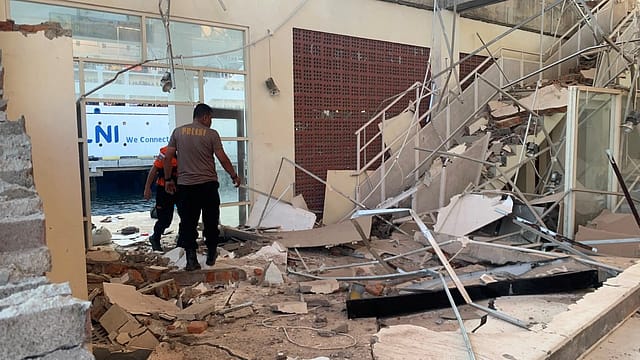
The ground moved again. On Monday morning, as rescue teams were still working through the wreckage left by one of Indonesia’s most devastating earthquakes in years, another strong tremor struck the Flores region. A magnitude 5.9 earthquake hit the area at a shallow depth of about 10 kilometres, according to the German Research Centre for Geosciences (GFZ). The latest tremor came two days after a much larger 7.7-magnitude earthquake struck eastern Indonesia, killing at least 54 people.
For communities already sleeping outside, waiting for aid and searching for missing relatives, it was another reminder that the disaster is not over.
A second shock while rescue work continues
The fresh earthquake struck as authorities were still trying to reach some of the worst-hit areas. Indonesia's National Disaster Management Agency, or BNPB, said the death toll from Saturday's earthquake had risen to 54, while more than 130 people were injured. Reuters reported that thousands of residents had been forced from their homes, with landslides blocking roads and communications disrupted in several areas.

Losing Memory
16 Oct 2026 - Vol 05 | Issue 42
The making of a medical and social emergency
Nearly 1,000 aftershocks had been recorded following the main earthquake, according to Indonesian authorities, although only a fraction were strong enough to be felt. The latest 5.9 tremor adds another layer of difficulty for rescuers already working in unstable conditions.
What happened on Saturday?
The original earthquake struck at around 5:58 am local time on August 15, according to the US Geological Survey. The epicentre was in the Flores region of East Nusa Tenggara, roughly 68 kilometres northwest of Ende. The earthquake was relatively shallow, making its shaking particularly destructive. It affected communities across several regencies, with Manggarai, East Manggarai and Nagekeo among the areas reporting significant damage.
Buildings collapsed. Roads were blocked by landslides. Power and communications were disrupted. And thousands of people left their homes, many choosing to sleep outdoors because they feared further tremors. Reuters reported that the earthquake was Indonesia's deadliest since the 2022 Cianjur earthquake.
The tsunami warning came — and then went
The earthquake also triggered a major fear familiar to Indonesians: a tsunami. Indonesia's Meteorology, Climatology and Geophysics Agency, or BMKG, issued a tsunami warning after the undersea earthquake. The warning was later lifted after authorities determined that no dangerous sea-level rise was occurring along the affected coastline. Reuters reported that minor tsunami waves of less than a metre were observed.
For residents who remember Indonesia's history of devastating tsunamis, even a temporary warning was enough to send people rushing away from the coast.
Thousands are still displaced
The destruction has left a huge humanitarian challenge. Reuters reported that around 5,000 people had evacuated in the aftermath of the earthquake, while thousands more were seeking shelter in temporary locations. In Sikka, more than 3,300 people were reported to have taken shelter in tents and other emergency locations. Hospitals have also been affected. A damaged regional hospital in Manggarai has disrupted medical services, prompting authorities to prepare a field hospital at Golo Dukal Stadium. Medical teams are dealing not only with earthquake injuries but also with the consequences of damaged infrastructure and difficult access to remote communities.
Getting aid there is becoming the next battle
The earthquake did not simply destroy homes. It damaged the roads needed to reach the people who now need help. That has forced authorities to rely on a combination of land, sea and air transport, including military aircraft and helicopters. Indonesia has also launched a major airlift operation from Jakarta. President Prabowo Subianto oversaw the initial dispatch of aid from Halim Perdanakusuma Air Force Base, with authorities preparing to move 50,000 aid packages weighing about 275 tonnes to affected areas.
The effort is particularly important for isolated communities where roads remain blocked or difficult to navigate.
Flores knows what a deadly earthquake can do
There is a painful historical memory beneath the current disaster. Flores was struck by another devastating earthquake in December 1992. That magnitude 7.8 earthquake generated a tsunami that killed more than 2,500 people along the island's coastline. The comparison has not been lost on residents. Nor has Indonesia's broader history of earthquakes.
The country sits along the Pacific Ring of Fire, one of the world's most seismically active regions. Earthquakes are common, but their consequences can vary dramatically depending on magnitude, depth, location, terrain and the vulnerability of buildings and infrastructure. Reuters noted that the country has experienced several catastrophic earthquakes over the past decade. The 2018 Sulawesi earthquake and tsunami killed more than 4,000 people, while the 2022 Cianjur earthquake killed more than 600.
The lesson is grim but clear: in Indonesia, the danger does not necessarily end when the first major tremor stops.
For people far away, a magnitude 5.9 earthquake may sound like another number in a long list of seismic events. For Flores, the timing makes it different. The region is already dealing with collapsed homes, damaged schools and health facilities, blocked roads, disrupted communications and thousands of displaced residents. Rescue teams are still searching. Aid is still moving. Families are still waiting for news. And now the earth has shaken again.
The immediate priority remains finding survivors, treating the injured and getting food, water, shelter and medical supplies to communities that need them. The fresh tremor is a reminder that for the people of Flores, Saturday's earthquake was not a single moment of disaster. It has become an unfolding emergency.
(With inputs from ANI)