Can $370 Million Clean Dhaka’s Waterways? World Bank Explains
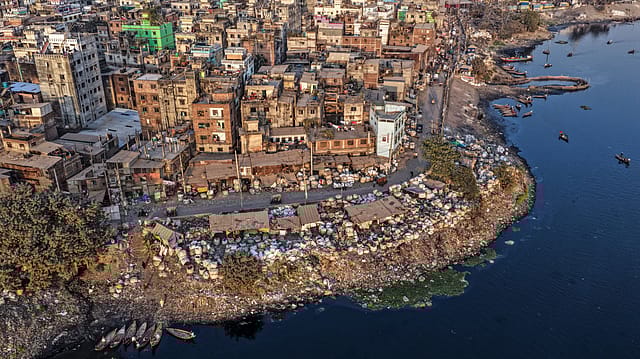
The World Bank has approved $370 million in financing to improve sanitation and solid waste management in Dhaka and surrounding areas, aiming to reduce water pollution and restore rivers and canals.
The funding, cleared by the World Bank’s Board of Executive Directors, will support the Metro Dhaka Water Security and Resilience Program, which focuses on strengthening institutions and improving wastewater and waste services in the greater Dhaka region.
Greater Dhaka accounts for nearly half of Bangladesh’s formal employment and about one-third of its GDP, making water security in the region crucial for the country’s economic and social stability.
Why Dhaka’s Water Pollution Is a Major Concern?
Dhaka faces severe wastewater and water pollution challenges due to rapid and largely unplanned urbanization and industrial expansion.
Currently, only around 20 per cent of residents are connected to a piped sewer system, while another 2 percent rely on functional fecal sludge management. More than 80 per cent of untreated wastewater and sewage is discharged into Dhaka’s interconnected waterways.
Additionally, over half of the city’s canals have either disappeared or become clogged, further worsening pollution and flooding risks.
“Waterbodies are the lifeline for millions of people in greater Dhaka. But rapid, unplanned urbanization and industrial growth have outpaced the city's capacity to manage wastewater and pollution, impacting public health, environment, and the economy,” said Jean Pesme, World Bank Division Director for Bangladesh and Bhutan.

Travel Issue 2026
15 May 2026 - Vol 04 | Issue 71
The Cultural Traveller
“This program will help build the institutional foundations needed to reduce pollution and restore the health of Dhaka's rivers and canals over time,” he added.
What the New Program Aims to Do?
The Metro Dhaka Water Security and Resilience Program introduces a results-based system to help city corporations and the Water Supply and Sewerage Authority (WASA) deliver measurable improvements.
Under the program, about 550,000 people will receive safely managed sanitation services and 500,000 will benefit from improved solid waste management. Priority will be given to communities most affected by pollution and service gaps.
The initiative takes a holistic approach by involving public institutions, private companies, and city authorities. It aims to strengthen service delivery, improve regulation, and restore rivers and canals by increasing their flow capacity and reducing pollution.
Industrial Pollution: A Key Target
Industrial pollution is another major contributor to Dhaka’s water crisis.
Around 80 per cent of Bangladesh’s export-oriented garment factories are located in Dhaka, and more than 7,000 factories discharge an estimated 2,400 million liters of untreated wastewater into waterways every day.
This pollution contributes to skin diseases, diarrheal illnesses, and neurological conditions among residents.
To address this, the program will mobilise private sector participation, especially from industries, to scale up effluent treatment systems and promote water reuse for better efficiency.
Long-Term Water Security Plans
The project is part of a broader, multi-phase effort to improve Bangladesh’s water resilience.
“The program is part of a multi-phase, long-term engagement supporting Bangladesh's broader water security and resilience agenda,” said Harsh Goyal, World Bank Senior Water Supply and Sanitation Specialist and Task Team Leader.
“This phase will prioritize reducing pollution discharge into Dhaka's water bodies, strengthening institutional and regulatory monitoring systems including a comprehensive water quality index for Dhaka's rivers, establishing digital real-time pollution monitoring, and developing integrated river restoration plans for four major Dhaka Rivers,” he added.
The program will also create digital monitoring systems and water quality indices to track pollution levels in real time.
Areas Covered and Community Involvement
In its first phase, the initiative will cover selected areas in Dhaka and Narayanganj. Key interventions include improving primary waste collection, especially in underserved communities, upgrading recycling systems, conducting community-led awareness campaigns and strengthening enforcement to prevent illegal dumping and sewage discharge.
Authorities will also work to stop direct industrial effluent release into rivers and canals.
World Bank’s Longstanding Support to Bangladesh
The World Bank has been one of Bangladesh’s earliest development partners. Since the country’s independence, it has committed over $46 billion in grants, interest-free loans, and concessional credits.
Currently, the Bank has ongoing commitments of more than $12 billion across 43 projects, focusing on infrastructure, social services, climate resilience and governance.
Through this new initiative, the World Bank aims to support Dhaka’s long-term transformation into a cleaner, healthier, and more resilient megacity.
(With inputs from ANI)