Bangladesh Enters Final Campaign Push Ahead of February 12 Parliamentary Elections
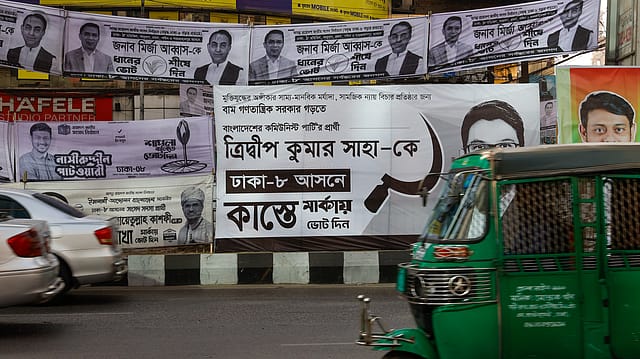
High-octane political campaigning has entered its final phase in Bangladesh as the country moves closer to its national parliamentary elections, with candidates stepping up efforts to woo voters across the country.
Candidates and their supporters are going door-to-door, organising rallies, speaking on microphones, and decorating neighbourhoods with colourful posters and banners in the last leg of campaigning.
Under Bangladesh’s election laws, official campaigning ends 48 hours before polling begins.
With voting scheduled to start at 7.30 am on February 12, campaigning will conclude at 7.30 pm on February 10.

Zeroing In on ECI
09 Oct 2026 - Vol 05 | Issue 41
Constitutional legitimacy versus political opportunism
Bobby Hajjaj, the Bangladesh Nationalist Party (BNP) candidate from the Dhaka-13 constituency, expressed optimism as the campaign entered its final hours.
Speaking to ANI, Hajjaj said, “We literally have only a few more hours. So, we are trying our best to do as much as we can in the last few hours of the election campaign.”
“It has been wonderful so far. We have been able to connect with the public, and the public has shown a great deal of enthusiasm because it has been almost two decades. Gen Z or the younger generation have no experience of voting because their voting rights were restricted for last almost two decades. We are hopeful for the future,” he added.
Political Upheaval and Regional Strain Shadow Bangladesh Polls
The elections are taking place against the backdrop of prolonged political and civil turmoil in Bangladesh following the ouster of former Prime Minister Sheikh Hasina in August 2024.
Hasina fled the country amid student-led protests nationwide, leading to the fall of the Awami League government on August 5, 2024.
Since then, Bangladesh, under interim leader Muhammad Yunus, has witnessed widespread protests, violence and destruction of public property.
Violence against minorities, particularly the Hindu community, following the political change in Dhaka has also strained bilateral ties with India.
In response, India has restricted tourist visas for Bangladeshis and withdrawn families of Indian diplomats from Bangladesh, citing security concerns ahead of the February 12 elections.
Cricket Fallout and Rising Islamist Influence Deepen Transition Worries
The diplomatic tension has spilled over into sports ties as well. Last month, Bangladesh withdrew from the men’s T20 World Cup after the International Cricket Council declined a request to move their group matches from India to co-host Sri Lanka.
Amid this turbulent transition, concerns are also growing over a sharp rise in Islamist politics following the July 2024 uprising.
A new research report released in Dhaka on Sunday warned that this trend could have widespread negative consequences, particularly for women.
The report, titled "Rupture, Reform, and Reimagining Democracy: Navigating the Agony of Transition," was published by the BRAC Institute of Governance and Development.
It examines the political and ideological shifts since the uprising that led to the fall of the Sheikh Hasina-led government.
Uprising Fell Short of Structural Change: BRAC Institute report
Explaining the findings, Mirza M Hassan, PhD, one of the authors, said the uprising failed to bring about the deep structural transformation many had expected.
"I'll be very brief about it. We thought there would be a change in the political order in terms of, party system, in terms of, reforms, and massive changes in the elite structure. There has to be a new elite structure, a new elite circulation. These things should have happened, and also a certain degree of rule of law. That didn't happen,” he said.
“Rather, we saw a chaotic situation, chaotic governance, a weak interim government who couldn't control the mobocracy and promote the democratic aspiration of the people,” he added.
“So in that sense, it would be an exaggeration to call it a rupture. It's rather, you know, some kind of, you know, some changes. More than regime changes, but not more than that. It wasn't a rupture. So that's the outcome of the uprising," Hassan said.
Electoral Landscape and Key Contenders
The main electoral contest is between the BNP, led by Tarique Rahman, and a newly formed 11-party alliance officially known as the Like-minded 11 Parties.
The alliance is led by the Bangladesh Jamaat-e-Islami and the National Citizen Party.
The Awami League, of which Sheikh Hasina remains president, is currently suspended and barred from contesting the elections.
The Bangladesh Parliament or Jatiya Sangsad has 350 seats, including 300 directly elected seats and 50 reserved seats for women.
To form a government, a party or coalition needs a simple majority of at least 151 of the 300 directly elected seats.
The 50 reserved seats for women are allocated after the election results based on a party’s share of the 300 seats and do not affect the initial threshold for forming a government.
Members of Parliament serve five-year terms.
Bangladesh is administratively divided into eight divisions, 64 districts and 495 upazilas.
Local governments oversee municipal services, education and rural development, though they rely heavily on funding and authority from the central government.
While securing 151 seats would provide a working majority, a two-thirds super-majority needed for major constitutional changes without opposition support would require at least 200 seats.
(With inputs from ANI)