All-Round New Zealand knock Sri Lanka out of T20 World Cup
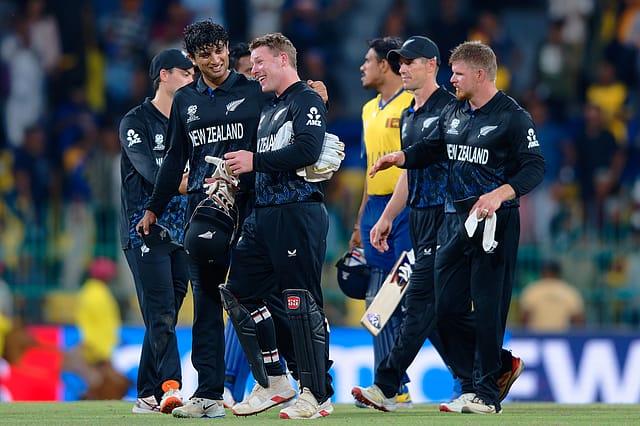
Two teams with contrasting rhythms walked into the R Premadasa Stadium in Colombo on Wednesday evening—New Zealand brimming with confidence after rolling through their recent matches, and Sri Lanka who continued to search for consistency at a crucial stage of the T20 World Cup tournament.
Meetings between Sri Lanka and New Zealand may not carry the intensity of a traditional rivalry, yet they often follow a familiar pattern. Sri Lanka create pressure, New Zealand remain composed, and the outcome turns on decisive passages. On Wednesday, the Super Eight clash at Colombo followed that familiar script, with the night ending with co-hosts Sri Lanka being knocked out of the 2026 T20 World Cup after suffering a crushing 61 run defeat at the hands of the Black Caps.
Earlier in the evening, in front of an electric Colombo crowd, Sri Lanka won the toss and decided to field first. And their bowlers then backed up their captain’s decision by doing all the hard work and operating with precision. The new ball was probing, and spinners controlled the middle overs.

What Rahul Gandhi Wants
28 Aug 2026 - Vol 05 | Issue 35
He is desperately courting the angry youth. That won't be enough to credibly challenge Modi
Maheesh Theekshana took 3 for 30 while Dushmantha Chameera claimed 3 for 38, dismissing Rachin Ravindra (32), Glenn Phillips (18), and Daryl Mitchell (3) early to leave NZ at 84 for 6 after 15 overs. Mitchell Santner (47 off 26) and Cole McConchie (31* off 23) added a record 84-run 7th-wicket stand, blasting 70 in the last four overs on a turning pitch. The duo carried New Zealand to 168/7 in 20 overs, a total that looked well within Sri Lanka’s reach despite the assistance from the pitch.
And at the halfway stage, Sri Lanka would have backed themselves to chase 169. Instead, their innings faltered almost immediately.
Matt Henry (2 for 3) wrecked the Powerplay, bowling Pathum Nissanka and Charith Asalanka and leaving Sri Lanka 6 for 2 in 2.1 overs. Rachin Ravindra then dominated with career-best figures of 4 for 27.
Soon, what should have been a measured chase turned into repair work. Partnerships almost formed. A boundary every now and then almost gave hope. But Sri Lanka never actually caught up to the scoreboard pressure.
At 60/3 after nine overs, Sri Lanka were still technically in the contest, the required rate hovering around eight an over. Yet the innings lacked rhythm. The middle overs were slow, with dot balls mounting and scoring options narrowing. Kamindu Mendis top-scored with 31; while Dunith Wellalage added 29, but no partnerships lasted. New Zealand’s bowlers varied pace effectively and fielders cut off boundaries, ensuring the pressure never eased.
“We felt 168 was defendable if we kept hitting our lengths and stayed patient,” Henry said after the match.
Sri Lanka captain Dasun Shanaka admitted the chase was defined by early setbacks. “We lost two wickets early and spent the rest of the innings catching up. We needed one partnership to take it deep,” he said.
Sri Lanka eventually finished on 107/8 in 20 overs, falling short by 61 runs.
The contrast between the sides lay in conversion. Sri Lanka controlled long phases with the ball and created the platform, but their batting lacked continuity. New Zealand, meanwhile, stayed composed despite a modest total, defended it through disciplined bowling, sharp fielding, and timely breakthroughs.
For Sri Lanka, the defeat will feel like a missed opportunity. Their tournament has featured similar patterns — strong passages undone by moments of fragility — and this match reinforced that narrative.
New Zealand leave with valuable points and renewed belief. They absorbed pressure, struck at key moments, and defended a total that once appeared vulnerable.
And so the night ended in familiar fashion—Sri Lanka competitive but incomplete, New Zealand efficient and composed. A match that remained within reach of Sri Lanka for most of the chase, yet one that slipped away in the first few overs when momentum stalled and never quite returned.