World Cup 2026: The Roar of the Desert Lions
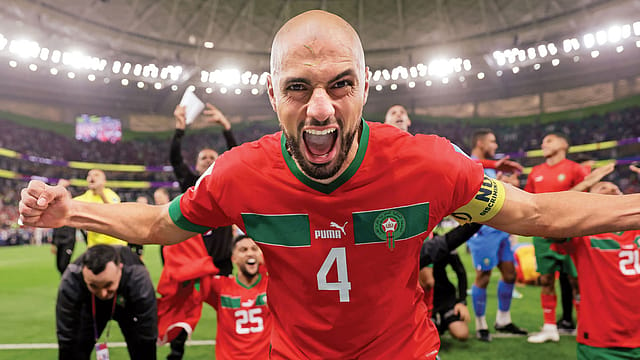
IT WAS HAKIM ZIYECH, the then-Chelsea winger, who first felt and promptly collapsed with the weight of footballing history. Subbed off sometime in the second-half of the World Cup quarterfinal match between Morocco and Portugal, Ziyech spent the entirety of the eight excruciatingly long added minutes at the Al Thumama in Doha on the touchline, pacing up and down with the Moroccan defenders, as they nervously kept out the might of the Portuguese attack, despite being down to 10 men. In that period of injury time alone, Rafael Leão narrowly missed finding the back of the net, and the equaliser to push this contest to extra time. As did Pepe, as did Bruno Fernandes, as did João Cancelo. As did Cristiano Ronaldo.
When the only whistle that mattered was finally blown— and not the thousands of shrill sounds arriving from the sea of red and green in the stands—Ziyech, who had his eyes firmly on the referee, fell to his knees and roared. It was only then that the others, busy with the match itself, realised what they had achieved. Sofyan Amrabat pressed his beautifully bald head to the grass and cried, even as the superstar of this side, Achraf Hakimi, threw himself into the arms of Yassine Bounou, the goalkeeper who had kept a clean sheet against all odds, magically sending an African nation into the semifinals of a FIFA World Cup for the very first time.
It did more than that, in fact, for Morocco’s run in Qatar 2022 shattered one of the oldest psychological ceilings in football itself. African sides had threatened before—Cameroon in 1990, Senegal in 2002, Ghana in 2010—but these campaigns were still spoken of as glorious interruptions, moments of chaos inflicted upon the established order before Europe and South America inevitably reclaimed control. Morocco altered the grammar entirely.
They did not stumble into the last four through adrenaline and fortune. They eliminated Belgium, Spain and Portugal through organisation, tactical intelligence and astonishing emotional discipline. Theirs was not the footballing equivalent of a miracle. It looked repeatable.
“We are Rocky Balboa in this World Cup,” Morocco coach Walid Regragui said with a smile, though by then his side had already evolved beyond underdog status. “There are no miracles in football,” Regragui would later say. “It’s hard work, it’s quality, it’s belief.” The line perhaps explained why Morocco’s run felt fundamentally different from previous African breakthroughs. Their victories were not powered by unpredictability alone, but by preparation.
Spain finished with nearly 80 per cent possession against Morocco in the Round of 16 and still looked strangely powerless, endlessly circulating the ball without incision, as if confronted not by outsiders but by a side entirely certain of its own methods. Portugal, too, entered the quarterfinal carrying the aura of inevitability around Ronaldo’s surge towards winning his maiden World Cup. Morocco dismantled even that script. He was filmed leaving Al Thumama weeping uncontrollably, perhaps knowing that his best chance at getting a star stitched to the Portuguese shirt had gone.

What made the achievement even more striking was how deeply prepared Morocco seemed for the moment. Long before Qatar, the Royal Moroccan Football Federation had spent years building towards relevance. The country invested heavily in infrastructure, youth systems and coaching pathways, determined to turn football into both national obsession and state project. The vast Mohammed VI Football Academy outside Rabat became the symbol of this ambition, a sprawling elite complex that has already produced a conveyor belt of talent.
Morocco simultaneously modernised stadiums across Casablanca, Rabat, Tangier, Agadir and Marrakesh as part of an ultimately unsuccessful bid to host the 2026 World Cup. Yet, even in defeat came opportunity. Morocco would instead host the Africa Cup of Nations, and then proceeded to win it themselves in January this year, transforming the emotional afterglow of Qatar into something more durable: continuity.
There was symbolism everywhere in that Moroccan side. Players raised in Amsterdam, Madrid, Paris and Brussels sang the anthem with tears in their eyes before matches. The team represented not merely a country, but an entire geography of migration and memory. “This is for all of Africa,” Regragui repeatedly said during the tournament, though Morocco simultaneously became a vessel for Arab and Muslim pride across the world. In Europe, diaspora communities that had spent decades suspended between identities suddenly found themselves reflected in a team capable of beating former colonial powers at their own game. Their victories over Spain and Portugal carried undertones that football scarcely needed explained aloud.
And, yet, the durability of Morocco’s rise lies not in symbolism but in talent. Hakimi, now 27 and in the prime of his career, has become one of the defining full-backs of his generation, a footballer who plays with the velocity of a winger and the composure of a midfielder. Fresh off his second UEFA Champions League title with Paris Saint-Germain, Hakimi now occupies that rare space where African footballers are no longer merely stars within Europe but central figures shaping the sport’s elite era itself. Around him sits a generation equally comfortable on the grandest stages: Bounou in goal, Amrabat in midfield, the endlessly inventive Ziyech, all products of a football culture that no longer approaches the world timidly.
IF MOROCCO HAS become the continent’s modern flagship, Egypt remains its emotional cathedral. Football in Cairo is less pastime than atmosphere, something inhaled continuously through traffic-clogged streets, smoke-filled cafés and the thunderous terraces of Al Ahly and Zamalek. The country’s domestic game possesses a scale and intensity few outside South America truly understand, until the great Egyptian Mohamed Salah came along and forced everyone to finally get it.
Mo Salah’s rise therefore resonated far beyond Liverpool goals and individual awards. For millions of Egyptians, Salah represented entry into the centre of modern football itself. Here was an Egyptian not surviving in Europe but dominating it, becoming one of the defining forwards of his age while carrying himself with unmistakable cultural ease. So profound was Salah’s presence at Liverpool that a Stanford University study later found anti-Muslim hate crimes in Merseyside had dropped by nearly 19 per cent following his arrival, even as anti-Muslim social media posts by Liverpool supporters halved. Footballers are rarely discussed in such terms, but Salah had quietly become something larger than sport itself.
Salah himself has often spoken about carrying Egypt with him wherever he goes. “I want people to believe that anything is possible,” he once said while reflecting on his journey from Nagrig, the small Nile Delta village where he grew up, to the summit of European football. The line explains why Salah’s rise has resonated so profoundly across Egypt and the wider Arab world.
Mo is not merely admired there as a footballer, but as proof that someone who looked, spoke and prayed like them could stand at the very centre of the global game without compromise. Egypt has often struggled to translate its immense continental pedigree into sustained World Cup success, yet the psychological shift brought by Salah may ultimately prove as important as any single tournament run.
Then comes the wider North African surge. Tunisia continues to remain stubbornly difficult opponents on the global stage, disciplined and tactically coherent in ways that regularly unsettle more glamorous nations. Algeria, meanwhile, perhaps best embody the complicated modern story of North African football altogether: migration, memory, France, identity and immense technical skill braided into one footballing culture.
Their greatest World Cup side arrived in Spain ’82, dazzling neutrals by defeating West Germany in one of the great upsets in tournament history, only to be eliminated after the now infamous “Disgrace of Gijón”, when Austria and West Germany effectively played out a mutually beneficial result to send Algeria home. Watching from Marseille was Smaïl Zidane, an Algerian immigrant whose young son Zinedine was absorbing football and ancestry simultaneously.
Years later, Zidane himself would speak often of the emotional pull Algeria retained over immigrant families in southern France, homes where football and memory frequently merged into the same conversation. That relationship produced generations of technically gifted footballers for France, but it also created a quieter longing across North Africa itself: the desire to no longer export greatness exclusively through diaspora success. Morocco’s rise, and the wider regional surge surrounding it, finally suggests that transition may now be complete.
For decades afterwards, North African brilliance often appeared indirectly inside European football, especially French football. From Zidane to Karim Benzema to Samir Nasri, the influence of Maghrebi communities helped shape generations of French sides. But there is a subtle shift underway now. Morocco’s semifinal, Algeria’s resurgence, Egypt’s enduring power and Tunisia’s consistency all point towards the same conclusion: North Africa no longer exists merely as a reservoir of talent for others. It has emerged as a footballing force in its own right. The players no longer need borrowed flags to illuminate the world stage. Their own are finally visible enough.