World Cup 2026: Players to Watch
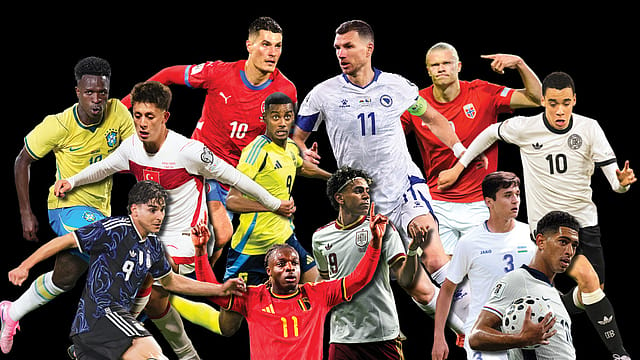

Patrik Schick (Czechia)
There are strikers who score goals, and then there are strikers who seem to arrive at them through instinctive geometry. Schick belongs firmly to the latter category. Tall, elegant and oddly unhurried, he often appears detached from matches until the exact second he alters them.
For Czechia, Schick carries the burden of continuity. Ever since his remarkable Euro 2020 campaign—including that astonishing halfway-line goal against Scotland—he has become both symbol and expectation, the latest forward entrusted with sustaining the country’s long tradition of technically gifted attacking football.
In an era increasingly obsessed with pressing systems and athletic chaos, Schick feels almost old-fashioned: a striker built around timing, touch and spatial intelligence. Which is perhaps why, when chances suddenly appear, few forwards in this tournament make finishing look quite so inevitable.
Edin Džeko (Bosnia)
Džeko has spent much of his career ageing against expectation. Long after quicker forwards faded, and younger names arrived, the 40-year-old continued scoring with the same understated certainty that first carried Bosnia onto the global stage.
There is something deeply representative about him for Bosnian football itself. Raised during the siege of Sarajevo, Džeko’s story has always extended beyond goals alone. Even now, in the closing stretch of his career, he remains the emotional centre of the national side.
Modern football increasingly worships speed and systems. Džeko instead survives through positioning, patience and intelligence—an old-world centre-forward who still understands exactly where matches are won.
There is very little excess in his game, only instinct and decisions, sometimes made a fraction of a second earlier than defenders expect.
Vinicius Jr (Brazil)
For all Brazil’s endless production line of talent, Viní Jr feels unmistakably modern. He plays at a speed that seems to distort defensive shape itself— all sudden acceleration, sharp feints and emotional electricity. Few footballers in this World Cup can alter the emotional temperature of a match as quickly as he can.
Yet, beneath the flair, lies something more hardened. Viní emerged into senior football carrying enormous expectation and then endured years of scrutiny over finishing, decision-making and consistency. What followed was not collapse, but evolution. He became more clinical without losing spontaneity, as he has been for his club, Real Madrid. For Brazil, he increasingly represents a post- Neymar future: less theatrical perhaps, but equally dangerous. A striker capable of turning chaos into inevitability within a single sprint towards the goal.
Arda Güler (Turkey)
Slim, left-footed and perpetually scanning for angles others miss, Güler plays with the imagination of a footballer raised on improvisation rather than systems. This has made him a phenomenon at Real Madrid. For Turkey, Güler represents promise. He carries the emotional weight of a football culture forever oscillating between romance and frustration.
What makes him special is not merely technique, but rhythm. Güler slows matches down in an era obsessed with speed. And when spaces finally open, his passing arrives with the precision of somebody already seeing the next phase before everyone else.
Jamal Musiala (Germany)
There is something unfinished about Musiala, which is also what makes him so irresistible to watch. Even at Bayern Munich, he still plays with the improvisational joy of a street footballer discovering space for the first time.
For Germany, this World Cup increasingly feels like his inheritance. After years of tournament disappointment, Musiala embodies a softer, freer footballing identity. He glides between midfield and attack with startling calm, carrying the ball through pressure as though defenders exist behind his thoughts.
At 23, he is already Germany’s next era.
Alexander Isak (Sweden)
Isak moves like a footballer designed in contradiction. At 6’4”, the Liverpool striker possesses the frame of a traditional centre-forward, yet much of his game feels borrowed from smaller, elusive players. He glides rather than charges, drifts wide instead of remaining fixed centrally, and often appears to create space through elegance rather than force.
For Sweden, Isak represents the clearest transition away from the Zlatan Ibrahimović era, not in charisma, but in imagination. Sweden once built itself around physical structure and collective discipline. Isak introduces improvisation into that identity.
There is also a quietness to him that feels increasingly rare in elite sport. Even during his rise through Borussia Dortmund, Real Sociedad, and then Newcastle, he remained curiously detached from the performative intensity surrounding modern stardom. The attention follows him anyway.
What separates Isak from many modern forwards is the calmness with which he carries danger. There is very little visible strain in his game. Even at high speed, he seems composed inside the chaos, capable of delaying a decision longer than defenders can tolerate.
At this World Cup, he arrives less as an emerging talent than as the player around whom Sweden’s entire attacking future now revolves.
Jérémy Doku (Belgium)
The Manchester City winger plays with such acceleration and sudden directional change that defenders often appear briefly disconnected from the match itself. For Belgium, Jérémy Doku increasingly feels like the bridge between generations. The old golden era—Eden Hazard, Kevin De Bruyne, Romelu Lukaku—carried the country to unprecedented heights without quite reaching a final.
What makes him so thrilling is unpredictability. Doku carries traces of improvisation. Even Pep Guardiola, football’s greatest new-age manager as well as a true machine of control, often used him as a deliberate source of disorder.
Yet there is also vulnerability inside his game, which perhaps explains why audiences connect with him so instinctively. His football remains unfinished: explosive one moment, frustrating the next. Through-balls can drift loose, decisions can arrive half a second too late and entire passages sometimes feel governed by instinct than calculation. But that is precisely the point of his gameplay. In an age obsessed with optimisation, Doku still plays like somebody discovering possibilities in real time. Watching him can feel less like observing a tactical system and more like witnessing football briefly return to impulse, risk and improvisational joy.
Lamine Yamal (Spain)
Lamine Yamal’s rise has unfolded at a speed that still feels slightly unnatural. Even within Barcelona’s long tradition of prodigious talent, few players have entered elite football carrying such immediate authority. By 17, he had already become a European champion with Spain at Euro 2024, accelerating past the usual developmental timelines of modern football.
What makes Yamal extraordinary is not merely technique, though that arrives in abundance. It is composure. Young attackers are supposed to play with visible urgency, eager to impose themselves on every possession. Yamal instead already understands rhythm. He pauses naturally,
waits for defensive structures to shift, and manipulates space with the calmness of a far older footballer. Perhaps all of this was passed through physical touch—he was, after all, held by Lionel Messi for an ad shoot while still a toddler.
For La Roja, he represents something culturally important as well. After years spent trapped between nostalgia for the tiki-taka era and uncertainty about what followed, Yamal offers a more fluid future: technical but vertical, expressive without abandoning control. There are still moments of youthful inconsistency. But, at this World Cup, Yamal arrives not as football’s next wonderkid, but already as one of Spain’s defining creative forces.
Erling Haaland (Norway)
The numbers increasingly feel absurd even by Premier League standards. Manchester City’s Erling Haaland became the fastest player in league history to reach 100 goals, doing so in just 111 matches, shattering Alan Shearer’s old benchmark of 124. He also reached 100 goal involvements in under 100 appearances, statistics that already place him inside conversations usually reserved for all-time greats.
For Norway, his presence has altered both expectation and visibility. A national side long associated with near-misses suddenly carries one of world football’s defining superstars. Alongside Arsenal captain Martin Ødegaard, Haaland has dragged Norway back into elite international relevance.
What makes him fascinating is how old-fashioned he can appear within modern football’s increasingly fluid attacking structures. He remains fundamentally a centre-forward: explosive movement, ruthless finishing, physical intimidation. Yet beneath that simplicity lies extraordinary timing and spatial intelligence. There are technically finer players at this World Cup. But no other scorer of goals makes scoring feel quite so inevitable as Haaland now does.
Julián Á lvarez (Argentina)
Even inside Argentina’s constellation of stars, the Atlético Madrid forward has become indispensable through movement, pressing and tactical selflessness that elite teams depend upon. Álvarez’s real global arrival came in Qatar, where he scored four goals during Argentina’s triumphant 2022 World Cup campaign.
Qatar transformed him from a promising supporting cast into one of Argentina’s central attacking figures. What makes him such an effective striker is that he disrupts matches through timing—sudden runs beyond defensive lines and rotations around heavier creative figures like Lionel Messi.
For Argentina, who he has already won a World Cup with at a young age, Álvarez feels like the ideal modern complement to greatness around Messi: tireless, intelligent and devastatingly efficient when spaces appear.
Abdukodir Khusanov (Uzbekistan)
The great Uzbek’s rise has been unusually fast for a defender from a nation still building its global football footprint. Born in 2004, he moved to Manchester City in 2025, a transfer reflecting how quickly elite clubs have begun valuing his profile. At City, he has already been integrated into a squad that demands near-perfect defensive timing and distribution under pressure.
For his country, he is part of the post-USSR generation that has begun to achieve tremendously in sports on its own (the summer Olympics in Paris being a great marker). While playing in Uzbekistan colours, young Khusanov’s emergence is the story of a defensive unit that has conceded significantly fewer goals across recent qualifying cycles compared to previous generations. Khusanov sits at the heart of that shift — a centre-back trusted in high lines and increasingly active in build-up phases.
At this World Cup, Khusanov represents an incredible data-backed ascent too: minutes accumulated early, transfers upward, and performance metrics steadily improving season by season.
Jude Bellingham (England)
Bellingham has already become one of the defining midfielders of his generation, not through gradual emergence but via immediate authority at every level he has entered. From Birmingham City to Borussia Dortmund and now Real Madrid, his trajectory has been marked by rapid assimilation.
During his ongoing time in Spain for Los Blancos, he has been used across roles— arriving late into the box, dictating tempo from deeper zones, and often functioning as both creator and finisher in the same match, a role that fits right into Harry Kane’s version of an England side. He scored 23 goals in his debut Real Madrid season, an unusually high return for a midfielder. Now, despite the figure of Declan Rice, Bellingham increasingly operates as the emotional and tactical centre of the team, shaping England’s rhythm in decisive moments.
He plays with visible emotional force, often shaping matches through intensity as much as execution. For England, Bellingham becomes the latest vessel for the long shadow of 1966 and the familiar refrain of “football coming home”.