World Cup 2026: Power and Flair
EVERYTHING CHANGES AND not necessarily to a more beautiful version of itself. In the late 1980s and early 1990s, a younger generation of football fans rejected their parents’ undying love for Brazil and O Jogo Bonito for Argentina’s passion and determination. A young fan wrote in a popular Bengali children’s magazine: “We are a new generation. We don’t understand art. We want to win.” Did he miss the irony that while Argentina were not a beautiful team, they had in their midst a beautiful man who was the team and its style? Those who refuse to forget Telê Santana’s magical but unsuccessful 1982 and 1986 Brazil squads, or revere the Total Football of Johan Cruyff and Rinus Michels of 1974, never settled the debate on the best team to not win a World Cup: the Flying Dutchmen or Messrs Sócrates, Zico, Falcão, and Éder?
Every generation comes of its own by rejecting its predecessor’s aesthetic. If football is art, it had to evolve. If football is science, it had to improve. The world-conquering Spanish sides of 2008-14 were humiliated when others had got the measure of tiki-taka, such as the Dutch in the group match of the 2014 World Cup. Irony: tiki-taka, the last great beautiful system, was Cruyff’s child, created in Barcelona and perfected by Pep Guardiola who, at 11, was mesmerised by the “organised chaos”—Sócrates’ words—of Brazil in 1982. But tiki-taka was not chaos. Individual brilliance was made to serve a system in a way Total Football was not really a system. And even as Guardiola adapted when beaten, as with Bayern Munich or Manchester City, tiki-taka Spain had failed to do so.
On the eve of every World Cup, we hear the old lament: the beautiful game is dead. Since 1990, it has mostly meant that Brazil no longer plays ‘Brazilian’ football. Back then it was Sebastião Lazaroni. Now it is Carlo Ancelotti. The first foreigner to take the reins of the Seleção, the Italian put a target on his back when he said, “The World Cup is won by the team that concedes fewer goals, not the one that scores more.” While that harks back to Lazaroni’s “It’s better to play ugly and win than play beautifully and lose”—the antithesis of Santana’s philosophy—Lazaroni’s 1990 team played ugly and lost. Irony again: in the second-round knockout against Argentina, Brazil had reverted to incessant attacking play and should have pulverised a subpar Argentina but lost to a Caniggia goal from a Maradona pass in the dying minutes. The world cried for Brazil once more.
Ancelotti, however, has a case not because of the heartbreaks under Tite, nor Brazil's 24-year World Cup drought, but because of Carlos Alberto Parreira’s success. In 1994, the last and only time the US hosted the World Cup before 2026, Parreira stripped Lazaroni’s ‘European’ Brazil of the last vestiges of jogo bonito, placing Bebeto and Romário up front without defensive responsibilities. The duo was brilliant but the team didn’t move much. It looked dull. And it won. Ancelotti provoked the Brazilian media by invoking that memory and another: “In 2002 they played with three centre-backs, and in 1994, they used two lines of four to boost Romário.” There is, of course, one instance of jogo bonito winning a World Cup—the Brazil of Pelé, Jairzinho, Tostão, Rivelino, and Gérson in 1970. Every outfield player scored at least once and the team pumped in 19 goals in six matches: individual creativity combining with structured improvisation to achieve collective success. But it still was a system. Not chaos.
The first template for the beautiful game was created by the Magical Magyars of Ferenc Puskás and coach Gusztáv Sebes after World War II. Those Hungarians scored 436 goals in 69 matches between 1950 and 1956, winning 58 and losing just one. In what Sebes called “socialist football”, no individual dominated. Puskás later claimed it was the prototype of Total Football. But in the 1954 World Cup final—the so-called Miracle of Bern—the team that had thrashed the West Germans 8:3 in the group stage, went 2:0 up and relaxed, a sin against any German team, and lost 3:2. It seems to have set the pattern: beautiful football didn’t win.

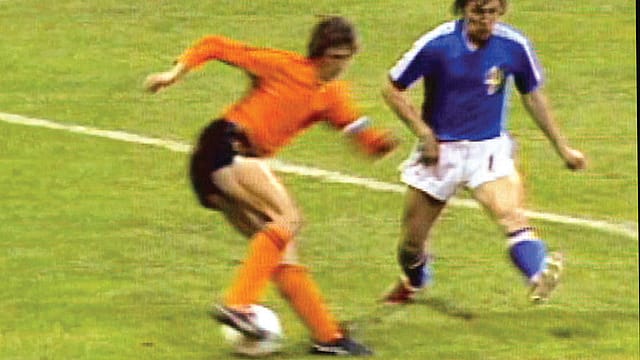
Two decades later, the famous Cruyff Turn, at the 23rd minute of the match between the Netherlands and Sweden in the 1974 World Cup changed football, but didn’t produce a goal. When the Dutch lost the final to Beckenbauer’s West Germany—after scoring first in the third minute before a German had even touched the ball— aesthetics and skill had again lost to discipline and application. However, two facts are usually kept out of the narrative about the Magical Magyars and the Flying Dutchmen. In 1954, Puskás & Co didn’t have a good final by their standards, having peaked too early in the tournament. In the 1974 final, the Dutch had slowed down their rhythm after Johan Neeskens’ penalty in the third minute. When they began pulverising the West German six-yard box in the second half, Sepp Maier pulled off save after save and a determined Beckenbauer neutralised Cruyff.
But when Santana's Brazil lost to Italy in 1982, it wasn’t because they had stopped playing the only way they knew. The moral goes that Brazil should have defended after Falcão drew them level for the second time in the 68th minute against Italy in the second round. Brazil needed only a draw. But Zico argued Santana wouldn’t have wanted them to play any other way—so they attacked and attacked, and lost. Falcão said decades later: “We lost to a team that seized their opportunities.”
A strain running through the lament for the beautiful game is the death of the maestro. Maradona inherited Pelé’s mantle but he was individual genius with a difference: rawer, more temperamental, his passion attributed to the poverty of Buenos Aires’ dirt tracks. His Goal of the Century is still the most watched passage of play in football. While Pelé was a gift, Maradona was a style—one that exited football with him. Lionel Messi, statistically the most complete footballer in history after winning the 2022 World Cup, may be the last of the maestros, but Argentina didn’t win in Qatar owing to his genius alone. Coach Lionel Scaloni’s defensive structure and tactical rigidity contributed just as much.
A LOT HAS CHANGED since Pelé and Garrincha, when natural athleticism was enough. By the time of the classic No 10 like Maradona or Zico, the team was organised to shield the creative genius who would be hard-tackled and physically targeted. Even before Messi, in the days of Ronaldo and Ronaldinho, the creative midfielder was already being pushed to the wings by overarching systems. In the age of positional play, there is no place for the elegance and ego of a classic playmaker like Sócrates or Maradona. Nor were they hyper-athletes like today’s footballers, forced by the coach’s system to press relentlessly and run almost 15km a match.
After Brazil’s defeat to France in the 1986 quarter-final in Mexico, beautiful football went missing as a philosophy. Until the arrival of Spain in 2008. Luis Aragonés and Vicente del Bosque adopted Guardiola’s Barcelona style built around Messi, Xavi, Andrés Iniesta, Sergio Busquets, Carles Puyol, et al for the international game. A possession-obsessed tactical system working with short and quick passes, tiki-taka sliced open opposing defences. Relentless passing and constant movement made it a delight to watch. And it kept winning. Until it didn’t. José Mourinho’s Inter Milan was the first to puncture tiki-taka in the 2010 Champions League semi-final, defeating Guardiola’s Barcelona. Spain returned to the top rung of world football by winning Euro 2024 after coach Luis de la Fuente put together a new system by increasing the pace, combining midfield dominance with penetrative verticality, and deploying lethal wingers like Nico Williams and Lamine Yamal.
But the most intellectual challenge to Spanish and Dutch possession football came from the German school of Ralf Rangnick and Jürgen Klopp, who developed Gegenpressing—hard-pressing the opposition every time possession is lost. Calling for tremendous physical fitness and sacrosanct organisation, Gegenpressing was quickly adopted across Europe and now defines the modern game.
Even as Gegenpressing spread, the European club system’s chokehold on world football has only tightened—the structural reason why improvisational, street-art Latin football is dying. Latin American, African, and Asian players are playing in European academies long before they mature. They emerge as athletic machines, efficient, disciplined, programmed to play within a system. Football today is designed by analysts, enforced by coaches, and executed by players. Technical homogenisation ensures footballers spend nine months at their clubs and barely a month in national training camps. By the time a World Cup comes, the national side has at hand what the club has made of the player. It matters less for European teams but a lot for a South American or African side.
Then there is the bloated 2026 World Cup itself—48 teams and a format so easy that eight of the 12 third-placed teams make the knockouts. The Group of Death is dead. With the risk of elimination reduced, the existential stakes are lower; aesthetically, that means duller football with less risk-taking.
The 2026 World Cup structurally militates against the beauty of football.
The beautiful game is not merely a matter of tactics. How football is played is rooted in culture, and football has always been political, especially in its more innovative avatars. Despite Sebes’ talk of “socialist football”, the magic of the Magyars was a reaction to Stalinism—football was one of the few human pursuits still accommodative of creative expression—and ended with the 1956 Hungarian Revolution crushed by Soviet tanks. The magicians scattered in exile. Cruyff refused to travel to Argentina for the 1978 World Cup because the country’s military junta was disappearing citizens—and throwing them into the Río de la Plata even as the tournament was underway. Sócrates was a trained physician and democratic activist whose every bone was political. Football philosophies were often extensions of political worldviews. The tragedy of beautiful football enacted on the pitch had its echoes off it.
It comes down to how we define success. Santana’s Brazil earned immortality, as did the Dutch runners-up of 1974. Nobody remembers the 1994 Brazil team except for Romário and Bebeto, and they too do not get the reverence they deserve. It also depends on how we define beauty. If we are looking for unpredictability, individual improvisation, and the triumph of instinct over system, then the beautiful game is indeed dead, killed by data analytics, GPS vests, and tactical rigidity. But if we prefer impeccable synchronicity, hyper-fast passing, and precision pressing, then football is still beautiful. In World Cup 2026, a Brazilian machine will clash with its European counterparts. Perhaps the system has won but it can produce beauty, as Spain showed more than a decade ago.
One thing might still irk though: it’s Brazil with an Italian coach in a marriage of two antithetical football cultures. Sócrates must be turning in his grave while the ghost of Paolo Rossi is laughing.