INS Nipun Explained: Inside India’s New Deep-Sea Submarine Rescue Ship and Its Role in Saving Trapped Sailors
A submarine sends no distress flare when it becomes trapped hundreds of metres beneath the sea.
There may be no wreckage on the surface. No lifeboats to follow. No survivors visible in the water. Somewhere below, sailors could be sealed inside a steel hull as oxygen thins, batteries weaken and pressure builds.
Finding them is only the beginning. A rescue ship must reach the location, hold itself almost perfectly still over moving water and lower specialised machines into a world without light. A remotely operated vehicle may first locate and inspect the submarine. A Deep Submergence Rescue Vehicle must then descend, align itself with an escape hatch and form a watertight seal before the trapped sailors can be ferried to safety in small groups.

Zeroing In on ECI
09 Oct 2026 - Vol 05 | Issue 41
Constitutional legitimacy versus political opportunism
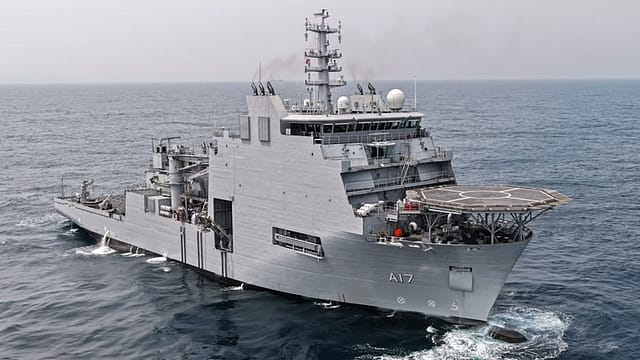
From August 31, the Indian Navy will have a new ship built to command precisely such an operation. Her name is Nipun.
The second of the Navy’s two Nistar-class Diving Support Vessels will be commissioned at the Naval Dockyard in Mumbai. Designed and built by Hindustan Shipyard Limited in Visakhapatnam, Nipun will strengthen India’s ability to conduct deep-sea diving, underwater inspection, salvage and submarine-rescue operations.
But what exactly does a Diving Support Vessel do? Can Nipun itself descend to a trapped submarine? Why must divers sometimes live inside pressurised chambers for days? And how does a rescue vehicle dock with a submarine in darkness hundreds of metres below the surface?
Here is how India’s new bridge between the surface and the seabed works.
What happens when a submarine becomes disabled underwater?
A submarine in distress is known in rescue terminology as a DISSUB, or disabled submarine. The crisis may begin with a collision, fire, flooding, mechanical breakdown, battery failure or damage caused during combat. If the submarine retains propulsion and buoyancy, it may be able to surface. If it sinks or settles on the seabed, the crew faces a far more dangerous situation.
The first challenge is location. A submarine is designed to remain difficult to detect, an advantage in war but a complication during rescue. Its last reported position, emergency communications, sonar, aircraft and surface ships may all be used to narrow the search.
A remotely operated vehicle can then descend to inspect the hull, determine its position and angle, clear debris from the rescue hatch and assess whether sailors remain alive inside. Some intervention vehicles can also deliver emergency supplies, including food, water, air or medical equipment.
Once the submarine has been found and assessed, rescuers must decide whether its crew can escape individually or must be removed through a rescue vehicle. Individual escape carries enormous risks, particularly from great depths. A submarine-rescue vehicle offers a more controlled option by docking directly with the disabled vessel and transporting groups of sailors to the surface. That is where Nipun enters the operation.
Is Nipun an underwater rescue vehicle?
No. Nipun is the large surface ship from which the underwater rescue operation would be controlled. Think of it as a floating diving base, workshop, hospital, command centre and launch platform rolled into one.
The smaller Deep Submergence Rescue Vehicle, or DSRV, is the machine that descends to the trapped submarine. Nipun carries, deploys, recovers and supports that vehicle while also accommodating divers, medical personnel, remotely operated vehicles, pressure chambers and the equipment required for underwater intervention.
This distinction matters. Nipun does not dive beneath the surface to collect sailors. It makes the dive possible. The Navy describes the ship as the DSRV’s “mother ship”. The term captures its function neatly: the rescue vehicle leaves Nipun, travels down to the submarine and returns with survivors. Depending upon the number of people trapped, the DSRV may have to repeat this journey several times.
India’s DSRV is operated by a crew of three and can evacuate 14 people during one sortie. The system is designed to conduct rescues at depths of up to 650 metres and operate in difficult sea conditions. During trials in 2018, the manned vehicle descended to 666 metres and successfully mated with a submarine at a depth of more than 300 feet, according to the Ministry of Defence. The machinery is impressive. The human arithmetic is sobering. If dozens of sailors are trapped, every descent, docking, transfer and ascent must be repeated until the submarine has been emptied.
How does a rescue vehicle dock with a submarine?
The DSRV must first find the submarine in dark and often turbulent water. Its pilots then manoeuvre the vehicle over a designated rescue hatch. At its base is a structure commonly called a mating skirt. The pilot carefully positions this over the hatch and creates a watertight seal. Water trapped between the two vessels is pumped out before the hatches can be opened.
The sailors then move directly from the submarine into the rescue vehicle without entering the surrounding sea. It sounds straightforward when compressed into a sentence. Underwater, the operation is exceptionally demanding. The submarine may be tilted. Debris may obstruct the hatch. Currents may push against the rescue vehicle. Visibility could be close to zero. The pilots must align two comparatively small openings while operating under immense pressure.
Exercises conducted by other submarine-rescue services illustrate the sequence. The Royal Navy describes its rescue vehicle Nemo positioning its mating skirt over a simulated submarine casing, creating a watertight seal and opening its rescue hatch exactly as it would during a real emergency. Nipun’s role is to give India a stable, fully equipped base above that operation.
How does a huge ship remain in place over a rescue site?
A vessel at sea is always being moved by wind, waves and currents. Anchoring may be impossible in deep water or undesirable when a trapped submarine and multiple cables, vehicles and divers lie below.
Diving Support Vessels, therefore, rely on dynamic positioning. The system combines satellite navigation, motion sensors, computers, propellers and thrusters to hold the ship at a fixed location and heading. It continuously calculates how the sea is moving the vessel and applies corrective thrust.
For an ordinary ship, drifting a few metres may be inconsequential. During a deep-sea operation, it can pull cables, displace a diving bell, endanger divers or complicate the launch and recovery of a rescue vehicle. Dynamic positioning allows the ship to become, in effect, a stationary island on moving water.
What is saturation diving, and why does Nipun need it?
Human bodies are not designed for repeated journeys into deep water. As a diver descends, surrounding pressure increases and gases dissolve into the body’s tissues. Returning too quickly can cause those gases, particularly nitrogen, to form bubbles in the blood and tissues. The result is decompression sickness, commonly known as “the bends”, which can cause severe pain, paralysis or death.
A diver working at great depth would ordinarily spend a large part of each shift descending and decompressing. Saturation diving changes the arrangement. After the body’s tissues have absorbed as much inert gas as they can at a particular pressure, additional time at that pressure does not greatly increase the eventual decompression burden. Divers can, therefore, live inside a pressurised chamber aboard the ship for days or weeks. A sealed diving bell transports them from that chamber to the underwater worksite while maintaining the same pressure.
They work beneath the sea, return to the chamber, eat and sleep under pressure, and undergo one long, carefully controlled decompression process when the assignment ends. A US Navy saturation system, for comparison, can house six divers at pressures equivalent to 1,000 feet of seawater for as long as 30 days. Its diving bell connects directly with the chamber in which the divers live, according to the US Naval Sea Systems Command.
Saturation diving places human skill where machines may not be enough. A remotely operated vehicle is excellent for observation, cutting, lifting and repetitive tasks. A trained diver can inspect damage, improvise with tools and make judgements in complex spaces. Nipun contains the systems required to support this extraordinary form of underwater work.
How deep can the Nistar-class vessels operate?
The Ministry of Defence has published more detailed figures for Nipun’s sister ship, INS Nistar, which establishes the class benchmark.
The 118-metre vessel displaces more than 10,000 tonnes and supports saturation-diving and salvage operations at depths of up to 300 metres. Its side-diving stage can support operations down to 75 metres, while its remotely operated vehicles can perform diver monitoring and salvage work down to 1,000 metres. Nistar is also equipped with diving-compression chambers and a self-propelled hyperbaric lifeboat, according to the Ministry of Defence.
Those depths need perspective. At 300 metres, the surrounding pressure is roughly 31 times the atmospheric pressure experienced at sea level. Sunlight has effectively vanished. Cold, darkness and pressure turn even a simple mechanical task into a high-risk operation. The ROV’s 1,000-metre reach also allows the ship to investigate and work at depths far beyond those accessible to human divers.
What else can Nipun do?
Submarine rescue may be its most dramatic mission, but it is unlikely to be its most frequent one. Nipun can support underwater inspection and repair, search for lost equipment, monitor divers and assist salvage operations involving ships, aircraft or other objects on the seabed. Such vessels can also support scientific, humanitarian and search-and-rescue missions.
Modern navies depend upon underwater infrastructure that remains largely invisible: submarine hulls, propellers, sonar systems, harbour installations, cables and pipelines. Inspecting or repairing these assets requires divers, robots and a surface platform capable of keeping them alive, supplied and connected. Nipun gives these operations endurance. It can carry the people, chambers, tools and underwater vehicles needed for a prolonged mission instead of merely transporting a dive team to the location.
Why does India need two Diving Support Vessels?
Geography supplies the answer. India has a coastline of more than 7,500 kilometres, island territories on either side of the peninsula and maritime interests extending deep into the Indian Ocean. Its submarine fleet operates across a vast area, while the time available to rescue a trapped crew may be painfully short.
When the Navy signed the contract for two Diving Support Vessels in September 2018, it said they would augment submarine-support operations on both coasts. Nistar is based on the eastern seaboard at Visakhapatnam. Nipun’s commissioning in Mumbai strengthens coverage on the western side. Two ships provide reach as well as redundancy. A single vessel could be undergoing maintenance, deployed elsewhere or simply too far from an emergency.
Submarine rescue is also inherently international. Navies train together because the nearest capable rescue system may belong to another country. Different rescue vehicles must be able to mate with different submarines, while teams must coordinate aircraft, ships, ports, doctors, divers and underwater machines across national boundaries. When Nistar was commissioned in 2025, the government said the capability could help India emerge as a preferred submarine-rescue partner in the region. With Nipun, that ambition gains a second operational platform.
How indigenous is Nipun?
Nipun was designed and constructed by the state-owned Hindustan Shipyard Limited under the classification rules of the Indian Register of Shipping. The Ministry of Defence says the ship has nearly 75 per cent indigenous content. Its sister vessel involved more than 120 Indian micro, small and medium enterprises, illustrating how specialised shipbuilding draws upon a much wider network of manufacturers producing steel, machinery, electronics, cables, valves and engineering systems.
India has built warships and submarines domestically for years. A Diving Support Vessel represents a different kind of industrial challenge. It must integrate ship propulsion, precision station-keeping, hyperbaric medicine, life-support systems, underwater robotics, diving equipment and submarine-rescue machinery on one platform. It may not possess the public glamour of an aircraft carrier or destroyer. Technically, however, it is among the most complicated support vessels a navy can operate.
Did the ships arrive on schedule?
The programme’s timeline deserves scrutiny.
The Navy signed the two-vessel contract with Hindustan Shipyard on September 20, 2018. The official announcement said the first ship would be built within 36 months and the second would follow six months later. On that schedule, the vessels would have arrived around September 2021 and March 2022. Both were launched in September 2022. Nistar was delivered in July 2025, while Nipun followed on July 30, 2026.
The publicly available Ministry of Defence releases do not provide a complete explanation for the gap between the original construction schedule and final delivery. The achievement of building the vessels domestically is significant, but so is the delay. A mature assessment of defence indigenisation must measure both capability gained and time taken.
Nipun’s commissioning closes that extended construction chapter. The harder test now begins: maintaining the ship, training its specialists and integrating its diving, medical and rescue systems into a response capable of moving at the speed of an underwater emergency.
Could Nipun save everyone aboard a trapped submarine?
It provides India with the machinery to attempt a rescue. It cannot guarantee the outcome. Success would depend upon the submarine surviving the original accident, the rescue hatch remaining accessible, the crew maintaining breathable air and power, the location being identified quickly and the sea permitting operations. Water depth, seabed conditions, distance from port and the submarine’s angle could all affect the mission.
That is the unforgiving truth of submarine rescue. Technology can narrow the distance between disaster and survival, but it cannot erase it. Nipun’s importance lies in giving rescuers more options once the alarm is raised. It can send machines ahead, divers downward and a rescue vehicle directly to the submarine’s hatch. It can receive survivors under pressure and support the medical treatment that may follow.
Most naval ships are built to deter an enemy or deliver force. Nipun has been built for the moment after something has gone terribly wrong. Above the water, it will resemble a large grey support vessel. Its real purpose begins hundreds of metres below, where there may be no light, no easy escape and no time to waste.
(With inputs from ANI)