EXPLAINED | Green Crackers Allowed for Diwali: What Does ‘Green’ Really Mean?
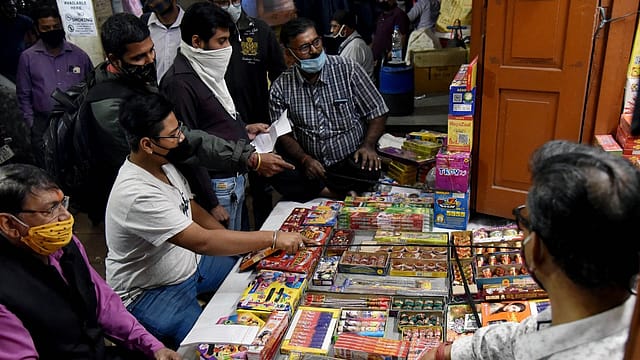
Why are green crackers in the news?
The Supreme Court on November 2, 2026, allowed certified green firecrackers in Delhi-NCR on November 7 and 8, subject to restrictions. They can be burst between 6 am and 7 am, and again between 8 pm and 10 pm, on both days. The complete ban is to return from November 9.
The permission is temporary and applies to approved products. It does not allow unrestricted fireworks throughout Diwali, which falls on November 8.
Green crackers are fireworks made with modified chemical formulations to reduce specified emissions compared with conventional crackers. Understanding what that comparison measures is essential to understanding the promise on the packet.

The Era of Forever Wars
30 Oct 2026 - Vol 05 | Issue 44
Coping with an explosive Middle East
What makes a cracker “green”?
Its formulation and measured emissions.
India’s Council of Scientific and Industrial Research, or CSIR, developed lower-emission fireworks through its laboratories, with the National Environmental Engineering Research Institute, or NEERI, coordinating the programme. The government launched these products in 2019.
NEERI’s definition includes a minimum 30% reduction in particulate matter compared with a conventional cracker of the same category. It also recognises a route involving at least 20% less particulate matter and a further reduction in gaseous emissions. Particulate matter means tiny solid particles and liquid droplets suspended in air.
The comparison concerns a particular product and its conventional equivalent. The word “green” on packaging, by itself, establishes none of this.
How do they produce less pollution?
Scientists change what burns, how efficiently it burns and how much material is used.
NEERI describes approaches including smaller shells, reduced raw materials, eliminating ash as a component and adding substances that suppress particle emissions. Different formulations achieve reductions through different mechanisms.
For example, a water-releasing formulation uses a material that releases water during combustion and helps capture particles. Another improves burning efficiency using iron oxide. A third uses zeolite-based materials to reduce aluminium use. Zeolites are materials with a porous structure.
These changes aim to retain the familiar light or sound effect while reducing the emissions generated to produce it.
Does “30% less pollution” mean Delhi’s air becomes 30% cleaner?
No. A product’s emission reduction cannot be applied directly to a city’s air quality.
The laboratory comparison asks how much less of a specified pollutant a cracker emits relative to its conventional equivalent. Delhi’s air contains pollution from numerous activities, including transport, industry and combustion. Weather and the quantity of fireworks used also influence the eventual concentration people breathe.
The Air Quality Index, or AQI, describes pollution levels in the surrounding air. It is not a percentage label attached to a firework.
More lower-emission crackers can still produce substantial pollution. A reduction per cracker does not guarantee a reduction in the total amount released.
Are green crackers harmless to breathe?
No. They still involve combustion and still release pollutants.
NEERI’s definition describes reduced emissions. It does not certify pollution-free air around the person lighting the cracker.
The World Health Organization links exposure to fine particulate matter with respiratory and cardiovascular disease. Children are particularly vulnerable to air pollution. Those risks explain why a lower-emission product can still be subject to tight restrictions.
Nor does “green” mean silent. CSIR’s programme includes sound-emitting fireworks as well as sparklers, flowerpots and spinning fireworks. A familiar shape or quieter sound does not establish certification.
Where are crackers prohibited even during the permitted hours?
The court has directed that fireworks must not be burst within 300 metres of hospitals, nursing homes, primary and district health centres, old-age homes and notified silence zones. Educational institutions are also covered by the no-cracker-zone directions. Authorities are to identify and publicise these areas.
The court has also reiterated restrictions on barium-containing crackers and prohibited joined strings of crackers, commonly called ladis or laris, under this Delhi-NCR relaxation.
Permission depends on the product, place and time together. An approved cracker does not override a no-cracker zone.
How can buyers distinguish genuine products from misleading labels?
Check the manufacturer’s registration and the seller’s authorisation, rather than relying on environmental slogans.
NEERI maintains a list of registered fireworks manufacturers. Its registration process involves manufacturing licences and approved formulations. Buyers should seek identifiable manufacturer and certification details from an authorised seller and follow the current district directions.
The government introduced green logos and QR codes in 2019 to distinguish approved products and tackle counterfeits. But a printed QR code should not be treated as conclusive proof.
The Supreme Court’s October 2025 order recorded concerns about codes reaching unregistered manufacturers. More recently, NEERI scientist R J Krupadam was quoted in an October 29 report from Kolkata saying the code mechanism had been discontinued because codes were being copied.
The practical lesson is to check the current authorised manufacturer and product information. A scan that opens an advertisement or a promotional video proves little about the contents of the box.
Does Delhi-NCR’s permission apply across India?
No. This relaxation concerns Delhi and the National Capital Region. Residents elsewhere must follow the directions applicable in their state, city or district.
Product approval and permission to use that product are separate requirements. A manufacturer’s registration cannot tell a buyer whether fireworks are allowed at a particular location or hour.
Similarly, a green-cracker certificate does not establish permission for online ordering or delivery. Those activities can be separately restricted. The Supreme Court’s 2025 Delhi-NCR order expressly restricted online sales.
What happens next?
The immediate task for authorities is to publicise permitted locations, enforce the time windows and stop conventional products being sold as green crackers.
On November 7 and 8, Delhi-NCR’s permitted bursting hours are 6–7 am and 8–10 pm. The complete ban resumes on November 9.
The scientific claim remains narrower than the marketing can suggest: a certified product emits less of specified pollutants than its conventional counterpart. How much that helps the air depends on what is actually sold, how much is burned and whether the restrictions are enforced.