The High Tide of Security in India
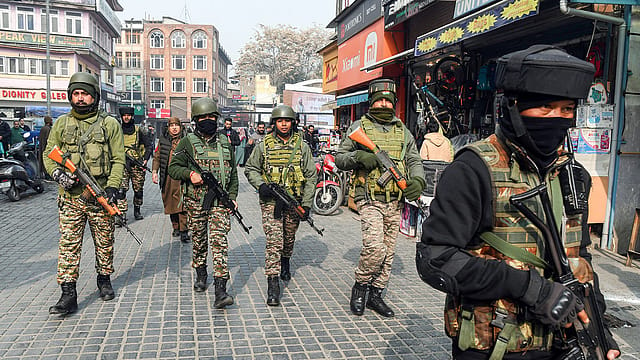
Trouble in India is never hard to find. From routine violence to separatist violence and from terrorism to anarchic tendencies, the catalogue of grim statistics has been around for a long time. But as the year ends, a positive—heart-warming—number has gone by relatively unnoticed. For the first time in the past 47 years, the Central Reserve Police Force (CRPF) has not lost a single trooper for consecutive 12 months. This is a significant statistic not just for the CRPF but for India at large. The country is less violent and more amenable to order than it has been in the past half-century.
The numbers speak for themselves. India has seen insurgencies across several states beginning within a decade of Independence. But what began in the late 1970s took violence to a different level. In the following decades it seemed as if the country was destined to remain in the league of other lawless de-colonised nation-states. The 13th of April 1978 clash between the Nirankari’s and Sikhs belonging to extremist organizations led to the death of sixteen persons. That marked the beginning of a decade of upheaval. It was not until 1991 that the peak of violence was reached. That year 497 security personnel died in the state while 2591 civilians perished. The next year, in 1979, Assam began its descent into violence against illegal migrants swamping the state. The year violence reached a peak was in 1998—nearly two decades after the start of turmoil—when seventy-two security personnel died and 531 civilians were killed. Jammu and Kashmir (J&K) witnessed the peak of violence in 2001, and matters began to cool thereafter.

The Era of Forever Wars
30 Oct 2026 - Vol 05 | Issue 44
Coping with an explosive Middle East
What these statistics do not show is how long it takes to fully restore order. The number that broadly encodes normalcy is the number of fatalities among security forces, the first line of defence after order breaks down in a state or a Union Territory. It is tough to mark the end of a cycle of political violence in analytical terms. It can be zero in one particular year. But what if some troopers die the next year due to violence? How does one distinguish between anomic violence, random incidents, and the continuation of organized political violence? A better measure is three consecutive years of zero deaths. In Punjab, that point did not arrive until 1998. Similarly, in the case of Assam, that year was 2020. It is yet to arrive in J&K and elsewhere in the Northeast.
It is instructive to note the number of years between peak number of deaths among security forces and the zero bound for three years. In Punjab that number is seven years; in Assam, it is 22 years. These numbers should alert one to the fact that even after the worst of violence ends, takes years and often decades for normalcy to return. That adage that it is easy to destroy things but difficult to build them has no better example than these cases.
In recent decades, a large number of security personnel who died was due to Maoist violence in Chhattisgarh and Jharkhand. That insurgency has been ended. This was due to political will of the Narendra Modi government and the unwavering will of security forces in a terrain that did not have any infrastructure until very recently. There are signs that the zero bound in these states has arrived even as one waits for a fuller set of data. For now, the news is good.