India Raises the AI Bar: Key Takeaways from the AI Impact Summit 2026
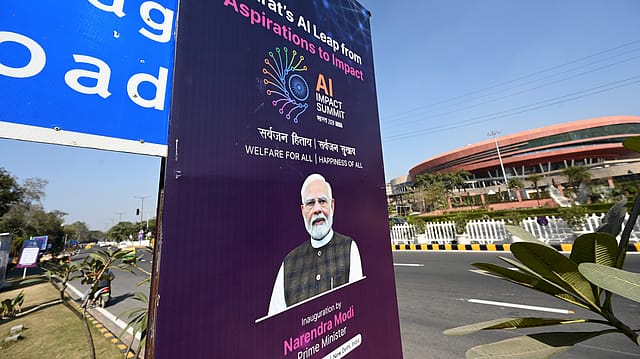
India’s biggest AI gathering just made a statement like no AI gathering in the past.
According to organisers, the event marked a decisive shift from “experimental AI” to enterprise-grade deployment. Some of the presentations grabbed eyeballs around the globe.
Here’s a round-up of moments that form the key highlights of the AI Impact Summit 2026:
What did Qualcomm bring to the AI Impact Summit 2026?
Qualcomm demonstrated a dancing humanoid robot as part of its new "physical AI" stack, powered by the Dragonwing IQ-10 processor - a chip built for robotics, edge computing, and AI-driven manufacturing and logistics automation.
What is the MANAV Vision and who announced it?
Prime Minister Narendra Modi unveiled the MANAV Vision - a national framework for ethical and inclusive AI governance. The acronym stands for Moral/Ethical, Accountable, National Sovereignty, Accessible/Inclusive, and Valid/Legitimate.

Zeroing In on ECI
09 Oct 2026 - Vol 05 | Issue 41
Constitutional legitimacy versus political opportunism
What did Tata Group and OpenAI announce?
Tata Group and OpenAI announced a partnership to develop 100 MW of AI infrastructure in India, with plans to scale to 1 GW. The initiative focuses on green-energy data centers, branded HyperVault, built for enterprise-grade AI workloads.
What is Google building in Visakhapatnam?
Google CEO Sundar Pichai announced a full-stack AI hub in Visakhapatnam, part of a reportedly $15 billion investment in India. The hub aims to develop localised, sovereign AI models designed for the Global South.
What did Mukesh Ambani announce for Jio?
Ambani announced that Jio is building gigawatt-scale sovereign compute infrastructure, with 120 MW set to go online in the second half of 2026. The strategy, framed around "super abundance," aims to deliver low-latency, affordable AI to Indians across the country. Ambani also pledged a ₹10 lakh crore investment.
What was the overarching theme of the AI Impact Summit?
According to summit organisers, the central shift was from pilots to production - AI moving into healthcare, education, and public services at scale, with infrastructure and governance catching up to ambition.
Why does Qualcomm's humanoid robot matter beyond the spectacle?
The Dragonwing IQ-10 is engineered for real-world deployment in manufacturing and logistics - making it a signal that physical AI, not just software, is entering the enterprise conversation in India.
What makes the Tata-OpenAI deal significant?
The scale - 100 MW scaling to 1 GW - places it among the largest AI infrastructure commitments announced on Indian soil, with a green-energy focus adding a sustainability dimension to raw compute ambition.
How does the MANAV framework fit into global AI governance debates?
It positions India as a proponent of human-centric, sovereign AI governance - addressing accountability and inclusivity at a time when global regulation of AI remains fragmented and contested.
What does "sovereign compute" actually mean in practice?
It refers to AI infrastructure owned, operated, and governed within national borders - reducing dependence on foreign cloud providers and ensuring data and model outputs remain under domestic jurisdiction.
(With inputs from yMedia)