Google to Build Full-Stack AI Hub in Visakhapatnam, Says Sundar Pichai at India AI Impact Summit 2026
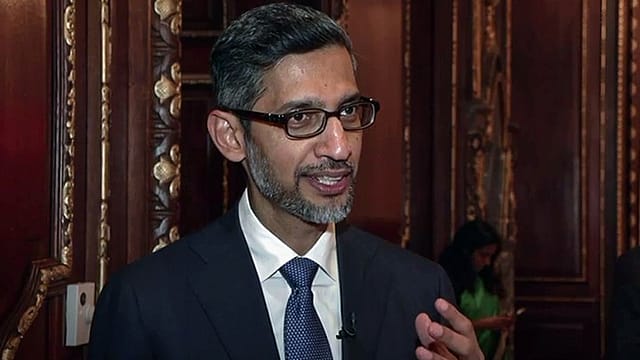
On the fourth day of the India AI Impact Summit in the national capital, leading voices from the global technology sector underscored artificial intelligence as a transformative force and highlighted India’s central role in its diffusion and deployment.
Delivering the keynote at Bharat Mandapam, Google and Alphabet CEO Sundar Pichai described artificial intelligence as a historic technological shift and outlined a major infrastructure commitment to India’s digital future.
Addressing the summit, he said that artificial intelligence shows that nothing is impossible when humanity dreams big and represents the biggest platform shift of our lifetimes.

The Modi Years
02 Oct 2026 - Vol 05 | Issue 40
A Nation Rebuilt
Pichai highlighted India’s growing role in the global AI ecosystem and the emergence of Visakhapatnam as a global AI hub.
Reflecting on the transformation of the coastal city, where Google has made a major investment, he said it is remarkable to see it evolve into a major centre for artificial intelligence as part of the company’s long-term investment in India.
What does Google’s $15 billion AI infrastructure investment mean for India’s technology ecosystem?
"Through Visakhapatnam, Vizag. I remember it being a quiet and modest coastal city brimming with potential. Now in that same city, Google is establishing a full-stack AI hub, part of our $15 billion infrastructure investment in India. When finished, this hub will house gigawatt-scale compute and a new international subsea cable gateway, bringing jobs and cutting-edge AI to people and businesses across India. Sitting on the train, I never imagined Vizag becoming a global AI hub," he said.
Addressing a distinguished audience, Pichai also reflected on his personal journey and the rapid transformation of the Indian landscape.
The CEO used this personal anecdote to draw a parallel with Google’s ambitious plans for the same city, now at the heart of the tech giant’s global AI strategy.
The planned hub is expected to provide the foundational full-stack infrastructure necessary to power next-generation AI services, reinforcing India’s position as a pivotal player in the global technology ecosystem and significantly expanding Google’s footprint in the country.
Why did Sundar Pichai call AI the biggest platform shift of our lifetimes at the India AI Impact Summit?
Emphasising the broader implications of the technology, Pichai said, "The product shows what's possible when humanity dreams big, and no technology has me dreaming bigger than AI. It is the biggest platform shift of our lifetimes. We are on the cusp of hyper-progress and new discoveries that can help emerging economies leapfrog legacy gaps. But that outcome is neither guaranteed nor automatic."
Explaining the reasons for optimism around AI, he pointed to its role in advancing scientific discovery and improving lives globally.
"Because AI can improve billions of lives and solve some of the hardest problems in science. For 50 years, predicting protein structures was a grand challenge and a blind spot that stalled drug discovery. Demis Hassabis and his team at Google DeepMind asked an audacious question: how could we use AI to solve this? That question led to AlphaFold," he said.
"This breakthrough, that just win a Nobel Prize, it compressed decades of research into a database that is now open to the world. Today, over 3 million researchers in more than 190 countries are using it to develop malaria vaccines, fight antibiotic resistance, and much more," he added.
Pichai further stated that AI is being applied across the scientific ecosystem. "And we are asking similarly bold questions across the scientific stack, from cataloging DNA disease markers to building AI agents that act as true partners in the scientific method. We must be equally bold in tackling problems in regions that have lacked access to technology," he added.
He stressed that artificial intelligence has the potential to drive innovation, create opportunities and help address global challenges, while underscoring the need for responsible and inclusive development so that its benefits reach everyone.
The summit, hosted from February 16 to 20, is a landmark global convening aimed at shaping the future of inclusive, responsible and resilient artificial intelligence.
It brings together nations and international institutions to utilise AI to address global challenges and unlock new opportunities for shared growth.
The five-day event is anchored in three foundational pillars or Sutras: People, Planet and Progress, themes that have remained at the forefront since the Prime Minister inaugurated the India AI Impact Expo 2026 at Bharat Mandapam in New Delhi.
(With inputs from ANI)