India Has No Fuel Shortage Despite West Asia Crisis, Hardeep Singh Puri Tells Lok Sabha
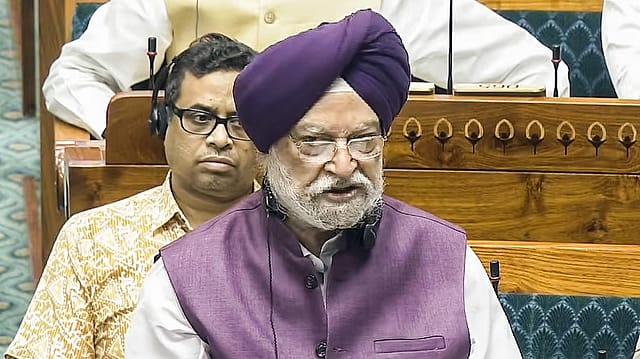
As tensions in West Asia disrupt one of the world’s most critical energy corridors, the Indian government has moved quickly to reassure citizens and industry that the country’s fuel security remains intact. Speaking in the Lok Sabha, Union Petroleum and Natural Gas Minister Hardeep Singh Puri said India has sufficient fuel and gas supplies to withstand even a prolonged regional conflict.
The minister outlined how diversified sourcing, domestic production and emergency allocation policies are helping India cushion the impact of disruptions around the strategic Strait of Hormuz, through which a major share of global energy normally flows.
What did the government say about India’s fuel supply?
Addressing Parliament amid protests from Opposition members, Puri said India’s energy system remains stable despite the global shock triggered by the West Asia conflict.

The Health and Wellness Issue
25 Sep 2026 - Vol 05 | Issue 39
"India has sufficient gas production and supply arrangements to sustain this position even in the event of a prolonged conflict. Power generation for every household and for industry is fully protected," Hardeep Singh Puri said.
The minister emphasised that India’s refineries are operating at high capacity utilisation and that supplies of key petroleum products remain steady across the country.
"There is no shortage of petrol, diesel, kerosene, ATF or fuel oil. The availability of petrol, diesel, aviation turbine fuel, kerosene, and fuel oil is fully assured," he told the House.
Why is the Strait of Hormuz disruption significant?
The ongoing conflict has effectively shut commercial traffic through the Strait of Hormuz, a maritime chokepoint that normally handles around 20 percent of global crude oil, natural gas and LPG shipments.
For India, the disruption carries particular importance because a large share of the country’s energy imports typically passes through the corridor.
Puri acknowledged that about 45 per cent of India’s crude imports earlier transited the route but stressed that diversification efforts have sharply reduced the country’s dependence on it.
"Non-Hormuz sourcing has risen to approximately 70 per cent of crude imports, up from 55 per cent before the conflict began".
He also highlighted a longer-term shift in sourcing patterns. India now imports crude from around 40 countries, compared with 27 suppliers in 2006-07, making the energy system more resilient during global disruptions.
How is the government managing natural gas supplies?
The government has activated an emergency allocation framework under the Natural Gas Control Order issued on March 9 to manage the supply of natural gas across sectors.
The move followed a force majeure declaration at a major Qatari facility affecting 30 MMSCMD of imports, although domestic production continues at around 90 MMSCMD.
"Domestic piped gas to homes and CNG for vehicles receive 100 per cent supply with no cuts. Industrial and manufacturing consumers will receive up to 80 per cent of their previous six-month average. Fertiliser plants will receive up to 70 per cent, protecting the agricultural input chain ahead of the sowing season. Refineries and petrochemical units absorb a managed reduction, with that gas redirected to higher-priority sectors. I am pleased to inform the House that the shortfall has been substantially offset through alternative procurement," Puri said.
What steps are being taken to protect LPG supply?
The government has also taken measures to safeguard cooking gas supplies for nearly 33 crore households across the country.
Domestic LPG production has been increased by 28 percent over the past five days following directives issued to refineries. To prevent panic buying and hoarding, authorities have introduced a 25-day minimum gap between LPG bookings in urban areas.
In addition, the Delivery Authentication Code system has been expanded to cover around 90 percent of consumers, strengthening monitoring and supply efficiency.
Puri sought to reassure consumers that deliveries remain on schedule.
"Domestic supply is fully protected, and the delivery cycle is unchanged. The standard time from booking to delivery for domestic LPG cylinders remains 2.5 days, unchanged from pre-crisis norms."
What alternative fuel measures has the government introduced?
To reduce pressure on gas supplies, the government has activated alternative fuel options across multiple sectors.
Kerosene has been made available through the public distribution system, while temporary regulatory relaxations allow businesses to use other fuels during the crisis.
The Ministry of Environment, Forest and Climate Change has "advised State Pollution Control Boards to permit, for the duration of this crisis period, the use of biomass, RDF pellets, and Kerosene/coal as alternate fuels for the hospitality and restaurant segment for 1 month, which would enable a wider range of establishments to switch and free up LPG for priority consumers," Puri said.
(With inputs from ANI)