Ashwini Vaishnaw Highlights Multilingual AI and Data Centre Push at Impact Summit
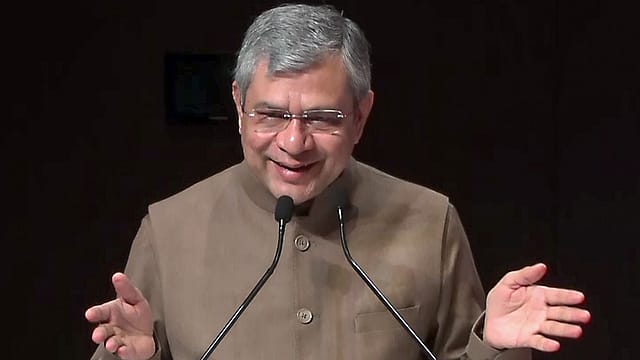
The AI-India Impact Summit on Thursday witnessed the welcome of high profile heads of state by Prime Minister Narendra Modi, as Union Minister Ashwini Vaishnaw outlined India’s comprehensive five-layer artificial intelligence strategy at the first global AI Summit hosted in the country, describing it as the “biggest AI summit so far” with participation from 118 countries.
"Welcome to the first AI summit in the global south and the biggest AI summit so far. We have participation from 118 countries. Thank you all for making this summit a grand success...PM Narendra Modi believes that the true value of technology lies in ensuring that its benefits reach the masses. Our Prime Minister's vision is to democratize technology, deploy it at scale, make it accessible to all," Vaishnaw said.

The Modi Years
02 Oct 2026 - Vol 05 | Issue 40
A Nation Rebuilt
Addressing heads of state, delegates, industry leaders, students and members of the media, the minister said artificial intelligence is a foundational technology already transforming how people work, learn and make decisions.
He explained that the third layer is compute infrastructure, while the fourth layer is infrastructure and the fifth and final layer is energy, underscoring India’s commitment to clean power.
How does India’s AI Impact Summit vision link clean energy and compute infrastructure?
Vaishnaw stated that more than 50 per cent of the country’s installed power generation capacity now comes from renewable and clean energy sources.
Referring to a recent policy announcement during the Union Budget, he said India aims to attract global data to be processed within the country, delivering high value digital services worldwide, and expressed optimism about significant investments in data centres in the coming months.
The minister also highlighted India’s vision of placing compute as a tool for doing good for its citizens.
"We treat compute as a public good. In a public-private partnership, we have created a common compute platform where we are providing access to 38,000 GPUs at a very affordable rate for our startups, academia, researchers and students. We will be adding another 20,000 GPUs to this common compute platform," Vasihnaw said.
What are the New Delhi Frontier AI Commitments announced at the AI Impact Summit?
Vaishnaw further announced a major outcome of the summit, unveiling the “New Delhi Frontier AI Commitments” as a shared voluntary framework adopted by leading global and Indian AI companies.
Calling it a “significant outcome” of the summit, Vaishnaw said, "Today, leading frontier AI companies along with our own AI companies have come together to make a set of voluntary commitments - a shared commitment for inclusive and shared AI."
He outlined two key commitments under the initiative. "The first is advancing real-world AI usage through anonymised and aggregated insights," the minister said, adding that this would "support evidence-based policymaking on jobs, skills and policy making."
According to Vaishnaw, the effort will help governments and institutions better understand employment trends and skill requirements while maintaining privacy safeguards.
"The second is strengthening multilingual and use-case evaluations," he said, emphasising the need to ensure that AI systems function effectively across languages and cultures.
"This is especially important for the Global South, to ensure that AI works effectively across languages and cultures," he added.
Vaishnaw said the commitments represent a collaborative step towards responsible AI development. "Together these efforts mark an important step towards shaping AI that is not only powerful, but also inclusive, development-oriented and globally relevant," he stated.
(With inputs from ANI)