'India is playing a whole new game': PM Modi Uses Grand Theft Auto (GTA) Imagery to Take a Dig at UPA
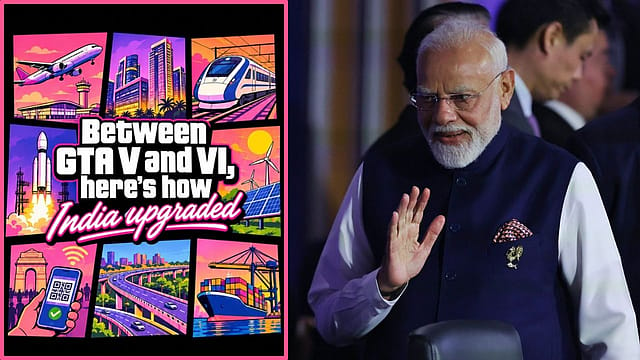
The comparison draws on the gap between the release of Grand Theft Auto V in September 2013 and Grand Theft Auto VI on November 19, 2026. GTA V arrived several months before Modi became Prime Minister in May 2014. The Prime Minister used the two release dates as a marker to contrast the country's development indicators before his government took office with the latest figures.
In his post on X, PM Modi wrote: “India is playing a whole new game!”
The accompanying graphic compared nine areas, presenting 2013 figures alongside the numbers cited by the government for 2026. The post framed the changes as evidence of India's transformation over the past 11 years.

The Wealth Issue 2026
06 Nov 2026 - Vol 05 | Issue 45
Portraits of Dreamers and Doers under 35
FROM 'FRAGILE FIVE' TO FAST-GROWING ECONOMY
On the economic front, the graphic contrasted India's position among the so-called 'Fragile Five' economies in 2013 with its current status as the world's fastest-growing major economy.

The Prime Minister also cited a decline in extreme poverty from 27 per cent to 2.6 per cent. On sanitation, the graphic said coverage had increased from 39 per cent to 100 per cent following the launch of the Swachh Bharat Abhiyan.
The figures were presented as part of the government's broader argument that its development programmes have expanded access to basic services and improved India's economic standing.
SOLAR POWER AND SPACE STARTUPS
Renewable energy was another focus of the comparison. The graphic said India's solar power capacity had risen from 2.82 GW in 2013 to 175 GW in 2026.
In the space sector, PM Modi highlighted the growth in startups, saying their number had increased from one to 440. The comparison reflects the expansion of India's private space industry since the opening up of the sector to private participation.
RAILWAYS, INTERNET AND DEFENCE
On railway infrastructure, the graphic highlighted an increase in railway electrification from 20 per cent to 99.6 per cent. It also pointed to the sharp fall in mobile internet costs, with the price of one GB of data declining from Rs 308 during the 3G era to Rs 7.51 in the 5G era.
On defence, the Prime Minister contrasted India's earlier position as a major arms importer with its emergence as an exporter of military equipment to more than 80 countries. The graphic also featured the BrahMos missile as an example of India's defence manufacturing capabilities.
The post also claimed that the number of districts affected by Naxal violence had fallen from 182 to zero, presenting it as a major change in the country's internal security situation.
GDP GROWTH REMAINS A KEY CLAIM
The comparison comes as the government continues to highlight India's economic performance. According to data released by the Ministry of Statistics and Programme Implementation, India's real Gross Domestic Product (GDP) grew by 7.8 per cent in the first quarter of the financial year 2026-27. Real Gross Value Added (GVA) grew by 8.2 per cent during the same period.
The government attributed the growth to household consumption, investment and exports. The Prime Minister has previously described the 7.8 per cent growth figure as a reflection of India's economic resilience amid global uncertainty.
Through the GTA comparison, PM Modi has sought to frame the period since 2014 as one of significant change across the economy, infrastructure, digital connectivity, renewable energy, space technology and national security.
With inputs from ANI