EXPLAINED | Who Protects a Cheetah When It Leaves Kuno?
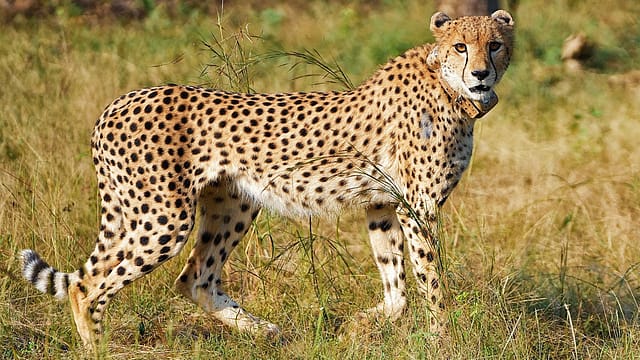
What happened to the cub that left Kuno?
The X-ray showed foreign objects inside the young cheetah. A CT scan revealed damage to its internal organs, musculoskeletal system and nervous system. During emergency surgery, veterinarians recovered five firearm pellets.
The 19-month-old male, identified as KNG22, could not be saved.
Born to Nirva, one of the South African cheetahs brought to India, it was found injured outside Kuno National Park on October 25. The official statement identifies the rescue location as Compartment No. 748 of the Sheopur Territorial Forest Division. Earlier accounts placed it in the adjoining Morena forest landscape.
It was taken to Kuno and subsequently moved to the veterinary university in Jabalpur for advanced treatment. According to the latest reports, the state government has constituted a Special Task Force comprising forest and police officers to investigate.
The pellets provide evidence of a shooting. Who fired, which weapon was used and what led to the incident remain questions for investigators.

Look Who's Talking Regime Change
23 Oct 2026 - Vol 05 | Issue 43
WHY DOES THIS DEATH RAISE A BIGGER QUESTION?
Project Cheetah depends on animals eventually establishing themselves in the wild. That involves movement across a landscape whose administrative boundaries mean little to a hunting cat.
KNG22’s death exposes the difficulty of protecting that movement. A cheetah can leave the national park and enter forests administered by another division, or approach land used by people and livestock.
The immediate investigation concerns a shooting. The wider conservation question concerns the protection available along the animal’s route.
A growing population will require arrangements that work wherever the animals travel.
WAS THE YOUNG CHEETAH TOO YOUNG TO BE ROAMING?
Its age makes independent movement biologically plausible.
According to the Smithsonian’s National Zoo, cheetahs typically separate from their mothers at around 18 months. Siblings may remain together for several more months. Research on wild cheetahs also documents young males dispersing considerable distances from their birth ranges.
At 19 months, KNG22 was around that transition.
This does not establish its precise movements or behaviour before it was injured. Investigators still need to reconstruct those events. It does explain why a young cheetah moving beyond its mother’s range should be anticipated in a reintroduction programme.
DOESN’T A RADIO COLLAR KEEP AN ANIMAL SAFE?
A collar helps monitoring teams locate an animal and follow its movements. Protection also requires staff who can reach it, assess the situation and coordinate with colleagues responsible for the area. KNG22 was reportedly radio-collared and this highlights the challenge of monitoring animals across forest divisions.
The practical questions now include when its condition was detected, what teams knew about its location and whether there had been warning signs of danger.
A collar’s location data may help reconstruct the sequence. Establishing whether there were preventable gaps requires the investigation.
WAS THIS RETALIATION FOR A LIVESTOCK ATTACK?
That has not been established.
Reports have raised possible livestock conflict and other explanations for the shooting. None should be presented as the confirmed motive.
There is a wider reason to examine the issue carefully. The IUCN Cat Specialist Group identifies actual or perceived livestock predation as a conservation problem across much of the cheetah’s range. People’s fear of losing animals can itself create hostility.
That general risk cannot establish who injured KNG22 or why. Nor does the presence of pellets, by itself, prove an organised poaching operation.
The investigation must distinguish among the possibilities using evidence.
WAS CONFLICT WITH PEOPLE PART OF THE ORIGINAL PLAN?
Yes. Community support was an explicit objective.
The government’s 2022 action-plan summary called for conflict involving cheetahs and other wildlife to be addressed promptly through compensation, awareness and management measures.
KNG22’s death makes the implementation of those commitments a central question.
Can residents quickly report a cheetah near their homes or livestock? Can response teams arrive before a confrontation develops? If livestock is lost, is the claim assessed promptly and compensation delivered reliably?
These are practical measures through which conservation earns local cooperation. The shooting does not establish that any particular measure failed here. It makes their performance worth examining.
HOW MUCH HAS PROJECT CHEETAH ACHIEVED?
India began the reintroduction in September 2022 with eight cheetahs from Namibia. Twelve followed from South Africa in February 2023, with another nine arriving from Botswana in February 2026.
The four-year status review recorded 52 surviving cheetahs, including 32 born in India. Of the 49 then at Kuno, 17 were in the wild and 32 were in soft-release enclosures.
Those figures document breeding and survival. They also show why the total population requires context: animals in enclosures and animals ranging freely face different conditions.
Following KNG22’s death, the forest department reported 58 cheetahs nationally: 52 at Kuno, four at Gandhi Sagar Wildlife Sanctuary and two at Veerangana Durgavati Tiger Reserve.
DOES ONE DEATH MEAN THE PROJECT HAS FAILED?
One incident cannot settle the outcome of a long-term reintroduction programme.
Breeding, survival into adulthood and the establishment of India-born animals are meaningful developments. A firearm death nevertheless introduces an urgent threat that a population total cannot explain away.
The programme’s performance must be assessed over time: how many animals survive, reproduce and establish themselves in the wild, and how effectively managers address the causes of death.
KNG22’s death warrants accountability for this incident and scrutiny of protection across the wider landscape.
WHAT MUST THE INVESTIGATION ESTABLISH?
The STF must reconstruct where and when the shooting occurred, identify the weapon and determine who was responsible.
Forensic examination of the recovered pellets may help. Reports have mentioned a traditional muzzle-loading bharmar firearm, but the weapon has not been conclusively identified in the material available.
Investigators should also examine the animal’s movements and the monitoring response. Those findings could reveal whether changes are needed in coordination, field protection or engagement with nearby settlements.
Project Cheetah will produce more young animals ready to explore beyond their mothers’ ranges. Their movement is foreseeable. Their protection must be planned across the routes they are likely to take.
With inputs from agencies