Fishing in Troubled Waters
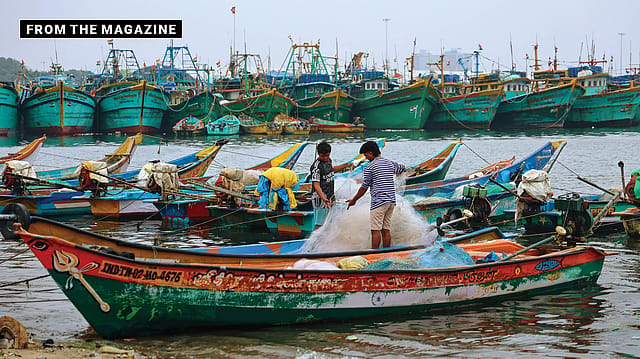
The hour is dusk, a watery one, when four men on a small but noisy boat arrive by the long coast of the Bay of Bengal in southern Chennai. With the slanting rays of the setting sun in their eyes, the men squint as they tackle the last set of waves, the stern of the boat rising and falling with the tide. Once the diesel engine is killed, a silence falls across the beach and all four leap into the shallow water, their lungis fastened high above their knees, dragging the boat by its bow ashore.
Within the belly of the boat lies a large tangle of nets, this nylon cage carrying their haul of fish—silver bodies glinting in the last rays of sunlight, some of their tailfins still thrashing. The oldest of the fishermen, Vijayakumar, observes their evening catch as the net is tactfully carried to a nearby hut that doubles as a depot, his head already deliberating with swift calculations. “Nethili (anchovy), mainly,” he tells the others and shrugs. “Paakkalaam (we’ll see).”
On a blue tarp, they segregate the fish by kind. There is plenty of nethili, of course, but also ailai, or Indian mackerel, kavalai, sardines, and a decent amount of karapodi, the flat-bodied ponyfish. These heaps are of the smaller fish, but Vijayakumar’s net has also caught some big ones, amongst them vanjaram, or seer fish, and koduva, sea bass. “Vanjaram is in demand,” the 65-year-old tells me. “Their long bodies will fetch us a good price at the market.”
A fraction of the catch is kept aside for the fishermen to take home to their families. “Ailai is best for meen kuzhambu (fish curry),” says Sankar, one of the younger fishermen. The rest is packed into an ice-box for sale. Before the men head out to the nearby Injambakkam Fish Market, they surround their boat and offer a prayer. Vijayakumar leads the way. “Goddess Gowri Amman, thank you for this haul. With your blessings, we will get a richer haul tomorrow, enough to feed our families and even sell at Kasimedu harbour.”
Kasimedu, located in the north of the city, is Chennai’s fishing nerve centre, a sprawling wholesale market where the seafood trade converges every morning. This is where anyone with a boat brings in their catch, while wholesalers, suppliers, restaurant buyers and fish vendors descend in numbers, jostling for the day’s best haul. For anyone in Chennai’s fish trade, it is the one-stop shop.
“In Kasimedu, they have an auction every dawn, for which people like us line up with our catch by midnight,” says Vijayakumar. “But we can only go there if our haul is large enough. Otherwise we cannot compete with those big boats that you can see in the distance.”
All across the far end of the bay are bright white lights of large fishing trawlers, dotting the dark horizon in an equidistant fashion. These trawlers are the big players in this trade. Powered by heavy engines and equipped with enormous nets that sweep the seabed, they can haul in several tonnes of fish in a single outing. Small-boat fishermen such as Vijayakumar, with their limited range, modest equipment and meagre catches, simply cannot compete. They are left fishing the same shallow waters with fewer fish to bring home and little bargaining power when they reach the shore.
“Those trawlers go up and down round the clock, swallowing up more fish than necessary. Several species have gone extinct because their greed doesn’t care for environmental factors such as breeding season,” he says. “A single trawler, in one outing, can earn in lakhs worth of fish. Do you know how much our haul today was worth?”
He smiles sadly. “About Rs. 3,000,” Vijayakumar says. “I’ll know the exact amount once I get to the market, but my guess is Rs. 3,000. Now, once we account for the diesel cost, say about Rs. 500, we are left with Rs. 2,500, split four ways. So, each of us on the boat made Rs. 600.”

Vijayakumar’s predicament is not unique to Injambakkam. Along Tamil Nadu’s 1,076-km coastline, one of the longest in the country, fishing supports a vast population of coastal communities. Yet the catch is far from evenly distributed. Estimates cited by fisheries researchers suggest that mechanised trawlers account for around 70 per cent of the fish caught at sea, leaving the remaining 30 per cent to smaller boats. This imbalance is even more striking when employment is considered: mechanised boats provide work for only around 20 per cent of fishermen, while the rest depend on smaller craft for a living.
“Less than a decade ago, I used to come back with seela (barracuda) and paarai (trevally) from less than half-a-kilometre into the sea,” says Selvan, a 50-year-old fisherman I met at the makeshift depot. “Today, I have to travel at least 10 to 15km away from shallow waters searching for them. The cost of fuel for such a trip is enormous, especially when we return without a substantial catch. But that is our plight. These trawlers have put us at a great disadvantage.”
This disadvantage begins with the boats themselves. Trawlers are built around volume. And power. They can remain at sea for days, sometimes weeks, returning with a hold full of catch. A single trip can consume around 2,000 litres of diesel, but the quantities of fish it brings back can make the expense worthwhile. A small fishing boat such as Vijayakumar’s has neither the range nor the storage capacity to stay out for extended periods. His boat, named Sri Gowri Amman Thunai (Gowri Amman is our refuge), printed in red Tamil font below the bow, must return to shore more frequently, often with considerably smaller catches.
The two kinds of fishing also compete for the same waters. Bottom trawling is usually carried out in relatively shallow waters, often at depths of less than 60 or 100m, where much of marine life is concentrated. This stretch forms part of the continental shelf, the gently sloping landmass that continues beneath the sea. Dragging heavy nets across its seabed can damage marine habitats, while the nets themselves capture juvenile fish and species never intended to be caught.
Or as V Vivekanandan, secretary of the Fisheries Management Resource Centre, once put it in an interview, one cannot bottomtrawl at a depth of one kilometre—it will have to be done at less than 100m, for that is the most productive zone.
Thus, for smaller fishermen, the consequences are felt both at sea and on shore. Trawlers can bring back enormous quantities of fish, increasing the supply available to buyers and influencing prices at the market. Small boats, meanwhile, have little control over the quantity or quality of their catch. Fish entangled in nets can be bruised or damaged, reducing their shelf life and the price they command. A fisherman returning with a modest haul must compete with boats carrying several times as much, often with little bargaining power of his own. “You know, unless we bring in something exotic, like sharks, eels or stingrays, no one really cares about us at the auction,” says Selvan. “We could bring in vanjaram, but so have the trawlers, in great quantities. So, unless we drop our prices our catch doesn’t really count for much.”
The solution for these small-scale fishermen isn’t simply to acquire a motor and a bigger net. Mechanisation brings its own expenses, from diesel and equipment to loans that must be repaid regardless of how much fish a boat brings home. Those who cannot afford to upgrade risk being left behind; those who do take on the financial burden of keeping their boats running.
Even the fish that eventually make it ashore have a journey ahead of them. Their eventual price will depend not only on what has been caught but on who buys it, who sells it and how many hands it passes through before reaching a consumer. Vijayakumar’s haul of small fish, and the bigger ones, sell for a total of Rs. 2,700 at the Injambakkam Fish Market. They are bought in bulk by Sarala, a 46-year-old woman who has worked in this fish market for over 15 years. She sits cross-legged in front of a large spread of fish, placed on low-lying stone counters. “Most of what you see here is not sourced from the local fisherfolk,” Sarala says. “We too go to the auction in Kasimedu which is 30km away, often as early as 1AM, to have enough fresh produce to sell to our customers.”
Sarala is distracted by a buyer who informs her that he needs koduva for a fine-dining restaurant, located on the nearby VGP beach. This seems to be an emergency run. “We ran out of sea bass, so I came here because it is the closest,” says the man. “Our vendors usually deliver our fish daily from the Kovalam fish market. We also have frozen basa fish that we import from Vietnam. But when we are low on stock, this is where I am sent on short notice.”Asked if he cares where and how the fish was caught, he shrugs. “No, not really,” he says. “Fish is fish.”
The following dawn I meet Vijayakumar at our rendezvous point at the fishing hamlet hemming Injambakkam Beach. He had invited me to join him on his boat for a fishing trip. But Sri Gowri Amman Thunai is resting on its sandy dock among a row of all the other boats. Vijayakumar is all alone, tightening the pellet-like weights of the net. “There is a cyclone warning,” he says. “No boat is allowed into the sea, government orders.”
Vijayakumar informs me that it will be at least a couple of days before Cyclone Akvan makes landfall and passes, bringing his livelihood to a standstill—just as Cyclone Arnab and Cyclone Murasu had in the previous weeks. “There is nothing we can do about it, the winds are too dangerous for our little boats,” he says. “But I must continue to fish, even without a boat.”
When an individual trip becomes too uncertain, such as during Tamil Nadu’s cyclone season, Vijayakumar switches over to a process called karaivalai, a traditional form of shore-seine fishing. Soon joined by a yawning Sankar, they spread the large dragnet close to the waterline, the pair holding either end and slowly hauling it towards the beach. It is a labour-heavy process and the catch is often meagre, but an hour later, as the first rays of the rising sun splinters through the grey skies, they have fish to sell. And eat.
“At least it saves us on diesel,” says Vijayakumar. “And our families won’t go hungry today.”