PM Modi Says Parliament Mocked His Toilet Pledge, Cites World Bank Report on 50 Crore Indians Escaping Poverty
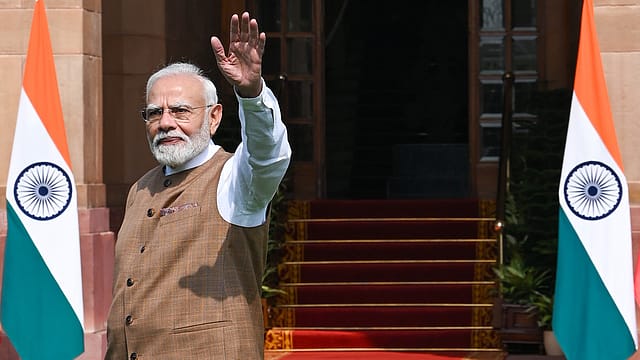
When Prime Minister Narendra Modi announced from the Red Fort that he would build toilets for the poor, one question followed him to Parliament. “What kind of Prime Minister is this? He’s talking about building toilets,” Modi recalled critics asking. Speaking at IIT Kharagpur on Saturday, he said the remark revealed how little attention policymakers had paid to what access to a toilet meant for poor women and their families.
Modi returned to that exchange during the institute’s platinum jubilee celebrations in West Bengal, where he cited a recent World Bank report that, he said, found 50 crore Indians had moved out of poverty in 12 to 13 years. For decades, he told students and alumni, India’s population had served as a ready explanation for why poverty would endure. He said his government had spent the past 12 years challenging that assumption.

The Wealth Issue 2026
06 Nov 2026 - Vol 05 | Issue 45
Portraits of Dreamers and Doers under 35
What the debate over toilets missed
Modi drew a distinction between two announcements from the same place. Five decades ago, he said, the Red Fort had been the setting for slogans about eradicating poverty. Years later, when he used it to announce a specific measure for poor households, the choice of subject itself drew ridicule.
“Such people failed to grasp how essential a toilet is, how critical it is for the poor, and especially for poor women and mothers,” he said.
Modi argued that the earlier promises had foundered when officials had to turn them into policy. As recently as 20 years ago, he said, poverty was widely regarded as a permanent feature of Indian life. Governments could promise to eradicate it, but decisions that might improve the lives of poor families rarely made it out of official files.
“Yet, whenever it came to taking action at the policy level, the entire system would simply bury the matter in files. This was because the prevailing mindset was that poverty could never be eradicated, especially given the size of our population,” he said.
Modi described his own guiding principle as “Power to Empower” and cited the World Bank figures as evidence of how much could change within a generation. “The World Bank has stated that in just 12 to 13 years, 50 crore people in India have been lifted out of poverty,” he told the gathering.
A date for IIT Kharagpur’s next ambition
For the students and alumni in the audience, Modi set a deadline tied to their own institution. IIT Kharagpur had turned 75. By the time it turned 100, he said, its graduates should be able to celebrate that anniversary in a developed India.
“You have done outstanding work over the past 75 years. Now you must move forward with the firm resolve that when IIT Kharagpur celebrates its 100th anniversary, it should do so in a developed India,” he said.
Urging graduates to adopt what he called a “Nation First” approach, Modi pointed to an alumnus who had already helped open up a field for other young Indians. Pawan Kumar Chandana co-founded Skyroot Aerospace, the company that developed and launched India’s first privately built rocket.
Modi credited the opening of the space sector to private players with giving young engineers a chance to build companies of their own. Chandana’s achievement, he told the gathering, was one example of former IIT Kharagpur students helping India do things once considered beyond its reach. Other startups were now contributing to the space programme alongside Skyroot.
The chipmaker Modi says India turned away
Semiconductors offered Modi a different example. About 50 years ago, he said, a company had approached India with a proposal to manufacture semiconductors here. It was turned away. Decades later, when he proposed a national semiconductor mission, he recalled hearing that India had already missed its chance.
“So, when I spoke about launching the Semiconductor Mission, people said it was already too late. We went ahead and initiated the mission, and today, India has begun exporting chips,” he said.
Modi used the episode to explain what he meant by “limiting beliefs”. An individual might decide in advance that a particular ambition lay beyond their abilities, he said. A country could make much the same mistake in deciding which industries it could build or which problems it could solve.
“We have come to accept the boundaries of our own thinking as the boundaries of our world. A nation, too, recognises its true potential only when it breaks through the limits of its own thinking,” he said.
Earlier at the celebrations, Modi unveiled a commemorative coin marking 75 years of IIT Kharagpur. His challenge to students concerned the 25 years still to come, and what their own work could contribute by the time the institute marked its next milestone.
With inputs from ANI