The Demographic Sweep
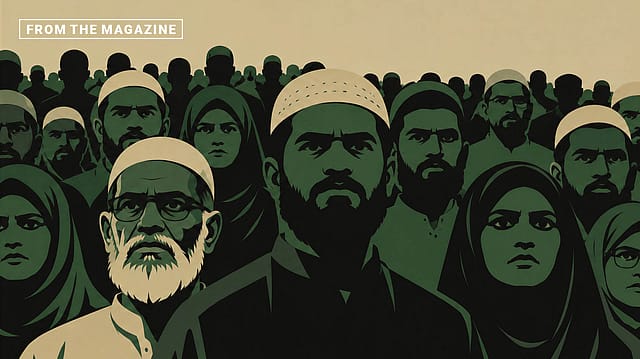
By 2070, Islam will become the dominant religion in the world by the number of adherents. The number of Muslims is forecast to grow rapidly on every continent except the Latin American-Caribbean countries, according to a new report on the world’s religious population by the Pew Research Center, released on November 18.
India will host the world’s second-largest Muslim population in 2070, up from its current third position. The country’s Muslim population is expected to increase by 120.56 million from the current (2020) figure of 213.06 million. The Hindu population will go up by an estimated 176 million. In that year, Hindus are estimated to constitute 75.8 per cent of India’s population, down 3.6 percentage points from the current 79.4 per cent. Muslims, in contrast, will make up 19.6 per cent, up 4.4 percentage points from the current 15.2 per cent.
“While India’s overall fertility rate has fallen rapidly in recent decades, Muslims in India still have more children per woman than Hindus do. Given this fertility gap and Muslims’ younger age profile, Hindus are projected to decline as a portion of the Indian population, while Muslims are expected to rise,” the report says in its section on the Hindu population.
The Pew report deals with population projections based on well-known methodologies. It does not consider migration trends across countries. That is one reason its counts may be conservative for countries like India and some in Europe, where immigration—legal and illegal—has been a major driver of changes in the composition of populations.
At the global level, the report says Muslims tend to have more children than other major religious groups. During 2020-25, the total fertility rate for Muslims was 3.1 children per woman, compared with 2.0 for non-Muslims. The other factor at work is the relative youthfulness of the Muslim population. In 2020, 33 per cent of the global Muslim population was in the 0-14 age group and another 51 per cent in the 15-49 bracket, the youngest profile among all world religions. The report says: “Muslims’ relative youth is an advantage for growth, since a large portion of their population is in or near their prime childbearing years.”
In India there is another factor at work in the rapid increase in the number of Muslims: illegal immigration from neighbouring countries, Bangladesh in particular. That has distorted the demographic structure and profile of states like West Bengal and Assam, among others, beyond recognition. By 2070, Bangladesh’s Muslim population will stand at 218.16 million, up from 151.44 million in 2020. The problem for Bangladesh—and, in turn, for India—is that it has a rising population on a small piece of land, giving it one of the worst land-to-man ratios in the world. That makes it natural for its people to ‘escape’ somewhere else, a situation India’s eastern and northeastern states know very well. To top it all, Bangladesh is no longer the rising star of Western commentators, who once never lost a chance to point out that its per capita income was rising much faster than India’s. Even if Bangladesh were to grow rapidly, it would not be able to take care of its people. At one time, India’s preferred solution to that risk was tighter economic integration between the two countries, which would have ensured shared prosperity and reduced the pressure to migrate to India. Unfortunately, even at the best of times that idea was more imagined than real. Now it is well beyond its expiry date. A radicalised population is least likely to be a productive asset, and Bangladesh’s leaders know that. Muhammad Yunus, lately Chief Adviser to the interim government of that country, hinted more than once that India’s northeastern states belonged to Bangladesh.
India will host the world’s second-largest Muslim population in 2070. Its Muslim population is expected to increase by 120.56 million from the current 213.06 million. The Hindu population will go up by 176 million
The danger from a rising Muslim population of foreign origin—largely Bangladeshi—has not been lost on India’s security planners. At some point, the number of illegal immigrants will overwhelm the indigenous residents of Indian states in that region. The mechanism is not hard to discern. Earlier, it worked through illegal immigrants acquiring Indian citizenship and then becoming a powerful political bloc in these states. That danger has been averted, for now, even if it has not fully dissipated.
Risks such as these are no longer brushed away. A high-level committee to study demographic changes arising from illegal immigration and other abnormal reasons, and to suggest measures to deal with them, was constituted in May this year. It is expected to make its recommendations sometime next year.
The problem for India is that Bangladesh is highly unlikely to admit that its citizens have illegally migrated to India. Some rearguard action, such as providing political and economic safeguards to the indigenous people of India’s imperilled states, is necessary now. The demographic changes that India is experiencing are therefore a mix of factors. No doubt, the fertility rate of India’s Muslim population is higher, and that contributes to its faster increase. But illegal immigration is an equally important factor, if not a bigger one.
Some of these changes will become clear when the results of the much-delayed Census start trickling in a couple of years from now. India is a large country in every way, in terms of size as well as population. A country with so large a population could count itself blessed in economic terms. A market of that size is something most countries would envy. But the trouble with this large population is its composition. If a substantial fraction of that population is of foreign origin and belongs to a different religion, the risk of conflict is relatively higher than any advantage conferred by the size of the population. India needs to pay heed to these risks, now.