Budget 2026: Tax Relief for Accident Victims, Lower TCS on Foreign Travel and Education
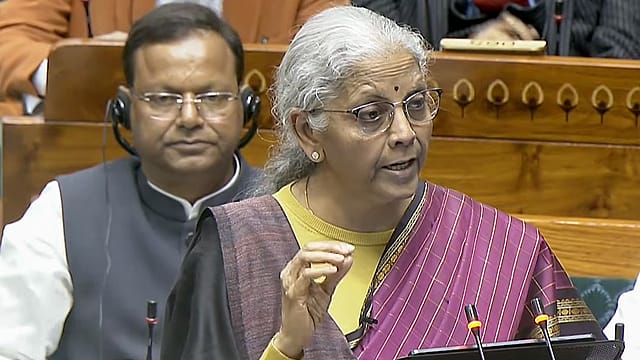
Union Finance Minister Nirmala Sitharaman on Sunday announced a clutch of tax relief and compliance-simplification measures in the Union Budget 2026–27, aimed at easing the burden on individuals while making the income-tax system more citizen-friendly.
Presenting the Budget in Parliament, Sitharaman said the government’s focus is on simplification, clarity and ease of living for taxpayers. One of the most significant reliefs is the full income-tax exemption on interest awarded by the Motor Accident Claims Tribunal (MACT) to natural persons.
“Any interest awarded by the Motor Accident Claims Tribunal to a natural person will be exempt from income tax, and any TDS from this account will be done away with,” the Finance Minister said. The move ensures that compensation meant for accident victims and their families is not eroded by tax deductions.

Zeroing In on ECI
09 Oct 2026 - Vol 05 | Issue 41
Constitutional legitimacy versus political opportunism
The Budget also announced a sharp cut in Tax Collection at Source (TCS) on overseas spending. The TCS rate on foreign tour packages will be reduced to 2%, down from the existing 5% and 20%, with no minimum transaction threshold—making foreign travel transactions simpler and less cash-intensive.
Further relief was extended to families remitting money abroad for education and medical purposes. Under the Liberalised Remittance Scheme (LRS), the TCS rate for these categories will be reduced from 5% to 2%, easing financial pressure on students and patients.
To reduce disputes and ambiguity, Sitharaman clarified that manpower supply services will be explicitly treated as payments to contractors for TDS purposes, attracting TDS of 1% or 2%, depending on the entity.
In another taxpayer-friendly move, the government announced immunity from prosecution for small foreign asset disclosures. Individuals who failed to disclose non-immovable foreign assets worth less than ₹20 lakh will be granted immunity, with the provision applying retrospectively from October 1, 2024.
Sitharaman also confirmed that the Income Tax Act, 2025 will come into force from April 1, 2026, with simplified rules and redesigned tax forms to be notified shortly.
Medical tourism and eco-travel get a major push
Beyond tax relief, the Budget laid out a growth strategy centred on tourism and healthcare.
Sitharaman announced that the Centre will support states in setting up five regional hubs for medical tourism, in partnership with the private sector. These hubs will integrate modern hospitals, diagnostics, post-treatment care, rehabilitation and AYUSH systems, positioning India as a global destination for medical value tourism.
As part of this push, the Budget proposed three new All India Institutes of Ayurveda, upgradation of the WHO Global Traditional Medicine Centre in Jamnagar and a loan-linked subsidy scheme for veterinary infrastructure.
Tourism was placed at the heart of employment generation. The government will develop ecologically sustainable mountain and nature trails across the Himalayas, Western Ghats, Eastern Ghats and Araku Valley, along with turtle nesting trails and bird-watching circuits.
To strengthen skills and institutions, the Budget announced upgrading the National Council for Hotel Management into a National Institute of Hospitality, a pilot programme to train 10,000 tourist guides across 20 iconic destinations, and creation of a national digital knowledge grid documenting India’s cultural, spiritual and heritage sites.
Municipal bonds and MSMEs: Unlocking capital
The Budget also focused on deepening financial markets and urban infrastructure financing.
To encourage large cities to tap bond markets, Sitharaman proposed an incentive of ₹100 crore for single municipal bond issuances exceeding ₹1,000 crore. The existing AMRUT scheme, which supports bond issuances up to ₹200 crore, will continue for smaller and medium towns.
She also proposed a market-making framework for corporate bonds, including access to derivatives and total-return swaps, to improve liquidity and depth.
For small businesses, the Finance Minister reiterated the government’s commitment to MSMEs, announcing a ₹10,000-crore SME Growth Fund to create future champions, a ₹2,000-crore top-up to the Self-Reliant India Fund, measures to strengthen TREDS, including mandatory use by CPSEs, credit guarantees, data-sharing via GeM, and creation of a secondary market for TREDS receivables. More than ₹7 lakh crore has already been made available to MSMEs through liquidity support, she said.
(With inputs from ANI)