Budget 2026: Girls’ Hostel in Every District, ‘She MARTS’ to Boost Women’s Entrepreneurship
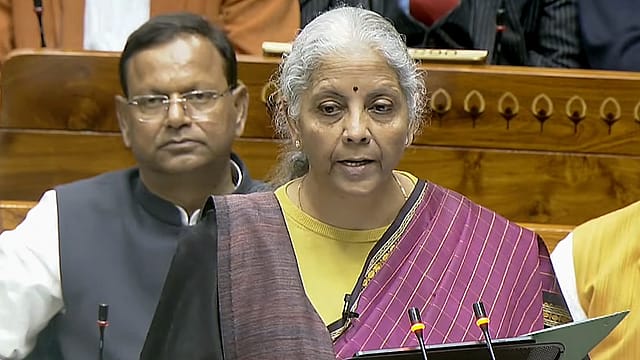
Union Finance Minister Nirmala Sitharaman on Sunday unveiled a series of targeted measures to strengthen women’s access to higher education and entrepreneurship, announcing that a girls’ hostel will be built in every district of the country and community-owned ‘She MARTS’ will be set up to help women move from livelihoods to enterprise ownership.
Presenting the Union Budget 2026–27, Sitharaman said the proposals are part of a broader push to deepen India’s higher education ecosystem and enable women to participate more fully in advanced learning and economic activity.
Losing Memory
16 Oct 2026 - Vol 05 | Issue 42
The making of a medical and social emergency
“I propose multiple steps towards setting up new institutes, university townships, girls’ hostels and telescope infrastructure facilities in the higher education sector,” she said, adding that safe and accessible accommodation remains a critical barrier for women pursuing higher studies.
Highlighting challenges faced by women in science, technology, engineering and mathematics (STEM) disciplines—where prolonged study hours and laboratory work are common—Sitharaman said the district-level hostels would improve enrolment and retention in advanced fields, including astrophysics and astronomy, through immersive learning environments.
‘She MARTS’: From self-help groups to enterprise owners
Alongside education, the Budget sharpened its focus on women-led entrepreneurship.
Building on the success of the Lakhpati Didi programme, Sitharaman announced the creation of ‘She MARTS’—self-help entrepreneur marts that will function as community-owned retail outlets at the cluster level. Supported by enhanced and innovative financing, these marts aim to help women transition from credit-linked livelihoods to sustainable, market-facing enterprises.
The initiative is designed to improve market access, branding and income stability for women entrepreneurs, while strengthening grassroots institutions such as self-help groups and cluster-level federations.
Khelo India Mission: A decade-long sports reset
The Budget also proposed the launch of a ‘Khelo India Mission’, aimed at transforming India’s sports ecosystem over the next decade.
Announcing the mission, Sitharaman said the sports sector offers significant opportunities for employment, skilling and career development. The mission will focus
on creating an integrated talent-development pathway, with training centres at foundational, intermediate and elite levels; systematic development of coaches and support staff; integration of sports science and technology; organisation of competitions and leagues; and expansion of sports infrastructure for training and tournaments.
The proposal builds on the Khelo India programme, launched in 2017, which established national competitions such as the Khelo India Youth Games, University Games and Winter Games to identify and nurture talent across the country.
States, local bodies and the rural economy
On the federal front, Sitharaman announced that the Centre has accepted the 16th Finance Commission’s recommendation to retain the vertical share of devolution at 41%, allocating ₹1.4 lakh crore to states in FY 2026–27 as Finance Commission grants.
These funds include allocations for rural and urban local bodies as well as disaster management, reinforcing the role of states and local institutions in service delivery and development.
The Budget also addressed the rural economy with the announcement of a Coconut Promotion Scheme, aimed at boosting productivity and competitiveness in major coconut-growing states. The scheme will focus on interventions such as replacing old, non-productive trees with high-yielding varieties, strengthening India’s position in coconut cultivation and allied value chains.
Taken together, the proposals signal a Budget that links women’s education, entrepreneurship, sports-led skilling, cooperative federalism and rural productivity into a broader framework of inclusive and long-term growth.
(With inputs from ANI)