Budget 2026: Fiscal Deficit Pegged at 4.3% as Sitharaman Pushes Reform Express Forward
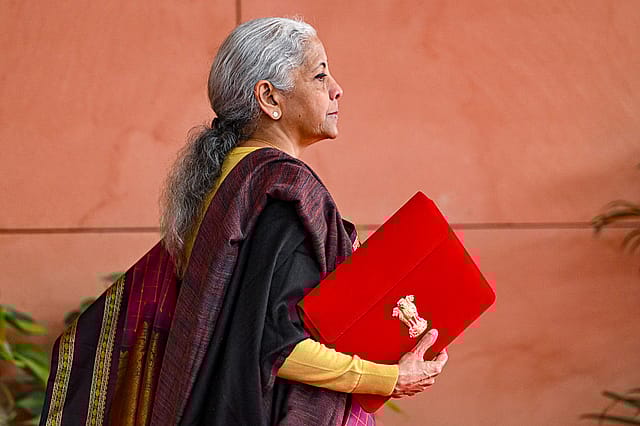
Finance Minister Nirmala Sitharaman, presenting her record ninth consecutive Union Budget, pegged the fiscal deficit at 4.3% of GDP for 2026–27, underscoring the government’s commitment to fiscal consolidation even as it accelerates growth-oriented reforms.
The deficit target marks an improvement from 4.4% in 2025–26 and keeps the government on track to bring the gap below 4.5%, as promised. Fiscal deficit—the difference between the government’s total expenditure and revenue—signals how much the state needs to borrow, and Sitharaman’s numbers reaffirm a calibrated approach to spending and borrowing.
In her opening remarks, the Finance Minister said that since the Modi government assumed office, India’s economic trajectory has been defined by stability, fiscal discipline, sustained growth and moderate inflation, achieved through “action over ambivalence and reform over rhetoric”, with Atmanirbharta as the guiding principle.
Zeroing In on ECI
09 Oct 2026 - Vol 05 | Issue 41
Constitutional legitimacy versus political opportunism
The macro outlook remains resilient. India’s real GDP growth for 2026–27 is projected in the 6.8–7.2% range, reflecting sustained medium-term potential despite a challenging global environment. The Budget follows the tabling of the Economic Survey 2025–26, which outlined the economy’s performance and set the context for the fiscal choices announced.
Six growth levers and the Reform Express
To sustain momentum, Sitharaman identified six focused areas of intervention under what she called the government’s continuing “Reform Express”.
These include scaling up manufacturing across seven strategic and frontier sectors, rejuvenating legacy industries, creating champion MSMEs, delivering a strong push to infrastructure, ensuring long-term security and stability, and developing city economic regions as new engines of growth.
“The Reform Express is running on its way and will maintain its momentum to help us fulfil our Kartavya,” Sitharaman said, framing the Budget as part of a longer reform journey rather than a one-year arithmetic exercise.
High-speed rail, freight corridors and waterways
A major pillar of that journey is infrastructure.
The Budget proposed seven high-speed rail corridors designed as growth connectors linking financial hubs, technology centres and manufacturing clusters. The proposed routes include Mumbai–Pune, Pune–Hyderabad, Hyderabad–Bengaluru, Hyderabad–Chennai, Chennai–Bengaluru, Delhi–Varanasi and Varanasi–Siliguri, aimed at reducing travel time, lowering emissions and boosting regional development.
Complementing passenger mobility is a freight overhaul. Sitharaman announced new dedicated freight corridors, including a key link from Dangkuni in West Bengal to Surat, and the plan to operationalise 20 national waterways over the next five years to shift cargo towards more energy-efficient inland water transport.
The Budget also flagged an eco-tourism push, with plans for sustainable mountain trails in Himachal Pradesh, Uttarakhand, Jammu and Kashmir, the Araku Valley and the Western Ghats, alongside wildlife trails such as turtle nesting routes and bird-watching circuits.
Ayurveda, textiles and cultural capital
Beyond hard infrastructure, the Budget invested in India’s traditional strengths.
Sitharaman announced three new All India Institutes of Ayurveda to meet rising global demand for Ayurvedic medicine, noting that Ayurveda, like yoga, has gained international recognition in the post-COVID world. She also proposed upgrades to AYUSH pharmacies, drug testing labs, and the WHO Global Traditional Medicine Centre in Jamnagar, positioning India as a global hub for evidence-based traditional medicine.
In the textiles sector, the Finance Minister unveiled the Mahatma Gandhi Handloom Scheme and announced plans for mega textile parks, aimed at strengthening khadi, handloom and handicrafts, improving skilling and production quality, and providing global market linkages. The initiatives are expected to benefit weavers, village industries, the ODOP programme, and rural youth.
Taken together, Budget 2026 balances fiscal prudence with reform ambition, tightening the deficit while expanding the country’s economic and cultural capacity. The message from North Block is clear: the Reform Express is not slowing down. It is being carefully steered.
(With inputs from ANI)