Budget 2026: Sitharaman Launches Semiconductor Mission 2.0 With ₹40,000-crore Push
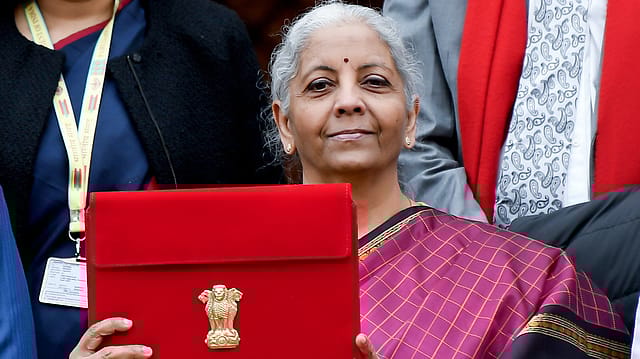
Finance Minister Nirmala Sitharaman on Sunday announced the launch of India Semiconductor Mission (ISM) 2.0, committing an outlay of ₹40,000 crore to deepen India’s semiconductor ecosystem and reduce dependence on global supply chains.
Presenting the Union Budget 2026–27, Sitharaman said ISM 2.0 builds on the gains of the first phase and will focus on manufacturing semiconductor equipment and materials, developing full-stack Indian intellectual property, and strengthening domestic and global supply-chain resilience.
A key pillar of the mission will be industry-led research and training centres, aimed at developing both cutting-edge technology and a skilled workforce to support India’s ambitions in electronics, clean energy, defence, and advanced manufacturing.

Losing Memory
16 Oct 2026 - Vol 05 | Issue 42
The making of a medical and social emergency
The Finance Minister also highlighted the success of the Electronics Components Manufacturing Scheme, launched in April 2025 with an outlay of ₹22,919 crore, which has already attracted investment commitments double the original targets. Riding on that momentum, she proposed raising its outlay to ₹40,000 crore.
From chips to classrooms: AI skilling scales up
The technology push extends beyond semiconductors.
Earlier, the Ministry of Electronics and Information Technology (MeitY) announced plans to expand artificial intelligence training to 500 universities across the country, creating a nationwide talent pipeline aligned with industry needs.
Union Minister Ashwini Vaishnaw said the model mirrors the semiconductor skilling programme, where students at 315 universities are already designing chips. Under the upcoming AI Mission 2.0, expected to be rolled out in the next five to six months, the government will finalise industry-aligned curricula, scale common compute infrastructure, and launch major research programmes to democratise access to advanced technology.
The approach, Vaishnaw said, builds on India’s digital public infrastructure successes such as UPI, DigiLocker and 5G, with a focus on equitable access to computing power and innovation.
Textiles get a reform-led reset
Alongside high technology, the Budget also delivered a major reform push for the labour-intensive textile sector.
Sitharaman announced the Mahatma Gandhi Handloom Scheme, aimed at strengthening khadi, handloom and handicrafts, while improving global market linkages, branding, skilling and production quality. The initiative is expected to benefit weavers, village industries, the One District One Product (ODOP) programme and rural youth.
She outlined an integrated textile programme anchored on three key components. First, there is National Fibre Scheme to achieve self-reliance in natural fibres such as silk, wool and jute, alongside man-made and new-age fibres. Second, Textile Expansion and Employment Scheme will modernise traditional clusters through capital support, technology upgrades and common testing facilities. Third, there is National Handloom and Handicraft Programme, integrating existing schemes with targeted support for artisans.
The Budget also proposed Samarth 2.0, designed to modernise textile skilling through collaboration with industry and academia, and announced plans to set up mega textile parks to reduce logistics costs, boost exports and promote technical textiles used in sectors ranging from healthcare to automobiles.
Reform Express as the common thread
Presenting her ninth consecutive Union Budget, Sitharaman said the government’s “Reform Express” remains firmly on track.
She underlined that since 2014, India’s economic trajectory has been marked by stability, fiscal discipline, sustained growth and moderate inflation, driven by conscious policy choices even amid global uncertainty. Anchored in Aatmanirbharta, the reform agenda, she said, has strengthened domestic manufacturing, ensured energy security, reduced critical import dependence and delivered growth of around 7%, alongside significant poverty reduction.
Against a global backdrop of strained trade, disrupted supply chains and rising demand for critical minerals, Sitharaman said India will continue to move towards Viksit Bharat by balancing ambition with inclusion.
(With inputs from ANI)