AI Impact Summit 2026: Ashwini Vaishnaw Calls for Safe, Human-Centric AI
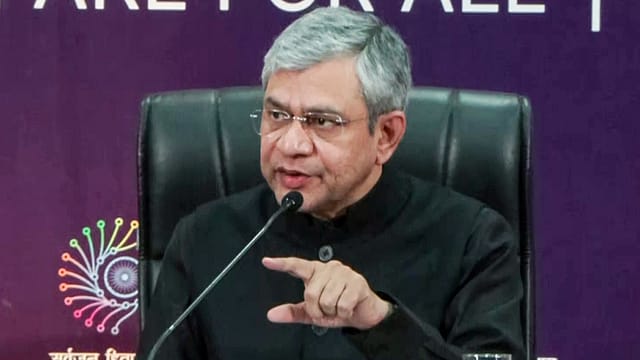
Union Minister Ashwini Vaishnaw on Wednesday hailed the enthusiasm of young participants at the AI Impact Summit, highlighting their strong turnout and optimism towards artificial intelligence.
Addressing the Opening Ceremony of the Research Symposium at the summit, he said India is leveraging AI to solve real world problems and urged top experts to provide concrete suggestions to ensure the technology remains safe and balanced.
He underlined India’s inclusive approach to artificial intelligence, adding, "We in India are very hopeful for AI in the edge, AI for use cases, solving real world problems, improving productivity in enterprises, for population scale problems like healthcare and agriculture."

Zeroing In on ECI
09 Oct 2026 - Vol 05 | Issue 41
Constitutional legitimacy versus political opportunism
He also called upon leading experts to bring forward solid and concrete suggestions on making AI safe and ensuring it does not distort balance.
Former G20 Sherpa of India and NITI Aayog CEO Amitabh Kant emphasised that India aims to advance in artificial intelligence with equality.
Speaking to ANI, Kant said the country possesses the necessary talent and data to emerge as a leading AI power while ensuring accessibility for all citizens.
"I agree with the vision the Prime Minister has set before the country, because India has the talent, the data... so that when we grow, we grow with equality. We agree that India will be one of the top-most powers of AI, simply because of talent and data. We will also ensure that there is accessibility for our citizens," he said.
He further noted that India’s expanding IT market will play a crucial role in AI adoption, stating, "Indian AI market is expanding rapidly and despite AI, we will require the IT companies to play a key role... We have demonstrated open APIs and globally interoperable models."
Can AI transform India’s IT sector without replacing jobs?
Earlier, Prime Minister Narendra Modi said that artificial intelligence is transforming rather than replacing India’s IT sector and could help the industry reach $400 billion by 2030.
In a special interview with ANI's text service, he said, "India's IT sector has been the backbone of our services exports and a key driver of economic growth. AI presents both a tremendous opportunity and a challenge for this sector. AI market projections show India's IT sector could reach $400 billion by 2030, driven by new waves of AI-enabled outsourcing and domain-specific automation."
He added that India plans to strengthen its AI compute infrastructure by adding another 20,000 GPUs, taking the total beyond 38,000.
Under the IndiaAI Mission, these high-end GPUs are available at about Rs 65 per hour, nearly one-third of the global average cost.
The next phase of the country’s AI strategy will prioritise design, research and development of solutions tailored to India’s needs.
The Prime Minister also indicated that AI-related investments at the summit could exceed $200 billion, including $90 billion already committed, with discussions ongoing with major companies for further investments.
Sweden’s Deputy Prime Minister and Minister for Energy, Business and Industry Ebba Busch arrived in the national capital for the summit.
Welcoming her visit, the Ministry of External Affairs said in a post on X that India-Sweden ties span cooperation across trade, economy, science, innovation, climate action and education.
The India AI Impact Summit 2026 is being held at Bharat Mandapam in New Delhi from February 16 to February 20, bringing together government policymakers, industry experts, academicians, technology innovators and civil society from across the world to advance global discussions on artificial intelligence.
The summit, described as the first global AI convening of this scale hosted in the Global South, aligns with the national vision of "Sarvajana Hitaya, Sarvajana Sukhaya" and the global principle of AI for Humanity.
Participation includes representatives from more than 110 countries, 30 international organisations, around 20 Heads of State or Government level participants and about 45 ministers.
The summit forms part of a broader international process aimed at strengthening global cooperation on the governance, safety and societal impact of AI.
Guided by three foundational Sutras of People, Planet and Progress, the event seeks to promote human-centric AI that safeguards rights and ensures equitable benefits, environmentally sustainable advancement of AI, and inclusive economic and technological progress.
(With inputs from ANI)