PM Modi in Uzbekistan: From a Grand Tashkent Welcome to Yangi Uzbekistan Park, Everything Happening on the Visit
For most Indians, Uzbekistan enters the news cycle only occasionally.
Yet this weekend, Tashkent has become one of the most important stops on India's diplomatic map.
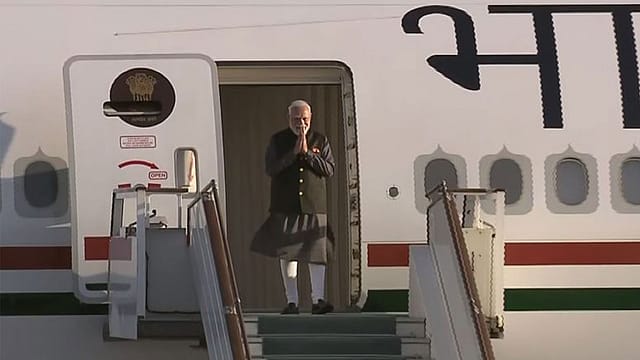
Prime Minister Narendra Modi arrived in the Uzbek capital on Saturday for a two-day state visit before heading to Kyrgyzstan for the Shanghai Cooperation Organisation (SCO) Summit. The visit is being viewed as a significant step in India's effort to deepen strategic, economic and cultural ties with Central Asia.
And the welcome was anything but routine.
According to reports from Tashkent, Modi was received personally by Uzbek President Shavkat Mirziyoyev at the airport, underlining the importance both countries attach to the relationship.
What happened after PM Modi reached Tashkent?
Soon after his arrival, Modi visited Yangi Uzbekistan Park, one of modern Uzbekistan's most prominent national landmarks.

Zeroing In on ECI
09 Oct 2026 - Vol 05 | Issue 41
Constitutional legitimacy versus political opportunism
There, he laid a wreath at the Independence Monument, paying tribute to Uzbekistan's nation-building journey and symbolically reaffirming India's support for its strategic partner in Central Asia.
The ceremony was among the first major engagements of the visit and set the tone for a trip focused not just on diplomacy and trade, but also on shared history, sovereignty and people-to-people ties.
What is Yangi Uzbekistan Park and why does it matter?
The name itself offers a clue.
"Yangi Uzbekistan" translates to "New Uzbekistan".
Opened in 2021 to mark the 30th anniversary of Uzbekistan's independence, the sprawling park has emerged as a symbol of the country's modern identity and development ambitions under President Mirziyoyev. At its heart stands the Independence Monument, which commemorates Uzbekistan's journey as an independent nation.
For visiting world leaders, a wreath-laying ceremony there carries both ceremonial and diplomatic significance.
It is Uzbekistan's equivalent of inviting a guest to understand the story the country tells about itself.
Why is this visit important for India?
Because Central Asia is becoming increasingly important to India's strategic calculations.
As global supply chains shift and geopolitical competition intensifies, India has been working to strengthen partnerships across the region.
Ahead of the visit, Modi said discussions with President Mirziyoyev would focus on trade, investment, digital connectivity, defence cooperation, energy, education and emerging technologies. The two leaders are also expected to discuss ways to align India's "Viksit Bharat" vision with Uzbekistan's national development plans.
The relationship has already expanded considerably over the past decade, with cooperation ranging from pharmaceuticals and IT to defence and higher education.
What are the key meetings and events on PM Modi's agenda?
The centrepiece of the visit will be Modi's bilateral talks with President Mirziyoyev.
The two leaders are expected to review progress in the India-Uzbekistan Strategic Partnership and explore new opportunities in trade, connectivity, healthcare, critical minerals, energy and technology.
The Prime Minister is also scheduled to visit the Shastri Memorial and the Mahatma Gandhi Centre at the Tashkent State University of Oriental Studies—two sites that highlight the deep cultural and historical links between the two countries.
Why does Tashkent hold special significance for India?
Few foreign cities occupy as unique a place in India's diplomatic memory as Tashkent.
It was here that former Prime Minister Lal Bahadur Shastri signed the historic Tashkent Declaration in January 1966 following the India-Pakistan war. It was also here that Shastri passed away shortly afterwards, making the city an emotional landmark in India's modern political history.
That is one reason Indian prime ministers often include the Shastri Memorial in their Tashkent itinerary.
What happens after Uzbekistan?
Modi's Central Asia tour does not end in Tashkent.
After completing the bilateral leg of the visit, he will travel to Bishkek, Kyrgyzstan, for the 26th SCO Summit, where leaders from across Eurasia are expected to discuss security, connectivity, trade and regional stability. Russian President Vladimir Putin and Chinese President Xi Jinping are among the leaders expected to participate.
India is expected to use the summit to push its vision of a region that is secure, connected and free from terrorism while also expanding economic cooperation with SCO members.
The bigger story: India's Central Asia push is getting personal
Diplomatic visits are often remembered for agreements and joint statements.
But sometimes the more revealing moments happen before the meetings begin.
This visit started with Uzbek students welcoming Modi in Hindi, continued with a presidential reception at the airport, and moved quickly to a wreath-laying ceremony at one of Uzbekistan's most important national symbols.
Taken together, those moments tell a story larger than a state visit.
India is no longer looking at Central Asia merely as a distant strategic region.
It is increasingly treating it as a long-term partnership—one built not only on trade and geopolitics, but also on history, culture and people-to-people connections.
(With inputs from ANI)