Jantar, Mantar & When Dissent Loses its Address
OCTOBER 5, 2006. JANTAR MANTAR. EVENING.
A mosquito net hangs over Irom Sharmila.
Beneath it, a blue patterned blanket covers most of her body. Black curls spread across a pale pillow. Her face is narrow, her eyes partly closed. A young volunteer sits beside her, keeping watch.
A camera flash briefly lights the scene.
Then the darkness returns.
The photographs from that evening preserve the smallness of the figure beneath the blanket, the care she needs, the little room her body takes up beside the road. The woman known as the “Iron Lady” lies before the camera in all her physical frailty.
Sharmila is nearly six years into her hunger strike against the Armed Forces Special Powers Act. In custody in Manipur, she has been kept alive through a tube passed through her nose. After her release, she has come to Delhi, laid flowers at Raj Ghat and carried her protest to Jantar Mantar.

Zeroing In on ECI
09 Oct 2026 - Vol 05 | Issue 41
Constitutional legitimacy versus political opportunism
Her demand has travelled a long way. Here, a short walk from Parliament, it fits on a pillow and a blanket beside the road. Jantar Mantar has room for her.
Twenty years later, she remembers.
“We are a democratic country. Jantar Mantar was a place where people could express their voice,” she tells OPEN Digital.
“I went there myself, and I have many memories of my own protest from that site.”
On October 12, 2026, the decision to de-notify Jantar Mantar as a designated protest venue becomes public.
A Delhi Police order dated October 11 says a committee constituted by the Ministry of Home Affairs has examined alternatives. Three sites are designated: Ramlila Ground, Burari Ground and CBD Ground in East Delhi. A revised standard operating procedure will follow.
The city has other places for protesters to gather.
What happens to the distance between where they stand and the people they have come to petition?
A PLACE TO READ THE SKY
Nearly three centuries before Sharmila lay down on that road, Maharaja Sawai Jai Singh II came to Delhi with an ambition of his own.
He wanted better readings of the heavens.
In 1724, during the reign of Mughal emperor Muhammad Shah, he built the Delhi observatory that became Jantar Mantar. It was the first of five associated with his astronomical project. The others rose in Jaipur, Ujjain, Mathura and Varanasi.
The instruments gave his ambition a body. A sundial the size of a building. Curved surfaces. Steps rising towards the sky. Stone structures through which shadows and lines of sight could help read time and celestial movement.
Today, the observatory is a protected monument, surrounded by a capital that has grown far beyond the world its builders knew.
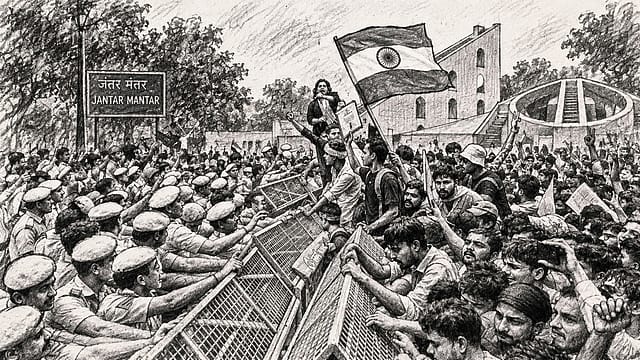
One distinction matters. The designated protest stretch lay on the nearby road, rather than within the observatory. The monument lent its name to the place where people came to make a grievance visible.
A village could be a thousand kilometres from Delhi. A pension dispute could vanish into files. Violence in a northeastern state could struggle to hold the nation’s attention. At Jantar Mantar, those causes acquired bodies, banners, witnesses and an address a short walk from Parliament.
The city knew where to find them.
DELHI HAS MOVED ITS ANGER BEFORE
The road inherited its role from the Boat Club lawns near India Gate.
Historian Mridula Mukherjee remembers the crowds.
“After the Emergency, in 1977, there was a huge public meeting at the Boat Club, which I attended," she recounts. Around two lakh people had gathered. The crowd stretched from the Boat Club to India Gate, and there was no anarchy. "Later, protests shifted to Jantar Mantar,” she adds.
October 1988.
Farmer leader Mahendra Singh Tikait brings an enormous gathering to the lawns. Farmers camp for days, with tractors and bullock carts. The scale of the occupation confronts the government with the consequences of allowing mass protest into the capital’s ceremonial heart.
Restrictions follow. By the early 1990s, Jantar Mantar Road has become Delhi’s familiar address for dissent.
It is an uneasy bargain. Protesters get to stand close to Parliament, ministries, MPs and journalists. The authorities get a defined stretch of the city on which to manage them.
Repetition turns a road into an institution.
“Hundreds and thousands of big and small protests have happened there," says Mukherjee. Women, farmers, safai karmacharis, students, army veterans. "It was a welcoming place for all,” she adds.
“I have attended and spoken at Jantar Mantar not once but many times. I cannot even count how many times I have gone there.”
That familiarity is part of its value. Organisers know the place. Reporters know the place. People arriving with causes that have struggled to travel beyond their districts know where to go.
A protest needs people. It also needs someone to notice.
THE ROAD FILLS
April 2011. Anna Hazare begins an indefinite fast at Jantar Mantar for a Jan Lokpal Bill.
The crowd swells. A campaign against corruption gains a face, a location and a national audience. Within days, the government agrees to a joint drafting committee.
The movement later shifts to Ramlila Maidan for Hazare’s August fast. The Lokpal and Lokayuktas Act follows in 2013. The agitation also helps set in motion the political mobilisation from which the Aam Aadmi Party emerges.
For a few days that April, a road near Parliament seems able to bend the government’s timetable.
Then other griefs arrive.
December 2012. After the Delhi gang rape, students and activists gather at Jantar Mantar while access to other prominent parts of the capital is restricted. Anger over one young woman’s ordeal becomes a demand for safety, justice and accountability.
In 2015, retired soldiers make the road part of their campaign for One Rank One Pension.
That April brings a terrible memory too. Rajasthan farmer Gajendra Singh dies by suicide at an AAP rally against the land acquisition ordinance.
A protest ground holds triumph, exhaustion and tragedy. Some demands win concessions. Others remain unanswered long after the banners are folded.
In 2017, drought-hit Tamil Nadu farmers, led by P. Ayyakannu, bring their desperation to Delhi. They carry skulls they say belong to dead farmers. Some strip off their clothes. Distress that can be flattened into agricultural statistics becomes an image the capital cannot easily look away from.
That May, Bhim Army supporters gather over caste violence in Saharanpur.
Different languages. Different injuries. The same road. Jantar Mantar can hold a cause long enough for the rest of the country to encounter it. That is its recurring promise.
WHO LIVES BESIDE A PROTEST?
For the neighbourhood, the promise comes with a daily cost.
Noise, crowds and disruption press in at close quarters. A place that gives demonstrators visibility can make life difficult for people whose homes stand nearby.
On October 5, 2017, the National Green Tribunal, hearing residents’ complaints, bans protests on Jantar Mantar Road and orders them shifted to Ramlila Maidan.
The following July, the Supreme Court steps in. In a case brought by the Mazdoor Kisan Shakti Sangathan, a bench of Justices A.K. Sikri and Ashok Bhushan rejects a complete ban at places such as Jantar Mantar and the Boat Club. It also makes clear that protesters cannot claim an unrestricted right to assemble wherever they choose.
Delhi Police is directed to frame guidelines. What follows is a more tightly regulated protest ground: permissions, limits on attendance and fixed hours.
The competing claims are real. Residents need relief. Commuters need access. Police need to manage crowds. Demonstrators need a meaningful chance to be heard. Every new restriction tests how much room the city is willing to leave for that last need.
CHAMPIONS ON THE ROAD
January 18, 2023.
Some of India’s most accomplished wrestlers sit down at Jantar Mantar. Vinesh Phogat. Sakshi Malik. Bajrang Punia.
They have represented India before roaring international crowds. Now they need an audience in their own capital. They accuse Wrestling Federation of India chief Brij Bhushan Sharan Singh of sexual harassment.
Their stature draws attention. It does not settle their demands.
They withdraw their initial protest after assurances of action. On April 23, they return, demanding Singh’s arrest. Farmers join them. The protest becomes a sustained confrontation over who will listen, who will act and how long the athletes must wait on the road.
May 28, 2023
The new Parliament building is being inaugurated. Police detain the wrestlers as they attempt to march towards it and clear the protest site.
The geography sharpens the confrontation. Parliament is close enough to march towards. Reaching it is another matter.
For decades, that tension has helped define Jantar Mantar. The institutions being addressed are nearby, and their nearness gives the protest its force. The barriers between petitioners and power remain firmly in place.
The road offers visibility. The people sitting on it must still fight for a response.
THE NEXT ADDRESS
This October, the dispute is over another demand.
Protesters seeking Chief Election Commissioner Gyanesh Kumar’s resignation over the Special Intensive Revision of electoral rolls are denied permission to gather at Jantar Mantar.
The confrontation reaches the Supreme Court. Restrictions affecting movement and public transport draw the court’s concern for ordinary commuters. In proceedings concerning the proposed demonstrations, the possibility of an alternative venue is discussed.
Then comes the police order. The administration’s case deserves a hearing.
Neeraj Kumar, Delhi Police Commissioner from July 2012 to July 2013, says the Boat Club gathering led by Tikait demonstrated the difficulties of accommodating enormous crowds in that part of the capital. Jantar Mantar, he argues, had shortcomings of its own.
“However, Jantar Mantar was never a suitable site as it lacks open space for large gatherings," he underlined. Its proximity with built-up areas, Connaught Place and Parliament are other drawbacks. "Therefore, Ramlila Ground, etc., are far more suitable sites from law & order point of view,” he added.
Space matters. So do sanitation, crowd safety and access.
Ramlila Maidan has its own substantial political history. Hazare’s August 2011 fast showed its capacity to host a movement with a national audience. The police operation that cleared Baba Ramdev’s camp in June that year remains part of its history too.
Yet suitability cannot be measured only by how many people a ground can accommodate.
For a protester, proximity to Parliament may be the reason for choosing a place. For a police officer, the same proximity is a complication.
Ravi Shrivastava, a founding member of AAP, argues that distance changes the value of the alternatives.
“Burari as an alternative does not work, because it is very far. Jantar Mantar is in the heart of the city, and it should not be taken away.”
A protest’s power has always been partly its address.
Jantar Mantar brought demonstrators within reach of MPs, ministries and journalists. Its familiarity reduced the effort required to draw attention: a reporter knew where to arrive; an organiser knew where to assemble; a visitor could find a cause already waiting on the road.
The revised rules will help determine how the new venues function. Whether people can obtain permission, reach them, assemble safely and attract attention will matter as much as the names on the order.
A larger ground may accommodate a larger crowd. Its usefulness also depends on whether that crowd can reach the audience it came to address.
Moving a gathering is administratively possible. Recreating the visibility an address has accumulated over decades is harder.
A PLACE BESIDE THE ROAD
Return to the photograph.
October 2006. The blanket. The pillow. The mosquito net. A volunteer beside Sharmila in the darkness.
A woman from Manipur has brought a struggle the capital has allowed to remain distant. Now she is here, a short walk from Parliament, waiting to be heard.
She needs somewhere to bring it.
So do the farmers who arrive with skulls, the veterans waiting for a pension decision, the students demanding justice and the wrestlers asking the country to hear their allegations.
Their causes differ. Their presence gives the road its history.
“It is a shame that it has been denotified,” says Mukherjee.
Sharmila’s words reach back to the memory of having been there herself. “It is a historic place, and a protest site should never be taken away from the people.”
Delhi will now direct those people to other grounds. Somewhere, a person whose demand has gone unheard for years will prepare to make that journey.
Will anyone come close enough to listen?