The Kathmandu Reset
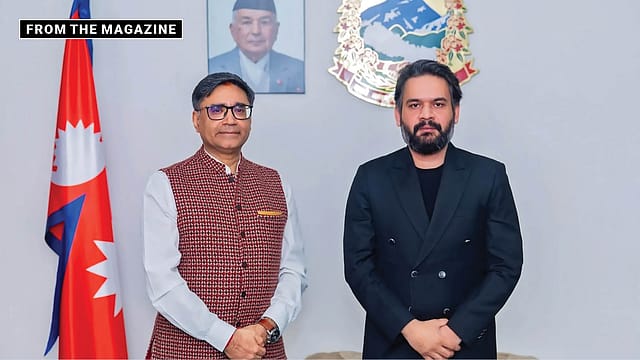
There are no deeper examples in South Asia of two countries intimately connected by geography, history, religion and commerce than India and Nepal. And yet, there perhaps are few relationships between neighbours that are as periodically marred by suspicion as the one between these two. Now with a new government at the helm in Nepal, attempts to reset the relationship have gained momentum. India’s Foreign Secretary Vikram Misri has just completed a visit to Kathmandu, meeting Nepal’s new political leadership and discussing the future of bilateral cooperation. The visit was also to prepare the ground for Nepal Prime Minister Balendra Shah’s first official trip to India, most likely from November 22 onwards. Shah is expected to meet Narendra Modi, among other Indian leaders.
The significance of these developments has to be seen beyond the usual diplomatic choreography. In the first six months of Shah’s government, relations with New Delhi were defined mostly by what could be termed an unusual degree of hesitation. Shah hardly engaged with India; in fact, a proposed visit by Misri in May had to be postponed amid differences over diplomatic protocol and the Lipulekh territorial dispute.
This phase now appears to be giving way to a more pragmatic engagement. Things began to change in light of India’s quick assistance following the devastating floods in Nepal in August—something that Shah acknowledged during Misri’s recent visit. There have also been discussions over several projects that could be inaugurated or taken forward during Shah’s India visit. These include the Lower Arun hydropower project, a petroleum pipeline linking Siliguri with Jhapa, and the proposed railway line between Ayodhya and Janakpur.
Nepal cannot forget the 2015 blockade, for it Reminds it of how economic dependence acquires a political meaning, especially during times of political upheaval. This is where India should give leeway to Nepal when it insists on autonomy

But experts caution that a diplomatic reset does not mean resolution. There are issues that have troubled India-Nepal relations for decades. There are concerns about territory, sovereignty, and also about economic dependence and the Chinese presence in Nepal. The economic dependence has often produced resentment in Nepal, viewed as it is through the prism of Indian influence over Nepal’s domestic political affairs. This structural imbalance, says India’s former Ambassador to Nepal, Ranjit Rae, is likely to remain. “Indian policymakers must factor this in and be sensitive to Nepal’s concerns. This is particularly important in the context of nationalism in Nepal, where India often becomes part of the political narrative. These dynamics are unlikely to disappear and will need to be managed with care going forward,” he told the Kathmandu Post earlier this year.
The imbalance that Rae speaks about caused a rupture in 2015 during protests by Madhesi groups. These resulted in the disruption of movement across the border, leading to severe shortages of fuel and essential supplies. Nepal accused India of imposing an unofficial blockade, an allegation New Delhi denied while maintaining that the disruption was caused by protests on the Nepali side. The episode was one among several events that left a lasting impression in Nepal that its dependence on India could become a vulnerability. It also quickly led to an acceleration in Nepal’s efforts to cultivate other relationships independent of India, particularly with China.
Balendra Shah’s arrival in Nepal has introduced a new element into this equation. He rose to power because Nepal’s younger generation rejected Nepal’s traditional political class in the March elections. Shah’s Rastriya Swatantra Party won an overwhelming parliamentary majority after years of public frustration with political instability, corruption and the inability of successive governments to deliver economic change. This provided a new opportunity for India, but it also came with its own complications. Successive Indian governments have had a working relationship with Nepal’s old political leadership, which also meant that they could predict political calculations and understood its institutional networks. But Shah is different in the sense that his public image is built on his espousal of distance from conventional political diplomacy.
In the initial days, his stance caused considerable unease. A planned visit by Misri had to be withdrawn because of differences over protocol. Nepal also raised objections to India’s use of the Lipulekh route for the Kailash Mansarovar Yatra, maintaining a claim over the territory the route passes through. This approach raised questions both in Kathmandu and New Delhi. Many thought that this belligerence could hardly be a coherent foreign policy, while some thought that this was a political assertion put in place of a diplomatic strategy that was at best insufficiently developed.
Madhu Raman Acharya, a former Nepali foreign secretary, said that this approach was just the new government’s way of prioritising one issue over another. “The international situation, our geopolitical location, and historical facts have not changed. In such a situation, what the government can do in diplomacy is merely change its priorities regarding which issues to push forward,” he told Nepal News in June. Nepal’s former Ambassador to India, Lok Raj Baral, made this argument more succinctly. “There has not been much departure in Nepal’s foreign policy. The fundamentals remain the same. What has changed is the style,” he said.
The question then remains: will this change translate into a substantive change in how Nepal conducts its relationship with India? Many in Nepal believe that the country’s relationship with India has always been defined by the interests of its own leadership. Shah’s rise has lent a new political expression to this sentiment. It is here that China enters the conversation. Nepal’s relationship with Beijing causes enormous strategic anxiety in India. For Nepal, China is not only a counterweight to India; it is also where it seeks investment. Shankar Prasad Sharma, Nepal’s former ambassador to India, said that Nepal would like to balance its foreign policy relationships because “we all need our friends”.
Some friends of Nepal and India have suggested that Nepal could use its position as a buffer between India and China, becoming a bridge connecting the two economies. But given the degree of mistrust between India and China, this is highly unlikely. For India, though, a more effective (and pragmatic) response would be to improve its own quality of engagement with Nepal. Better access to its markets and a stake in its development, particularly infrastructure, will create more durable goodwill than its flagging of Chinese foray in Nepal. The open border and its historical connections are advantages, but these cannot be taken for granted.
The economic relationship seems to offer the most viable route forward. Nepal has tremendous hydropower potential, and looking at how India’s power needs are growing, this can work out well. There already are frameworks in place that look at Nepal exporting electricity up to 10,000MW over the next decade. Nepal is also using the Indian grid to supply electricity to Bangladesh. This works for the mutual benefit of both countries. The possibilities are immense, but these are often held back due to disagreements. For example, even after almost three decades of agreement, the Pancheshwar Multipurpose Project, envisaged under the Mahakali Treaty of 1996, has not been able to take off. It has remained stalled due to, among other things, inconsistency in approach and disagreements over cost-sharing—Nepal has proposed a 30:70 cost-sharing ratio, but India says it is willing to bear only 65 per cent of the cost.
There are similar difficulties in trade and connectivity. India is Nepal’s largest trading partner, but Nepal feels the relationship is heavily tilted towards India. Kathmandu has sought better access to its agricultural and manufactured products; it also seeks measures to make its international airports at Pokhara and Bhairawaha commercially viable. These matters have considerable political significance in Nepal, especially among the young people who have given Shah a chance.
Shah’s forthcoming visit will bring some of these issues to the negotiating table. According to media sources in Nepal, it seeks a financial package of around $2 billion for post-flood reconstruction. How New Delhi responds to this need from Nepal and on what terms will largely determine the intensity of the reset.
The observation about structural imbalance between the two countries is relevant here. Nepal cannot forget the 2015 blockade, for it remains a reminder of how economic dependence acquires a political meaning, especially during times of political upheaval. This is where New Delhi should give leeway to Nepal when it insists on autonomy; after all, that does not have to be automatically interpreted as hostility. For Kathmandu, it would be prudent to maintain a sustained engagement that is not prone to episodic hostility. As Rae rightly puts it, “Ask no favour and take no wish list along. Talk to the other side eye to eye as an equal counterpart.”
For Modi, too, currently grappling with how to engage domestically with its own Gen Z, the visit by Nepal’s prime minister offers an opportunity to establish a working relationship with a government that came to power by trampling on all bearings of old power dynamics. Historical connection and geography are good, but to translate it into political goodwill needs serious work. As Pankaj Saran, India’s former ambassador to Nepal and former deputy national security adviser, has argued, “the stakes are too high for both countries to allow individual incidents to derail the promise of a new relationship based on mutual respect and advantage.”
This is precisely why India and Nepal must move beyond the old vocabulary of roti-beti. The real measure of how the reset will go will only be clear once Shah concludes his India visit and returns. How much movement happens on trade and other issues will determine the future of the relationship. The challenge before India and Nepal is to turn their arguments for friendship into a relationship that does not appear as a burden to either party.