Drones, Darknet & Poultry-Farm Labs: Inside India’s New Narcotics Map
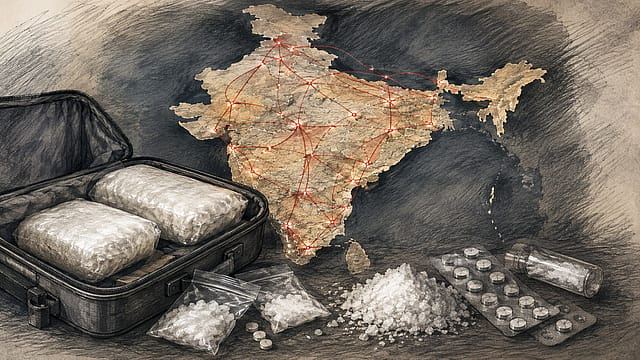
The bus from Indore rolled into Mira Road carrying two passengers, two packets and a much larger map.
Officers from the Directorate of Revenue Intelligence’s Mumbai unit had reportedly been watching for an inter-state narcotics delivery. They intercepted a Kenyan woman arriving from Madhya Pradesh and a Nigerian national who had come to receive the consignment.
Inside the woman’s luggage, officers found two packets marked “LV”. A field-testing kit indicated that the 547 grams of white crystalline material contained cocaine and methaqualone, according to the DRI. Both passengers were arrested under the Narcotic Drugs and Psychotropic Substances Act. Laboratory confirmation and the search for other members of the alleged network remain part of the investigation.

Zeroing In on ECI
09 Oct 2026 - Vol 05 | Issue 41
Constitutional legitimacy versus political opportunism
Measured against India’s biggest seizures of 2026, 547 grams barely registers.
In January, DRI seized 270 kg of mephedrone from a truck in Rajasthan. In May, the Narcotics Control Bureau said it recovered 349 kg of cocaine from warehouses in the Mumbai region. The same month, NCB announced India’s first Captagon seizure, involving more than 227 kg of tablets and powder recovered from Delhi and Gujarat.
The Mira Road bust matters for another reason. A bus had connected Indore to Mumbai. An international carrier allegedly delivered the luggage. Another foreign national waited downstream. Cocaine, a South American drug that commands premium prices in Indian cities, travelled alongside methaqualone, a sedative once sold legally under brands such as Quaalude and Mandrax.
The seizure contained several parts of India’s new narcotics economy in one suitcase: an international supply chain, an inland consolidation point, an inter-state passenger route and an urban market.
India once featured largely in the global drug story as a country wedged between two notorious production zones. Heroin moved from the Golden Crescent through Pakistan and the western border. Opium and methamphetamine came from the Golden Triangle through Myanmar and the Northeast.
That geography still matters. It no longer explains enough.
Andean cocaine is arriving through airports, ports and container cargo. Captagon and other synthetic stimulants have entered the trafficking map connecting West and South Asia. Prescription opioids and psychotropic medicines are being diverted from legitimate manufacturing and distribution channels. LSD and MDMA travel through international post, domestic couriers and darknet marketplaces. Mephedrone does not always need to cross a border at all. It can be cooked in an Indian poultry farm.
The Year Began Beneath Chicken Feed
The scale changed on January 11 and 12.
DRI officers intercepted a truck in Rajasthan and found 270 kg of mephedrone concealed beneath a consignment of chicken feed. The agency valued the drug at ₹81 crore. Follow-up searches in Haryana reportedly led investigators to raw material recovered from a dismantled clandestine manufacturing facility. Six people were arrested.
Less than two weeks later, another bird farm yielded another drug factory.
Under Operation Sahyadri Checkmate, DRI officers entered a poultry unit in Satara district’s remote Sahyadri hinterland. The birds provided cover for what the agency described as a mobile and fully operational mephedrone laboratory designed to change locations whenever suspicion drew near.
Officers recovered 21.912 kg of the drug in liquid, semi-liquid and crystalline forms. They also found 71.5 kg of raw material that DRI said could produce another 15 kg of finished mephedrone.
Five people were reportedly arrested, including the alleged manufacturer, financier and poultry-farm owner. Four had faced earlier criminal cases, according to reports based on the agency’s statement.
Around the same time, NCB officers intercepted a vehicle in Surat carrying approximately 35 kg of mephedrone. The vehicle took investigators to Mysuru’s Hebbal Industrial Area, where an alleged manufacturing unit had been operating behind a cleaning-chemicals business. More than 500 kg of chemicals, manufacturing equipment, cash and a vehicle were reportedly recovered.
Another investigation began with just 4.6 grams of mephedrone in Ahmedabad. That small packet eventually led Gujarat ATS and Uttar Pradesh Police to an alleged factory operating from a poultry farm in Ambedkar Nagar. Media reports citing investigators said the raid yielded finished mephedrone, around 50 kg of liquid MD, a controlled precursor chemical and large quantities of raw material.
The packets were leading to the factories.
This marks a critical change in India’s drug economy. Every kilogram produced domestically avoids the risks of crossing an international border as a finished narcotic. Precursor chemicals, equipment and technical knowledge can be dispersed among legitimate industries. Production can move from one shed, farm or industrial unit to another.
India’s pharmaceutical and chemical manufacturing strength creates an uncomfortable vulnerability. The same industrial ecosystem that produces essential medicines and export revenue can supply cover, inputs and expertise to illegal laboratories when controls fail.
During the 2025-26 financial year, DRI said it had dismantled six clandestine factories manufacturing mephedrone, alprazolam and methamphetamine.
The drug route no longer begins only in Afghanistan, Myanmar, Colombia or a distant port. It can begin behind a chicken shed in Satara.
Cocaine Crosses an Ocean and Finds Cricket Pads
The narcotics trail jumped from the hinterland to the warehouse in May.
Under Operation White Strike, NCB announced the seizure of 349 kg of high-grade cocaine from storage facilities along the Kalamboli-Bhiwandi corridor in the Mumbai Metropolitan Region. The agency estimated its illicit-market value at ₹1,745 crore.
According to NCB, the cocaine had entered India inside cavities built into imported machinery. Some packets were reportedly repacked into cricket pads and gloves, possibly to move smaller quantities from bulk storage into distribution.
A drug produced in South America had crossed oceans, entered through industrial cargo and acquired an Indian sporting disguise. NCB said the operation followed more than six months of intelligence gathering, surveillance and inter-agency coordination. The quantity pointed towards industrial-scale logistics rather than a succession of airport couriers carrying capsules.
The valuation requires caution. Cocaine prices fluctuate with purity, volume, city and position in the distribution chain. The ₹1,745-crore figure belongs to the NCB and should not be treated as audited commercial value. The physical haul nevertheless carried its own message. India was becoming attractive enough to receive cocaine by the warehouse.
The smaller Mira Road seizure three months later sits downstream from that larger transformation. Premium drugs that once appeared mainly in isolated airport interceptions are now moving through machinery, storage facilities, road networks, passenger buses and local delivery chains.
The foreign courier remains visible because the courier gets caught. Behind the courier may sit exporters, financiers, warehouse operators, transporters, chemical suppliers, document forgers and domestic distributors.
The arrest is the end of the journey for one carrier. For investigators, it should be the beginning of the story.
Meth From the Hills, Heroin From the Sky
India stands at the intersection of at least four international trafficking systems, according to the NCB’s 2025 annual assessment released in June 2026.
Golden Crescent heroin approaches from Afghanistan and Pakistan. Golden Triangle opioids and synthetic stimulants enter through Myanmar. Andean cocaine reaches Indian cities through maritime and aviation networks. Heroin moving along the Balkan route can arrive through Gulf transit hubs.
Each corridor produces a different enforcement map.
Punjab, Rajasthan and Jammu and Kashmir confront heroin moving across or near the Pakistan border. Drone drops have altered the final crossing. A flying machine can carry packets across fencing, fields and patrol routes, releasing them at coordinates shared with collectors through encrypted applications.
The NCB’s 2025 annual report recorded 305 drone-related narcotics cases and 468 kg of seizures, almost double the quantity reported in 2024. Punjab accounted for 298 cases and 461 kg, including 449.7 kg of heroin and 9 kg of methamphetamine.
These are 2025 figures, not a 2026 total, but they explain the operations continuing this year.
In March, police in Rajasthan’s Sriganganagar district said they recovered approximately 10 kg of heroin from packets believed to have been dropped from across the border. Five people, including alleged collectors from Punjab, were detained. The route and foreign origin remain allegations under investigation.
In August, NCB announced the recovery of 5.16 kg of heroin in Jammu and the arrest of three people, including the alleged mastermind traced to Ladakh. The agency described the case as a Pakistan-linked cross-border trafficking network.
The Northeast faces another geography.
In March, NCB’s regional units said operations during the preceding two months had yielded 72.5 kg of methamphetamine, 17 kg of heroin, 1,036 kg of cannabis, 6.25 kg of morphine and 13,816 bottles of codeine-based cough syrup. The agency registered 21 cases and arrested 40 people during that period.
One operation near Silchar yielded 11.7 kg of methamphetamine. Another at Khatkhati in Assam recovered 524.9 kg of cannabis concealed inside a specially fabricated truck cavity. NCB said the cannabis originated in Manipur’s Senapati district and was headed towards West Bengal.
In August, Assam Police’s Special Task Force recovered 10.48 kg of suspected heroin from an apartment in Guwahati. Police valued it at around ₹80 crore and said the consignment had arrived from Manipur for onward movement to Punjab. Until laboratory confirmation is disclosed, the substance and purity must remain described as suspected.
These routes demonstrate why the state recording the seizure cannot automatically be labelled the intended market.
A consignment caught in Assam may be headed for Punjab. Cocaine stored outside Mumbai may be divided among several cities. A Captagon shipment intercepted at Mundra may have been waiting to leave India again.
The place where a drug is caught may be far removed from where it was produced or meant to be consumed.
The Chapati Machine and India’s First Captagon Haul
Operation Ragepill added another route to India’s narcotics map in May. NCB said it made the country’s first seizure of Captagon, an illicit stimulant associated primarily with West Asian markets. Officers recovered approximately 31.5 kg of tablets from a Delhi residence. The pills had allegedly been concealed in a commercial chapati-cutting machine.
The investigation then travelled to Gujarat.
At Mundra port, officers examined a container that had reportedly arrived from Syria with sheep wool declared as its cargo. NCB said three bags inside contained approximately 196.2 kg of Captagon powder.
The total seizure reached around 227.7 kg. The agency estimated its international illicit-market value at ₹182 crore. A Syrian national was arrested, while investigators traced alleged production activity and tablet-making equipment to Uttarakhand.
The NCB believed the consignment was intended for onward movement to Saudi Arabia and neighbouring markets. That detail complicates the question of whether India is being drugged. Some narcotics enter because Indian consumers will buy them. Others exploit India’s ports, factories, logistics and international commercial connections before leaving for another market.
India can suffer from a trafficking economy even when the intended consumer lives elsewhere. Transit brings organised crime, corruption, illegal finance, falsified documentation and compromised ports and warehouses. It also creates the risk that part of the consignment will leak into domestic distribution.
A country does not have to consume every drug to be damaged by its passage.
The Dealer Disappears Into the Darknet
Some of 2026’s most dangerous consignments were measured in blots, pills and millilitres.
In March, NCB announced that it had dismantled “Team Kalki”, an alleged darknet network distributing party drugs across India. According to the agency, the accused used encrypted communication, cryptocurrency and parcel services to hide identities and payments.
NCB recovered 2,338 LSD blots, 160 MDMA pills weighing more than 77 grams, 3.6 kg of liquid MDMA, 73.61 grams of charas and 3.64 grams of amphetamine from domestic and international parcels.
The agency alleged that the network had shipped more than 1,000 consignments since January 2025. A traditional checkpoint is poorly equipped for such commerce. A truck carrying half a tonne of cannabis occupies physical space. Thousands of LSD doses can disappear into envelopes. A hidden marketplace can connect an overseas seller, Indian buyer, cryptocurrency wallet and ordinary courier without the participants ever meeting.
In April, NCB launched Operation WIPE, or Web-based Illicit Activities Prevention and Enforcement, to target online listings of pharmaceutical substances regulated under the NDPS Act. The agency’s technical teams identified 122 listings involving 62 substances, including the high-potency synthetic opioid fentanyl. Online platforms were asked to suspend suspect vendors and remove the listings.
The web can turn a marketplace designed for machinery, medicines or business supplies into a trafficking directory. The parcel then merges with millions of legitimate deliveries. The peddler may never stand at a street corner. The customer may never enter a nightclub. The drug arrives with the rest of the shopping.
When the Network Has a Pharmacy Licence
The August interception at Mumbai’s air cargo complex exposed another part of the crisis.
DRI examined a consignment declared as Pregabalin capsules and destined for Nigeria. According to the Ministry of Finance, officers instead found one lakh Tramadol Hydrochloride tablets weighing approximately 25 kg and one lakh Tapentadol tablets weighing around 20 kg.
The Tramadol had allegedly been manufactured at a clandestine facility in Ambernath, packed into unmarked cartons, moved to a warehouse near the airport and repacked for export. Machinery and raw materials were recovered during follow-up searches. Three people were arrested.
Tramadol is regulated as a psychotropic substance under the NDPS Act. Tapentadol is regulated under the Drugs and Cosmetics framework but is not presently scheduled under the NDPS Act, the ministry clarified. Both are legitimate opioid painkillers when prescribed and medically supervised. Both carry risks of abuse and dependence.
This distinction matters. A medicine does not become an illicit narcotic merely because it appears in a drug-seizure story. The illegality can arise from clandestine manufacture, unauthorised possession, diversion, concealment, false declaration or trafficking. The NCB’s latest annual assessment warned that diverted pharmaceutical opioids and codeine-based cough syrups are emerging as a dangerous second wave, particularly in Punjab. Punjab accounted for 2,086 kg, or approximately 58 per cent, of the heroin seized nationally in 2025, according to NCB figures. The state also recorded the seizure of 8,95,508 bottles of codeine-based cough syrup.
These numbers measure enforcement recoveries. They do not reveal how many bottles entered misuse or how many people consumed them. They nevertheless show where the pharmaceutical and illicit-drug economies can overlap.
Heroin may require an international cartel, a drone and a collector waiting near the border. A diverted medicine may require a compromised distributor or a non-compliant chemist. The trafficking network may wear a cartel’s face. It may also have a pharmacy licence.
Which State Is India’s Drug Capital?
There is no honest single answer.
“Worst affected” can refer to the quantity of drugs seized, the number of NDPS cases registered, the absolute number of users or the share of a state’s population suffering harmful use or dependence.
Those measurements produce different maps. According to the latest state-level case data reported to the NCB for 2024, Kerala registered 27,701 NDPS cases, around 31 per cent of the national total of 89,913. Punjab recorded 9,025, Maharashtra 7,536, Uttar Pradesh 6,204 and Rajasthan 5,462.
Kerala’s lead in registered cases does not establish that it has India’s highest drug-use prevalence. It may also reflect more intensive enforcement, greater registration of possession cases or different policing practices. Punjab dominates recent heroin seizures and carries a severe opioid burden. Gujarat’s coastline, ports and industrial infrastructure make it prominent in maritime interceptions and large recoveries. Maharashtra combines major urban markets with mounting evidence of domestic synthetic-drug manufacturing.
Northeastern states face high opioid prevalence and trafficking from Myanmar. Delhi, Mumbai, Bengaluru, Hyderabad, Goa and parts of Kerala repeatedly appear in cases involving cocaine, MDMA, LSD and other urban recreational drugs. Uttar Pradesh, Rajasthan and Madhya Pradesh feature in opium routes, pharmaceutical diversion and synthetic laboratories.
India’s most comprehensive national prevalence evidence remains the Ministry of Social Justice and AIIMS survey released in February 2019. It estimated that 3.1 crore people used cannabis products and 2.26 crore used opioids. Approximately 77 lakh people needed help for opioid-use problems, according to the ministry’s current summary of the findings.
The study placed the highest opioid-use prevalence in parts of the Northeast, including Sikkim, Arunachal Pradesh, Nagaland, Manipur and Mizoram, along with Punjab, Haryana and Delhi. In absolute numbers, Uttar Pradesh, Punjab, Haryana, Delhi, Maharashtra, Rajasthan, Andhra Pradesh and Gujarat accounted for more than half the people estimated to have opioid-use disorders.
That nationwide survey is now seven years old. India is fighting an altered narcotics economy involving drones, synthetic opioids, darknet markets and domestic laboratories without an equally current map of consumption. Seizures have become more sophisticated and visible. The people requiring treatment remain harder to count. That data gap weakens every confident claim about which state is India’s “drug capital”.
A Bigger Haul Can Tell Two Stories
Rising seizures make attractive evidence. They fill official tables, produce mountains of confiscated packets and allow governments to announce the value of drugs kept away from the streets.
They can reflect sharper intelligence, stronger coordination and more capable enforcement. They can also signal an expanding trade. If police recover twice as much heroin this year, the interception rate may have improved. Traffickers may also be moving three times as much. Without a credible estimate of the total flow, a seizure cannot distinguish victory from escalation.
Street-value totals create another problem. Agencies may value the same substance differently depending on purity, location and assumed retail price. Cannabis, cocaine, heroin, LSD blots, cough-syrup bottles and precursor chemicals cannot be added meaningfully by weight.
The Union government released its Vision Document on Drug Control 2026-2029 in June, describing the next three years as decisive.
The strategy expands intelligence-led operations, action against synthetic drugs and precursor chemicals, financial investigation, international cooperation, demand reduction and treatment. Anti-Narcotics Task Forces have been established across states and Union territories, supported by a four-tier Narco-Coordination Centre mechanism connecting central, state and district authorities.
NCB’s MANAS helpline, reachable at 1933, allows citizens to share information confidentially. DRI, NCB, customs, BSF, Coast Guard, state police and financial agencies are increasingly expected to pursue the chain beyond the courier. That means identifying the supplier, manufacturer, chemical source, warehouse, exporter, financier, cryptocurrency wallet and property allegedly acquired through drug proceeds.
The government has also increased preventive detention against habitual traffickers. Official information reported in Parliament showed detention orders against 810 alleged habitual offenders in 2025 and another 427 up to June 2026 under the PITNDPS framework. Enforcement has become faster and more technologically aware. Treatment remains the quieter battlefield.
The Social Justice Ministry defines substance dependence as a psycho-social and medical problem requiring community support, counselling, treatment and rehabilitation. Its response includes de-addiction centres, outreach services and the Nasha Mukt Bharat Abhiyaan.
Yet the 2019 national survey found an enormous treatment gap. Among people dependent on illicit drugs, only about one in 20 had ever received inpatient treatment, according to findings reported when the study was released. Police can seize a packet once. Dependence must be treated every day.
Is India Being Drugged?
The evidence does not support one cinematic answer involving a single enemy, cartel or border. India is confronting several narcotics economies simultaneously.
Heroin crosses western and northeastern frontiers. Methamphetamine travels out of the Golden Triangle. Cocaine arrives for affluent urban markets. Cannabis moves in far larger physical quantities through domestic corridors. Mephedrone is manufactured in hidden laboratories. Prescription opioids leak from legitimate commerce. LSD and MDMA travel through parcels ordered on hidden marketplaces. Captagon can enter India as transit cargo and leave for West Asia.
Different drugs pursue different customers, margins and routes. Their networks converge on the same advantages: India’s size, ports, highways, chemical industry, pharmaceutical capacity, digital marketplaces and enormous population.
The 2026 seizures show that agencies are finding factories as well as carriers and following consignments across state boundaries. They also reveal how widely the market has mutated.
A poultry farm can become a laboratory. Chicken feed can hide mephedrone. A chapati machine can carry Captagon. Cricket pads can hold cocaine. A medicine consignment can conceal another medicine. A marketplace can become a dealer. And a bus from Indore can arrive at Mira Road with two packets marked “LV”. The DRI seized 547 grams. The map inside the suitcase covered the country.
(With inputs from ANI)