93 Lakh Applications, 1.12 Lakh Khaki Uniforms: Why Millions of Young Indians Compete for Police Constable Jobs
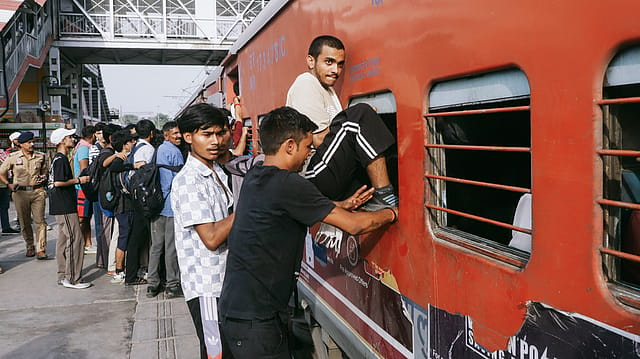
A police constable stands close to the bottom of the official hierarchy. There are head constables above him, followed by assistant sub-inspectors, sub-inspectors, inspectors, deputy superintendents and the ladder of IPS officers whose stars illuminate their shoulders and whose names appear in the newspapers.
Yet, in the employment hierarchy of young India, the constable can still look like arrival.
Himachal Pradesh Chief Minister Sukhvinder Singh Sukhu told the Assembly that the state had received 98,719 applications for 1,088 male and female police constable posts. That works out to almost 91 applications for every available uniform. The number could rise further before the extended application window closes. Initially, approximately 65,000 candidates applied. Another 11,000 arrived after the state granted a one-year relaxation in the age limit. The government subsequently gave its employees a one-time relaxation of five years and extended the deadline again.
Rise of the Pivotal Power
18 Sep 2026 - Vol 05 | Issue 38
The BRICS declaration is a strategic victory for Modi
Each extension admitted another group of aspirants who feared that age had carried them past one of their few remaining routes into secure employment. The Himachal Pradesh Public Service Commission has now ruled out any further extension, citing the approaching winter and the danger of delaying the physical tests and the recruitment process. For nearly 99,000 applicants, the race for a government job will soon become an actual race.
They will run, jump, measure their height and chest, write an examination and wait. At the end of a process that could take six months or longer, barely one of every 91 applications can result in a uniform. The overwhelming majority of candidates will go home without one. The other 98 will go home.
A National Queue for Khaki
Himachal is not an outlier. It is the newest window into a national queue.
In 2024, Uttar Pradesh received nearly 48 lakh applications for 60,244 police constable posts, or almost 80 applicants for every vacancy. The examination was so large that it had to be conducted over five days and ten shifts. It was also being held for the second time after the original examination was cancelled following a question-paper leak.
Bihar received over 16.73 lakh applications for 19,838 constable posts in 2025, creating a field of approximately 84 candidates for every position.
In Maharashtra, 17.76 lakh applications arrived for 17,471 constabulary positions in 2024. That recruitment included police constables, drivers, bandsmen, State Reserve Police Force personnel and prison staff. The ratio exceeded 100 applications per post.
The competition became almost surreal in one category. Maharashtra had 41 vacancies for police bandsmen. It received 32,026 applications, or approximately 781 for every position. Among those seeking constabulary jobs were graduates, postgraduates, engineers and MBAs applying for posts whose minimum educational requirement was considerably lower.
In Karnataka, approximately 4.54 lakh candidates were listed to appear for 3,991 civil police constable positions in 2026. Rajasthan received around 5.25 lakh applications for 10,000 constable vacancies in 2025, although about 3.76 lakh candidates eventually appeared for the examination.
Across these six state recruitment exercises, more than 93 lakh applications or registered candidatures chased just over 1.12 lakh jobs. They do not necessarily represent 93 lakh different people. Recruitment rules vary, and some aspirants may enter more than one process over time. But the aggregate captures the scale of the longing. Every time a state opens a small door into the constabulary, a population large enough to fill several cities begins running towards it.
Why?
What Does the Uniform Contain?
The easiest answer is unemployment. It is also incomplete. A constable’s uniform contains far more than a job. To a young person from a village or small town, it can contain a salary that arrives on a fixed date, allowances, medical protection, retirement benefits and employment that is unlikely to disappear because a company lost a client or a manager changed a target.
It can change how a family is treated at the bank, in the neighbourhood and in the marriage market. It can move a household from agricultural uncertainty or informal labour towards the lower middle class. It can turn a young person repeatedly asked, “What are you doing these days?” into someone with an answer that requires no explanation.
“I am in the police.”
The salary may not be spectacular. The sentence carries weight.
A private security guard also wears a uniform, stands for long hours and protects property. His clothing does not produce the same social transformation. Khaki carries the authority of the state. The recruit who wore an ordinary shirt while searching for work returns to the village wearing a nameplate, belt and badge.
Employment provides income. The uniform supplies identity.
This distinction matters in an economy that has expanded educational access much faster than it has created dependable work for everyone leaving college. The India Employment Report 2024, produced by the International Labour Organization and the Institute for Human Development, found that educated young people experience particularly high unemployment. More education has raised aspirations, but the jobs available to many graduates have failed to rise with them.
A degree promises mobility. The market frequently offers a temporary sales job, delivery work, a small private-school salary or months of unpaid searching. Khaki offers a future that can be explained to one’s parents.
Why Would an MBA Want to Become a Constable?
The presence of graduates, engineers, MBAs and postgraduates in constable examinations is often presented as a national absurdity.
Perhaps it is the rational response to an absurd employment market.
A young graduate may be offered ₹15,000 or ₹20,000 a month by a private employer, sometimes in a distant city where rent and food consume much of the salary. The job may carry targets but no security, a designation but little social standing, and the possibility of being replaced without notice.
The constable’s starting salary may not be dramatically higher. Its value lies in its predictability over the next 20 or 30 years. This helps explain why applicants are prepared to spend years preparing for examinations carrying forbidding odds. A Lokniti-CSDS survey published in 2023 found that three out of every five young Indians preferred a government job over private employment or running a business. Job security emerged as a central attraction.
The preference is frequently dismissed as a desire for comfort. That interpretation overlooks the insecurity surrounding many young workers. India’s private economy contains exceptional jobs at the top and a large expanse of fragile work below them. A government post offers protection against a family catastrophe, an economic slowdown, automation and the whims of an employer.
The aspirant is not merely comparing two monthly salaries. He is comparing two versions of his life.
For Women, Khaki Can Mean Something More
The 1,088 Himachal Pradesh vacancies include posts for both men and women. Behind the female applications lies another story. A government job can give a young woman financial independence. A police uniform can add physical and social authority in places where women must still negotiate permission to study, travel, work late or remain unmarried.
The preparation itself becomes an assertion. Women train on public grounds, run on village roads and enter an occupation historically identified with men. Once selected, they gain a recognised reason to inhabit police stations, streets, courtrooms and public events.
The working environment can be harsh. Women remain underrepresented in Indian police forces and frequently encounter inadequate facilities, stereotyped assignments and competing demands at home. Yet the uniform can renegotiate their position within the family before it alters their position within the police. For a young man, becoming a constable may establish him as a provider. For a young woman, it can establish ownership over her own future.
The Job Waiting Behind the Dream
The irony is that lakhs of Indians are competing to enter a profession whose existing members frequently describe themselves as exhausted.
The Status of Policing in India Report 2019, prepared by Common Cause and Lokniti-CSDS, found that police personnel worked an average of 14 hours a day. Around 80 per cent worked longer than eight hours, nearly half received no weekly day off, and eight out of ten personnel who worked overtime were not paid for it.
Constables bear much of that burden. They patrol streets, control crowds, manage traffic, guard politicians, escort prisoners, deliver summons, respond to domestic disputes, stand through festivals and elections, and are recalled when a riot, accident, protest or disaster erases the boundary between working time and personal life.
Promotion can be painfully slow. Constables constitute the overwhelming majority of state police forces, but the organisational pyramid narrows sharply above them. Many receive only one substantive promotion during their careers and retire as head constables.
The young applicant sees the uniform from outside: status, stability and authority. The serving constable knows its interior: fatigue, hierarchy, transferred holidays and a phone that can summon him back to duty at any hour.
Still, applications continue to arrive. That may be the most damning comment on the alternatives.
Too Many Applicants, Too Few Police
India confronts a peculiar paradox. It has millions of people willing to join the police and police forces that remain chronically understaffed. The country does not lack aspirants. It lacks sufficient sanctioned positions, predictable recruitment calendars and the institutional ability to fill vacancies quickly and fairly.
Recruitments are announced after long gaps, creating a backlog of candidates across multiple age groups. Once the application window opens, years of accumulated hope descend upon a few thousand posts. Governments grant age relaxations because delays have pushed candidates beyond eligibility. Examinations are occasionally postponed, challenged in court or cancelled after leaks. Another batch of young people then becomes trapped between preparation and over-age disqualification.
The vacancy exists at one end. The willing candidate waits at the other. Between them lies administration.
Understaffing also worsens the conditions that should make the job less attractive. Fewer personnel means longer hours for those already serving, fewer weekly offs, greater stress and poorer policing. The state saves money by leaving positions vacant but transfers the cost to exhausted constables and underserved citizens.
India has simultaneously produced unemployed graduates desperate to police it and overworked policemen desperate for relief.
A Dream Measured in Seconds
Before the written tests and document verification comes the physical preparation.
Across towns and villages, police aspirants run before sunrise because speed is one part of employability. They practise long jumps, watch their weight, measure their chests and repeat drills while carrying the knowledge that a few seconds can separate a government career from another year of uncertainty.
Coaching centres have grown around this desire. So have hostel rooms, rented beds, mock-test platforms and grounds filled with repeat candidates. Government recruitment has become an economy before it becomes employment.
Families finance the preparation. Parents excuse young adults from farm work or household responsibilities. Some candidates take casual jobs between examinations. Others postpone marriage. The age limit hangs over them like a closing gate.
This is why demands for extensions become politically powerful. Fifteen additional days on an application portal can represent one final attempt for someone who has spent years waiting for recruitment.
The candidate is chasing one of 1,088 Himachal Pradesh uniforms. The family may be chasing its first secure salary.
What Young India Is Really Applying For
It would be easy to reduce 93 lakh applications to a verdict on joblessness. The numbers certainly expose the scarcity of stable, formal employment. Between 2014 and 2022, around 22 crore applications were submitted for jobs under the Central government, while only about 7.22 lakh candidates were reportedly recommended for appointment.
But the constable story contains aspiration alongside desperation. Some applicants have wanted the uniform since childhood. Some are drawn by public service, physical work or the possibility of protecting their communities. Some come from police families and understand both the pride and the price. Others have exhausted every less secure alternative.
They cannot be collapsed into a statistic or mocked for possessing degrees beyond the eligibility requirement. Their choices are telling India something.
A growing economy can create work without creating confidence in work. It can increase incomes without supplying predictability. It can send millions to college without convincing them that the degree will protect their future. The government job continues to perform that psychological function. Among such jobs, the police constable occupies a distinctive place. The post can be entered without an elite education. Its authority is instantly recognisable. Its symbolism travels easily from the police station to the family home.
For the successful 1.13 lakh, khaki will bring pride and a punishing working life. For the remaining applicants, there will be another notification, another age calculation and perhaps another morning on the running ground. A constable may stand on the lowest rung of the police ladder. Yet 93 lakh applications tell us that, for much of young India, even that first rung now appears high enough to fight for.
With inputs from agencies