Why Is the CJI Missing From the Election Commissioner Selection Panel?
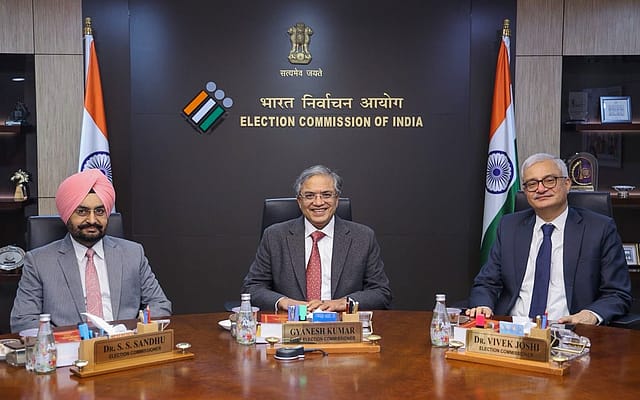
Who should help choose India’s election commissioners: the government of the day, the Opposition, or an independent constitutional authority? That question lies at the centre of a challenge to the law governing appointments to the Election Commission of India (ECI), after the Supreme Court delivered a split verdict on Wednesday on whether the case should be referred to a larger bench.
Justices Dipankar Datta and Satish Chandra Sharma differed on the question. Justice Datta rejected the plea for a larger-bench reference, while Justice Sharma held that the issue warranted consideration by a Constitution bench. The judges unanimously directed that the matter be placed before the Chief Justice of India (CJI) to consider constituting a bench of appropriate strength, observing that sending it first to a three-judge bench could cause further delay.

Zeroing In on ECI
09 Oct 2026 - Vol 05 | Issue 41
Constitutional legitimacy versus political opportunism
The court has not yet ruled on whether the 2023 law is constitutional. But the split verdict has brought renewed attention to a consequential change made by Parliament: the CJI, who was part of the interim selection committee prescribed by the Supreme Court in 2023, is no longer included in the statutory panel.
How did the CJI get removed from the panel?
The dispute goes back to the Supreme Court’s March 2, 2023 judgment in Anoop Baranwal v. Union of India. The Court had directed that appointments to the Election Commission be made on the advice of a committee comprising the Prime Minister, the CJI and the Leader of the Opposition in the Lok Sabha, until Parliament enacted a law governing the process.
Parliament subsequently passed the Chief Election Commissioner and Other Election Commissioners (Appointment, Conditions of Service and Term of Office) Act, 2023. The law replaced the interim arrangement with a committee comprising the Prime Minister, a Union Cabinet Minister nominated by the Prime Minister and the Leader of the Opposition in the Lok Sabha.
The CJI was thus excluded from the selection process. The President appoints the CEC and Election Commissioners on the committee’s recommendation.
Petitioners, including the Association for Democratic Reforms (ADR) and Jaya Thakur, have challenged Sections 7 and 8 of the Act, which lay down the appointment procedure. They argue that removing the CJI weakens the independence of the selection mechanism and undermines safeguards for free and fair elections.
Their concern is that the Prime Minister and the minister nominated by him could together determine the committee’s recommendation, leaving the Leader of the Opposition without an effective counterweight. The Centre sought a larger-bench reference, while the petitioners opposed it, arguing that another referral could prolong the case.
Why is the selection committee being challenged?
The petitioners argue that the appointment process must protect the Election Commission from executive influence because it is responsible for conducting elections. In their view, excluding the CJI diluted the safeguard established by the Supreme Court’s 2023 judgment.
The legal question is not simply whether the Prime Minister should be involved in appointments. It is whether the composition of the committee provides sufficient independence and checks when selecting the officials who oversee the electoral process.
The 2023 judgment had established the Prime Minister-CJI-Leader of Opposition arrangement as an interim measure, operating until Parliament made a law. Parliament then enacted a different mechanism, replacing the CJI with a Cabinet Minister nominated by the Prime Minister. The petitions ask the Court to examine whether that change is constitutionally valid.
Wikipedia
+1
What did the judges say?
Justice Datta raised preliminary concerns about whether the mechanism under the 2023 Act ensures an independent selection process. He questioned whether the committee’s composition appeared to give the Executive a veto and whether it would inspire public confidence in the Election Commission’s independence.
“Free and fair elections depend on a truly independent ECI. It is not enough for the ECI to be independent; it must appear to be independent,” Justice Datta observed.
He also questioned whether a Cabinet Minister nominated by the Prime Minister could reasonably be expected to vote against the Prime Minister, and whether the minister’s inclusion offered an independent counterweight to the Executive.
Justice Sharma, meanwhile, held that the constitutional validity of the law raised an issue requiring authoritative determination by a Constitution bench under Article 145(3) of the Constitution.
That provision requires a minimum five-judge bench when a case involves a substantial question of law concerning the interpretation of the Constitution. The judges differed on whether the matter warranted such a reference, not on the ultimate validity of the appointment law.
Why did the Court raise the issue of delays?
The hearing also focused on the time constitutional cases can spend waiting for larger benches. The Centre sought a reference, while the petitioners argued that doing so could delay adjudication further.
The bench acknowledged that constitutional matters referred to larger benches can remain pending for years. It said the concern was significant and observed that “self-introspection indeed is required”.
The judges also requested the CJI to consider constituting a permanent five-judge bench to hear and decide constitutional matters, with a view to addressing delays in cases requiring larger-bench consideration.
The request does not itself establish a permanent bench. It places the issue before the CJI for consideration, alongside the question of how the appointment-law challenge should proceed.
What happens next?
The Supreme Court had reserved its judgment in July on whether the petitions should be referred to a Constitution bench. Wednesday’s unanimous direction means the matter will now be placed before the CJI to consider constituting a bench of appropriate strength.
In 2024, the Supreme Court had declined to put on hold the appointments of two Election Commissioners under the 2023 Act. The present challenge concerns the validity of the appointment framework itself.
For now, the law remains in place, and the Court has not directed that the CJI be restored to the selection committee. The petitioners’ demand is still to be adjudicated.
The central question remains whether Parliament’s 2023 appointment mechanism provides sufficient safeguards for the independence of the Election Commission. The next stage of the case will determine how that constitutional challenge is heard; the final answer on the law’s validity is still pending.