Why India Will Play A Crucial Role In Coming Fight Over The Dalai Lama’s Reincarnation
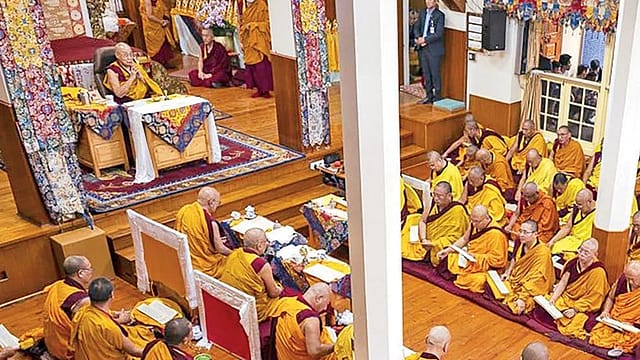
At the end of this month, Arunachal Pradesh will host a grand public exposition of the Buddha’s sacred relics. Organised by the Union Ministry of Culture in collaboration with the state government and the International Buddhist Confederation (IBC), a body that organises multiple Buddhist conferences and events throughout the year, this exposition will take place for about three weeks in three different locations in the state.
It will be a moment of great spiritual privilege for the locals and Buddhists from nearby states and countries like Bhutan who are expected to show up. It is also part of a larger geopolitical battle going on between China and India over Buddhism.
For years, Beijing has been trying to market its state-managed form of Buddhism and shape global Buddhist discourse. It has been spending lots of money building Buddhist temples and centres in other countries, hosting Buddhist conferences that draw thousands of scholars, and dispatching sacred relics and artefacts to countries with Buddhist populations to wield its version of the faith as a tool of soft power. In response, India has begun doubling down on promoting its own historical links with Buddhism and leveraging it. Whether it is intervening to get an auction of the sacred Piprahwa relics stopped in Hong Kong and then having it returned to India, stepping up its own relic diplomacy, or organising Buddhist conferences and public expositions of sacred relics such as the one that will take place in Arunachal Pradesh, India has begun challenging China in this geopolitical contest over the faith.
Zeroing In on ECI
09 Oct 2026 - Vol 05 | Issue 41
Constitutional legitimacy versus political opportunism
In this interview, Kate Saunders, a Tibet specialist who is part of Tibet Watch, a human rights research and advocacy group that focuses on Tibet, talks about this growing competition over Buddhism, and the big challenge that will emerge over the Dalai Lama’s future reincarnation.
Question:
Over the years we’ve witnessed massive Chinese attempts to use its state-managed version of Buddhism as a tool for outreach abroad, whether it is organising large Buddhist events and conferences or spending millions on Buddhist temples and centres for instance in Nepal. Can you please talk about the reasons behind China’s co-option of Buddhism and the manner in which it is using it to further its interests globally?
Answer:
China’s Buddhist diplomacy only makes sense when you look at what the Party is doing to Buddhism at home, and why. In Tibet, it imposes Party rule over monasteries, imprisons Tibetans for keeping the Dalai Lama’s picture and blocks even online teachings, as it escalates policies of forcible assimilation.
The CCP views Tibet as essential to its vision of political and economic global dominance, making control over the plateau a non-negotiable element of state policy. An independent Tibetan Buddhist identity and history are seen as obstacles to China’s ambitions. Beijing regards managing the Dalai Lama’s succession and installing an official candidate as integral to its ‘sovereignty’ over Tibet and its territorial imperatives. It now also seeks to control global Buddhist discourse, to ensure that no figure with the popularity and stature of the Dalai Lama can emerge in future, and to end international support for Tibet. The scope and scale of these efforts show both the importance Beijing places on the issue and its underlying anxieties about maintaining control.
China’s approach to Buddhism and the Dalai Lama’s leadership therefore goes far beyond religious control. It encompasses crucial geopolitical, economic and environmental interests. The first is control of the borders: Chinese incursions have tripled since Xi Jinping came to power, and China has built settlements and military installations on territory Bhutan regards as its own. The second is the expansion of mining on the resource-rich Tibetan plateau, which holds at least 85 percent of the People’s Republic of China’s (PRC) lithium reserves as China seeks global supremacy in electric vehicles and renewables. The third is control of Tibet’s water: the plateau holds the headwaters of Asia’s major rivers, critical to China’s own water scarcity and vital for millions of people downstream.
Alongside direct repression and the imposition of Party control over Buddhism in Tibet, China is waging a multi-faceted campaign to counter Tibetan Buddhism’s global influence and to consolidate control over religious institutions beyond its borders. This campaign combines traditional hard-power tactics with new approaches to cognitive warfare. It leverages economic influence, social media manipulation and institutional control to reshape the Buddhist landscape. Beijing seeks to spread disinformation, fragment communities and control narratives. Its digital and physical targeting of Tibetan diaspora groups in India and elsewhere demonstrates its determination to suppress alternative sources of authority and identity.
The methods combine money, institutions and pressure:
1. Beijing has institutionalised its claim to leadership through the World Buddhist Forum, which it uses to promote its own Panchen Lama, Gyaltsen Norbu. At the first Forum, in Hangzhou in 2006, the Dalai Lama — the world’s best-known Buddhist teacher — was not invited.
2. China has founded the Nanhai Academy of Buddhism to “offer the world a Sinicised Buddhist system”, positioned as a rival to India’s revival of Nalanda. Its head has described a Xi Jinping report to the Party Congress as “contemporary Buddhist scripture”.
3. China funds Buddhist organisations across Asia in exchange for loyalty. It presses governments to refuse the Dalai Lama visas and to block publication of his books.
4. It has had Tibetan and Indian scholars removed from international Buddhist initiatives. In Thailand, Tibetans were eased out of a major Buddhist translation project and Tibetan sources were reduced to footnotes.
5. In Sri Lanka, Chinese diplomats went to a monastery in the central highlands to complain after monks proposed inviting the Dalai Lama and denounced him as a dangerous “separatist”.
Nepal shows the strategy most clearly. Beijing seeks to make Lumbini, the Buddha’s birthplace a few kilometres from the Indian border, a rival in the Buddhist imagination to Bodh Gaya in India. Bodh Gaya is where the Buddha attained enlightenment, and where the Dalai Lama taught almost every winter until the pandemic. A Chinese-backed foundation proposed a $3 billion development of Lumbini, with temples, an airport, hotels and a Buddhist university to train young monks. The Buddhist Association of China, of which the Chinese-installed Panchen Lama is a vice-president, joined the project. It stalled, but the ambition has not gone away. In December 2024, Lumbini Buddhist University and a Beijing university inaugurated a China Institute at the then Nepalese Prime Minister’s residence.
China also goes to extreme lengths to control influential Buddhist figures even beyond PRC borders. Hungkar Dorje Rinpoche, a 56-year-old reincarnate lama and head of a monastery in Tibet, had escaped into exile in Vietnam after facing persecution by Chinese authorities for his commitment to preserving Tibetan language and cultural identity. He died in mysterious circumstances in March 2025, after apparently being detained in a joint cross-border operation by Chinese and Vietnamese security agents in Ho Chi Minh City.
Question:
In recent years, India has stepped up its own efforts to highlight its links to Buddhism and use it as a soft power tool. It has begun organising international Buddhist conferences, frequently dispatches Buddhist relics abroad, and there’s also talk of reviving and promoting India’s ‘Buddhist circuit’, etc. What do you make of these efforts?
Answer:
In the geopolitical contest as China seeks to assert dominance, India has a crucial role. It is where the Dalai Lama and the exile Tibetan administration are based. It is also where the Gaden Phodrang Trust [to whom the Dalai Lama formally vested exclusive authority to pick the next reincarnation] will need institutional and political space and support to carry out the role the Dalai Lama has given it in leading the succession process.
India has real assets, and it has started to use them. The IBC emerged from a global gathering in Delhi in 2011, which the Dalai Lama attended, and India hosts gatherings of Buddhists from across the world. At the Global Buddhist Summit in Delhi in 2023, Prime Minister Modi reminded the world that India gave it “Buddh, not Yudh”: the Buddha rather than war.
Relic diplomacy deserves to be taken seriously, because its devotional weight is real. For Buddhists across Asia, the bodily relics of the Buddha and his disciples are a form of his presence, not museum pieces. To pay homage to them is an act of merit that many devotees will only have the chance to perform once in a lifetime, and people queue for hours to do so. The Piprahwa gems, interred with relics associated with the Buddha’s own Sakya clan, were withdrawn from auction in Hong Kong after Indian protests and brought home. Their exposition, which Prime Minister Modi inaugurated in January 2026, was an act of reclaiming the sacred from the marketplace. India sent the Devnimori relics for exposition in Colombo this year. In May, an Indian Air Force aircraft carried relics of the Buddha’s two chief disciples to Gandan Monastery in Ulaanbaatar.
Mongolia matters here. It is a democracy whose economy depends on China, whose governments have leaned towards Beijing, and whose young spiritual leader, the Bogd Lama (Jebtsundamba) recognised by the Dalai Lama, has made it a frontline in the contest over Tibetan Buddhism. The relics were sent to Gandan rather than to a forum in China, and they were sent by the country where the Buddha taught. That says something Beijing cannot easily say: that the source of the tradition lies in India. Beijing has its own relic diplomacy, but it cannot claim the sites of the Buddha’s life.
Question:
Are these efforts working?
Answer:
The question is whether these gestures add up to a strategy. Here India’s policy remains transactional. Delhi calibrates Tibet and the Dalai Lama against its relationship with Beijing, raising them when it wants to signal displeasure and lowering them when it seeks stability.
Nalanda is one of the clearest examples. All four schools of Tibetan Buddhism trace their lineage to Nalanda. By the time it was destroyed, Tibetan translators had already carried much of the Buddhist canon to the plateau, and many regard the Dalai Lama as Nalanda’s living throne-holder. Yet when Prime Minister Modi inaugurated the revived Nalanda University in June 2024, the Dalai Lama was absent and the Chinese Ambassador was present.
This matters because India’s real strength lies not in heritage but in living authority, and that cannot be turned on and off. India hosts the re-established great monastic universities of the Tibetan tradition, while some 50 million people across the Indian Himalaya share deep religious ties with Tibet, and many revere the Dalai Lama. Devotees from across Asia, and from China, travel to Dharamsala because he can no longer travel to them. In 2024, Sri Lankan monks brought sacred relics to him in Dharamsala despite Chinese pressure, following visits to Sri Lanka by Ling Rinpoche, a young lama who is now a trustee of the Gaden Phodrang Trust. That gesture carried more weight than any official summit, because it showed where Buddhists themselves locate religious authority.
India’s outreach has succeeded in reminding Asia that the Buddha belongs to India’s story. It has not yet converted that into strategic advantage or fully acknowledged the Dalai Lama and the living Tibetan tradition as a lasting asset. Relics remind the world where Buddhism came from. But India cannot fully claim the Buddha’s legacy without taking a clear position on the most consequential question now facing the Buddhist world: whether an atheist state will be allowed to choose the next Dalai Lama.
Question:
When it comes to the issue of the Dalai Lama’s reincarnation, China routinely warns India against getting involved. Firstly, what do you think are Beijing’s concerns about India over this issue?
Answer:
India – as home to the Dalai Lama, the Central Tibetan Administration and the great monastic institutions of Tibetan Buddhism in exile – is the principal target of China’s military, economic and diplomatic pressure over the future of the Dalai Lama institution. The Dalai Lama has stated that the Gaden Phodrang Trust alone will have the authority to recognise his reincarnation, and that trust is based in India. Whatever Beijing does, the legitimacy of the succession will be decided by Tibetan Buddhists, and much of that process will unfold on Indian soil.
This matter is also inseparable from the border, and from India’s security. Tawang, the birthplace of the Sixth Dalai Lama, was overrun by Chinese troops in 1962. It is the one birthplace of a Dalai Lama still freely accessible to pilgrims. It is also where the present Dalai Lama first sought refuge after his escape in 1959. China claims Tawang and the whole of Arunachal Pradesh as ‘south Tibet’, and Chinese official media insist Beijing can “never give up the place”. When the Dalai Lama taught in Tawang in 2017, Beijing accused India of escalating the boundary dispute.
Under Xi Jinping, who aims to forge a “great wall of steel” along China’s frontiers, Chinese border incursions have tripled. As the Dalai Lama ages, military activity across the Line of Actual Control has intensified. Beijing is also working to draw India’s Himalayan neighbours into its orbit. In October 2023, it hosted officials from Nepal, Bhutan, Mongolia and Pakistan at a trans-Himalayan forum in Nyingtri, across the border from Arunachal Pradesh, and pointedly left India out. Delegations from the Tibet Autonomous Region have toured areas bordering Ladakh, Himachal Pradesh and Uttarakhand and new ‘defence’ villages facing Arunachal. This is the context in which Beijing has made clear that any refusal by India to recognise a Dalai Lama chosen by China will damage bilateral ties. In July 2025, Union Minister Kiren Rijiju said only the Dalai Lama and his office could decide the succession. The Chinese embassy in Delhi responded by calling the succession a “thorn” in relations and warning that playing the “Xizang card” would backfire on India. The contest over the succession is not a future scenario. It is under way now, along India’s own frontier.
Question:
Are there concerns that New Delhi may not have put together a comprehensive plan on this matter and that China would look to exploit such a vulnerability?
Answer:
India is not yet prepared. Its official line is that it takes no position on matters of faith, while describing the Dalai Lama as an ‘honoured guest’. This has produced an inconsistent and uncoordinated approach, which only weakens India. The former Foreign Secretary and ambassador to Beijing Vijay Gokhale has warned that inaction will not be sustainable. He also warns that any unilateral gesture intended to please Beijing will not be reciprocated.
China will seek to exploit that gap. Beijing’s preparations go back decades, including:
1. In 2000, with little attention, it installed a two-year-old as the Reting Rinpoche. This is one of the lineages that historically acted as regent while a Dalai Lama was a minor.
2. It cultivates the anti-Dalai Lama Shugden sect. The possibility that the sect could be used to put forward a rival candidate in exile cannot be ruled out.
3. It already circulates disinformation about the Dalai Lama’s health and character.
Beijing will press Nepal, which has already declared Tibet China’s internal affair, as well as Mongolia and Bhutan, to endorse its choice. It will also seek to make India’s position part of the bargaining over trade and the border. The current thaw in relations increases the pressure on Delhi to remain silent rather than reducing it.
India could now adopt clear language as a core position: the succession is a strictly religious matter for the Dalai Lama and the Tibetan Buddhist community, and India will reject any external interference. This is consistent with India’s own constitutional principle that religious denominations manage their own religious affairs. India can become the centripetal force safeguarding the sanctity of the process and can refer to the Dalai Lama as the leader of the Tibetan people rather than merely an honoured guest. It would not be alone. United States law already provides for sanctions on Chinese officials who interfere in the succession, and the European Union affirms the right of religious communities to choose their own leaders. What is missing is India’s voice, which matters most. Taking this position would not be interference in China’s affairs. It would be the defence of religious freedom on India’s own soil.