Delhi firecracker sales touch ₹300 crore: Traders blame stubble burning for pollution
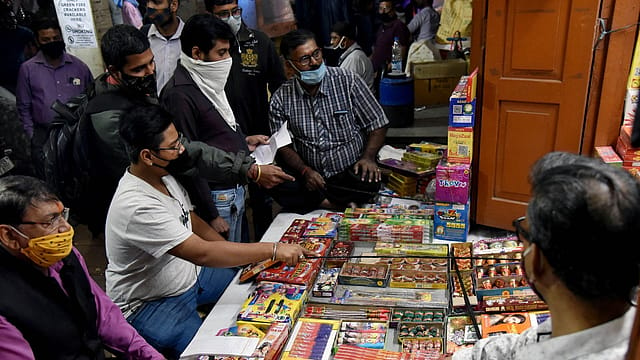
Firecrackers may have left Delhi under a blanket of smoke, but they also generated an estimated ₹300 crore in business during Diwali, according to the Chamber of Trade and Industry (CTI). Its chairman, Brijesh Goyal, said on Tuesday that the capital remained a major market for fireworks, most of which are brought in from Sivakasi and other manufacturing centres.
Goyal argued that traders could have planned their sales better if permissions had been granted earlier.
"Firecracker sales were good this Diwali, with business estimated at around Rs 300 crore. Delhi is a major market, although most firecrackers come from Sivakasi and other places. Earlier permission would have helped businesses manage sales better," he said.

The Wealth Issue 2026
06 Nov 2026 - Vol 05 | Issue 45
Portraits of Dreamers and Doers under 35
CTI says firecrackers are being unfairly blamed for Delhi pollution
The trade body's argument is that Diwali fireworks cannot explain Delhi's entire pollution problem. In a letter dated November 10 to political parties, the CTI said it opposed pollution but did not believe firecrackers should be held entirely responsible for the capital's poor air quality.
It pointed to AQI readings of between 350 and 400 on November 5, 6 and 7, before Diwali was celebrated on November 8. "That pollution was caused by whom? No firecrackers were burst at that time," the letter said.
Goyal also argued that the city experiences deteriorating air quality between October and January, when stubble burning and other sources add to the pollution burden.
"Firecrackers are being unfairly blamed for Delhi's pollution. While they do cause some smoke, their impact is temporary. Pollution levels are already high between October and January, even before Diwali, so stubble burning and other sources must also be addressed," he added.
Delhi's post-Diwali AQI improves, but pollution remains a concern
The latest readings offer some context to the debate. Delhi recorded an average AQI of 376 on Diwali, November 8, its highest Diwali-day reading in five years, according to reports citing Central Pollution Control Board data. The reading remained around 370 on November 9.
By November 10, the city's average AQI had improved to 299, entering the 'poor' category, according to NDTV's report citing CPCB data. However, 23 of the 57 monitoring stations reporting readings were still in the 'very poor' category.
There is also evidence that fireworks added to the pollution load. An analysis of CPCB's 15-minute readings by Hindustan Times found that average PM2.5 concentrations across 39 monitoring stations rose from 190 micrograms per cubic metre shortly before 8 pm on Diwali to 259 micrograms per cubic metre after fireworks began. That does not make crackers the only source, but it does show their contribution cannot simply be dismissed.
Traders warn restrictions threaten livelihoods
The CTI said the firecracker industry supports around 10 lakh people across the country, including manufacturers in Sivakasi and small retailers in Delhi. According to the organisation, many traders invest throughout the year and depend on the 15-20 days around Diwali to earn a substantial share of their annual income.
It also claimed that businesses had invested in licensed stocks and green firecrackers, leaving them exposed to losses when restrictions arrive at short notice.
The Supreme Court had allowed the sale and use of certified green crackers in Delhi-NCR for November 7 and 8, with bursting permitted only between 6 am and 7 am and 8 pm and 10 pm. The temporary relaxation ended on November 8, with the complete ban restored from November 9.
CTI proposes green crackers and limited timings instead of a complete ban
Rather than a blanket prohibition, the trade body has proposed allowing fewer firecrackers, restricting their use to designated hours and encouraging green alternatives. It also raised concerns about what it described as selective restrictions on Hindu festivals, naming Diwali, Holi, Chhath, Kanwar Yatra and Ganesh visarjan.
The letter asked political parties to work with the Central government to tackle stubble burning in their respective states. It also challenged them to guarantee that Delhi's AQI would not cross 300 between October and January if firecrackers were completely prohibited.
The CTI's appeal is ultimately for a solution that addresses pollution throughout the year, rather than focusing on a single festival or industry.
"We want clean air, businesses to continue, traditions to be preserved, children's happiness to remain and the law to be equal for everyone," the letter stated.
(With inputs from ANI)