Why Is Bollywood Reluctant To Make Corporate Biopics?
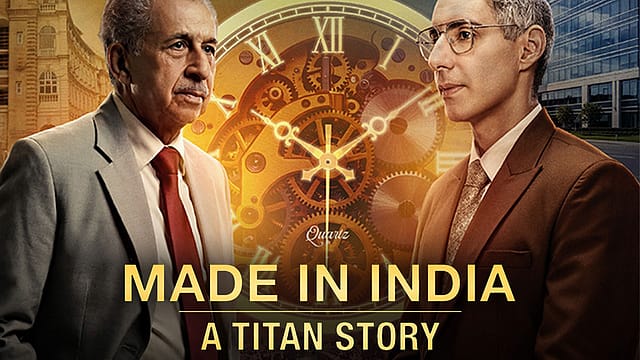
Recently, I watched in one-go the web series Made in India: A Titan Story, directed by Robbie Grewal. The six-episode docudrama focuses on Xerxes Desai, the man who built Titan from scratch. Undoubtedly, he made India proud by creating Brand Titan, which has become a globally respected name. He was also fortunate to have the blessings of the legendary JRD Tata.
Now let me connect the dots.
While I was in college, I worked at Tata Press (1976-79) as a proofreader. The managing director then was Xerxes Desai. Before joining Tata Press, he had worked at CIDCO and was handpicked by JRD Tata to turn around the company. He did so admirably with a team largely drawn from CIDCO.
The Identity Project
11 Sep 2026 - Vol 05 | Issue 37
Amit Shah leads the mission for a national demographic correction
The series shows how Xerxes Desai battled a smuggler-driven watch market to build a world-class Indian brand. However, what it doesn't reveal is that his first attempt to launch watches had failed. I distinctly remember that he had launched a watch under the Tata Hegde & Golay name, and I had even seen the prototypes. At the time, Tata Press had borrowed Rs 10 lakh from Bank of Baroda, ostensibly as working capital, but the money was diverted to new projects — something that was not uncommon in those days.
But this was not acceptable to Bank of Baroda. Under pressure from the bank, the watch project was put in cold storage. In hindsight, that proved to be a blessing in disguise. Otherwise, Titan may never have seen the light of day.
While the series largely revolves around Xerxes Desai, it spends considerable time on side stories. It also made me wonder why Indian filmmakers are reluctant to make biopics on iconic industrialists such as JRD Tata, G D Birla, Dhirubhai Ambani, Aditya Birla, Walchand Hirachand, the Bajaj family and the Sarabhais, to name a few. I am told someone is attempting a film on Ratan Tata. Better late than never.
To my mind, even a biopic on Vijay Mallya or Lalit Modi would fly. Their lives have all the ingredients of a box-office blockbuster.
This brings me to the larger question: is there a market for corporate biopics? Judging by Hollywood, the answer is an emphatic yes.
Interestingly, I have watched the Tamil classic Kappalottiya Thamizhan (The Tamilian Who Launched a Ship), released in 1961. The black-and-white film was based on the 1944 biography by M P Sivagnanam on V O Chidambaram Pillai, who founded the Swadeshi Steam Navigation Company to challenge the British monopoly over maritime trade. It performed well in its time.
Then there was Guru, directed by Mani Ratnam, which was clearly inspired by the life of Dhirubhai Ambani. Although no real names were used, every frame echoed Dhirubhai's remarkable rags-to-riches journey.
Likewise, The King of Good Times is the opening episode of Netflix's 2020 documentary series Bad Boy Billionaires: India, chronicling the spectacular rise and fall of liquor baron Vijay Mallya.
More recently, I read about G.D.N., starring R Madhavan as G D Naidu, often described as the "Edison of India". Though I haven't watched the film, reviews suggest it captures Naidu's journey from a self-taught innovator to one of India's pioneering industrialists.
For Tamil superstar Suriya, Soorarai Pottru (Hail the Brave) proved to be a career-defining film. Loosely based on the life of Air Deccan founder Capt G R Gopinath, it tells the story of the man who democratized air travel by making flying affordable for the common man. The film was both a critical and commercial success.
Similarly, Pad Man, starring Akshay Kumar, is based on the true story of Coimbatore-based social entrepreneur Arunachalam Muruganantham, who revolutionised menstrual hygiene by inventing a low-cost sanitary pad-making machine. So inspired was Akshay Kumar by his story that he decided to produce the film himself.
There are countless biographies of business leaders, many of them commissioned, but only a handful of films or web series on iconic entrepreneurs. Even though India has produced some of the world's greatest wealth creators, nation builders and business visionaries.
Is it because entrepreneurs are uncomfortable projecting a larger-than-life image? Or is it because they insist on factual accuracy down to every comma, making even minor cinematic dramatizations get legal notice. For instance, in the Titan web series, HMT is referred to as GMT.
Similarly, the 10-episode docudrama Scam 1992: The Harshad Mehta Story, directed by Hansal Mehta, was a runaway success. Harshad Mehta's dialogue, "Ishq hai toh risk hai", and the series' signature tune became hugely popular. The makers made a sincere effort to portray the dramatic rise and spectacular fall of the stockbroker with remarkable authenticity.
Malayalam superstar Prithviraj Sukumaran, who was slated to direct and star in Biscuit King, a web series based on Rajan Pillai, appears to have shelved the project. Yodlee Films, a subsidiary of Saregama, had announced the project in December 2021. Rajan Pillai, once known as the "Biscuit King", died a tragic death in Tihar Jail in 1995.
When the project was announced, Prithviraj had remarked: "This story has it all — ambition, success, a jet-setting lifestyle and then a hubris-induced fall. It will be fascinating to discover what made this charismatic personality tick and to relive his intriguing, complex life."
So which category of biopics works best?
It appears that films on sports personalities and movie stars generally perform well because audiences emotionally connect with their heroes. Not surprisingly, films glorifying the underworld also attract huge audiences. Gangster dramas possess all the ingredients of an engaging commercial entertainer.
When I looked at the numbers, I was surprised to discover that more than 80 biopics have been produced in India over the past two decades.

Clearly, several factors discourage filmmakers from attempting corporate biopics.
Hollywood, on the other hand, has mastered the art of turning corporate battles into compelling cinema. More importantly, it names names.
Hollywood has mastered the art of telling corporate stories with the tension of a thriller.
Barbarians at the Gate tells the extraordinary story of F Ross Johnson, CEO of RJR Nabisco, and the legendary leveraged buyout by KKR. It was a gripping film.
The Social Network narrates how Mark Zuckerberg built Facebook. Made on a budget of $40 million, it grossed over $224 million worldwide and won three Academy Awards.
The Wolf of Wall Street chronicles Jordan Belfort's meteoric financial rise and spectacular criminal downfall. It earned more than $400 million globally.
The Founder, starring Michael Keaton, depicts the ruthless business manoeuvring through which Ray Kroc wrested control of McDonald's.
Joy, featuring Jennifer Lawrence, tells the story of a single mother who overcomes personal and corporate obstacles to build a business empire around an innovative household product.
Air, directed by Ben Affleck, captures Nike's bold gamble in signing an unknown rookie named Michael Jordan — a decision that transformed sports marketing forever.
Why does Hollywood consistently succeed with corporate biopics?
American audiences seem naturally receptive to stories celebrating the American Dream, capitalism and disruptive entrepreneurship. Hollywood doesn't present dry corporate history. Instead, it portrays entrepreneurs as flawed, obsessive visionaries battling impossible odds. That creates high drama.
Ultimately, every successful biopic carries the same underlying message: someone dared to dream, fought overwhelming odds and eventually succeeded.
Such stories are both inspirational and aspirational. After all, everyone loves a fairy tale — as it has happy ending.