Auroville’s Hybrid Energy Experiment: Can Its Decentralised Renewable Model Work for the Rest of India?
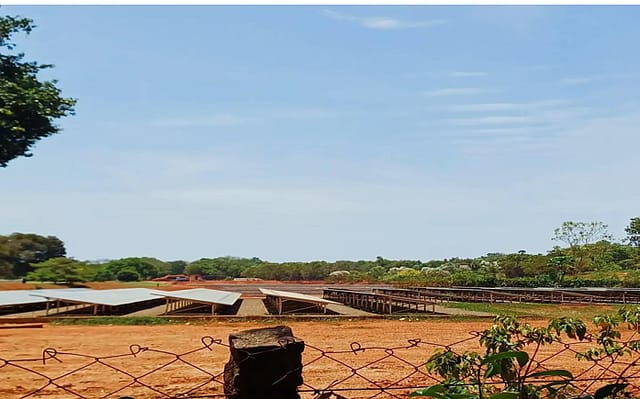
Auroville began experimenting with the sun long before solar roofing became a government initiative and renewable energy became the vocabulary of corporate boardrooms. The 1970s saw the introduction of solar energy to the town. In 1991, a 36-kWp stand-alone solar system was erected at the Matrimandir, making it one of the largest such systems in India. Over the years, Auroville has been growing with photovoltaic systems, wind turbines, solar water heating, solar cooking, biomass, and other decentralized technologies. Its Center for Scientific Research was a testing ground for technologies that hovered on the fringes of India’s mainstream energy system. Auroville today presents a fascinating conundrum. It has spent decades showing that renewable energy can be part of everyday life but has never completely separated itself from the conventional electrical grid. That’s not a failure necessarily; rather, it's the most important lesson that Auroville has to teach us.
According to Auroville’s energy data, solar accounted for 23% of Auroville’s electrical mix in 2022, with wind at 18% and grid electricity at 59%. That year, the community utilized 6,145 MWh of power and met almost 41% of its demand with renewable generation. It now has about 800 kW of grid-connected rooftop solar and 400 kW of off-grid solar. The numbers punctuate the idyllic notion of a settlement powered exclusively by sunlight. Auroville is not a self-sufficient energy island. It is a more complicated situation: a community experimenting with how decentralized renewable energy may coexist with a centralized infrastructure. And the distinction is really important for India.

Zeroing In on ECI
09 Oct 2026 - Vol 05 | Issue 41
Constitutional legitimacy versus political opportunism
The laboratory issue
Auroville's greatest strength as an energy experiment is simultaneously its greatest drawback as a national model. It is a remarkable location. Established as an experimental international township, it has attracted researchers, architects, engineers, environmentalists, and foreign volunteers. Its institutions have spent decades honing their technical competence in renewable energy, water management, ecological construction, and decentralized infrastructure. As a result, the community has something that many other villages have not: continuous experimenting. According to Auroville's Solar Service, solar was introduced in the neighborhood in the 1970s, and nearly 150 homes have run totally on solar PV electricity, while many others utilize solar as a backup to traditional grid electricity. However, technological success in an especially driven community does not always transfer into widespread acceptance elsewhere.
A farmer cannot necessarily afford a rooftop system because Auroville does. A low-income home may be unable to purchase batteries because a community workshop has established knowledge in solar technology. A hamlet cannot simply replicate an energy system that relies on decades of institutional knowledge. This is the first hard question for India's decentralized energy ambitions: Are we scaling technology or the institutional conditions that enable it to function? India has gotten really adept at announcing renewable-energy capacity. It is unclear whether it has resolved the issue of who maintains, finances, repairs, and administers decentralized systems once the initial project is completed. The history of Auroville implies that the second difficulty may be more difficult.
Solar panels are the simple part
The allure of the energy revolution is its hardware: panels on rooftops, batteries in buildings, and wind turbines in the distance. However, electricity functions as a system. It needs to be created, stored, balanced, transported, distributed, paid for, and maintained. A decentralized system must tackle these difficulties on a smaller scale, without the financial or technological advantages that huge utilities have. Auroville is currently creating its own underground power grid. Since 2014, it has been working toward an Auroville-owned and operated high- and low-tension network, with the goal of allowing locally generated solar electricity to be used by other buildings in the community rather than being exported to the public grid in big quantities. It has also identified storage and demand-side management as important future steps. That is important.
It implies that even a community with decades of renewable-energy testing has encountered the same challenge as the rest of India's energy transition: intermittency. When there is no need for power, the sun does not provide it. Wind does not blow on the schedule set by the electricity client. A renewable-heavy electrical system, therefore, necessitates flexibility—via storage, demand management, stronger grids, or a combination of the three. Auroville's own experience convincingly indicates that installing solar panels every place is not the same as developing a solar-powered energy infrastructure.
The grid did not disappear
Another lesson can be drawn from Auroville's 59% reliance on the grid. For years, energy discussions have been framed as a choice between centralized fossil-fuel systems and decentralized renewable systems. However, the future may be significantly less ideological. The practical question is not whether the grid will endure. This is what the grid will become. Auroville's evolving concept suggests a hybrid architecture that includes local generation, local consumption, storage, and an external grid that stays operational when renewable output is insufficient. That could be especially relevant in India, where decentralized solar is growing even as electricity demand rises.
Tamil Nadu provides a good context. The state is already a leader in renewable energy in India, but incorporating more solar and wind into the electrical system would necessitate infrastructure upgrades, storage, and improved management of changing generation patterns. Auroville Consulting's research identified several problems in scenarios for Tamil Nadu's renewable-energy expansion. The paradox is quite stark. Auroville began as an experiment to break free from traditional development notions. Decades later, its energy experiment is increasingly focused on how decentralized systems may be made compatible with the infrastructure that they were originally supposed to avoid. Perhaps this is progress.
But who can afford to do the experiment?
There is a more fundamental political question. Because sunlight is abundant everywhere, India's renewable transition is sometimes portrayed as fundamentally democratic. However, whereas sunlight is free, energy infrastructure is not. The costs of panels, inverters, batteries, wiring, maintenance, and financing may exclude households that have the most trouble paying their power bills. There's also the question of ownership. Who is the owner of the panels? Who benefits financially from excess electricity? Who is responsible for paying if an inverter fails? Who is responsible for replacing a battery? Who decides whether power should be prioritized for domestic usage, irrigation, refrigeration, schools, or small businesses? These are not technical questions. These are questions of energy justice.
Auroville has had institutional systems in place to facilitate collective experimentation for a long time. Renewable energy is not just an individual consumer purchase; it’s got energy services, research institutions, and community partnerships. When trying to replicate decentralized energy schemes elsewhere, the institutional layer is often missing. The danger is that India adopts the most obvious aspect of the Auroville model—the solar panel—while ignoring the less visible aspect: the social and institutional architecture required to make it function.
Beyond utopia
Auroville's renewable-energy story is valuable because it is incomplete. According to the community's own data, renewable energy does not immediately eliminate grid dependence. Its plans recognize the need for demand control and storage capacity. Its experiments demonstrate that decentralization necessitates the creation of its own infrastructure. This reduces Auroville to a warning against blueprints rather than a blueprint itself. India doesn't need a thousand Aurovilles. It must determine which components of the experiment can travel. The takeaway message may not be that every community should become a solar microgrid. It's possible that energy planning should start at the community level rather than at the generation capacity level.
A village with solar panels but no technician isn't energy-efficient. A school with a rooftop system but no battery replacement fund is not energy self-sufficient. A household that obtains a subsidized panel but cannot afford maintenance has not necessarily been empowered. And a state that adds gigawatts of renewable power without preparing to accept that electricity has not completed its energy shift. Auroville's experiment should not be judged on whether it has established a perfect renewable-energy nirvana. No, it has not. Its importance rests elsewhere.
For nearly half a century, it has tested a question that India is now forced to confront on a massive scale: can electricity become more local without becoming less reliable, more democratic without becoming more expensive, and cleaner without simply reproducing the inequalities of the old energy system? Auroville did not respond to all three. But perhaps that is precisely why it is worth investigating. The true test of Auroville's energy strategy will not be its ability to run on solar power. It will be determined whether the lessons learned beneath its peculiar canopy can be carried forward after leaving.