Herd Mentality in Business: Few Thrive, Some Survive, Most Fall By The Wayside
The numbers stunned me. According to the Nasscom–Zinnov GCC Landscape Report released in 2026, there are already 2,117 Global Capability Centres (GCCs) operating across 3,728 units in India, employing 2.36 million people and generating revenues of nearly $100 billion. Few had imagined that the GCC ecosystem would grow at such a scorching pace. One could say GCCs have mushroomed at the speed of light!
That's herd mentality for you.
An article on LinkedIn describes “herd mentality as a well-known phenomenon in the business world, where people tend to follow the crowd rather than think independently. It is a psychological tendency to adopt the beliefs or behaviour of a group instead of making decisions based on independent research and analysis.

Losing Memory
16 Oct 2026 - Vol 05 | Issue 42
The making of a medical and social emergency
Herd mentality can be observed in different areas of business, including investing, marketing and product development. When investors follow one another and buy the same stocks, they can drive prices far beyond their intrinsic value.”
Herd mentality is a recurring theme in Indian business history. As a business journalist, I have seen it across several sectors — leasing, plantations, polyester, mini-cement, steel, auto ancillaries, coaching classes, telecom, aviation, power and pharmaceuticals. Now, the flavour of the season is GCCs.
When businessmen see a success story, they naturally ask: Why reinvent the wheel or create a new market when somebody has already demonstrated that the business model works?
But following the herd does not necessarily mean copying the leader. Sometimes, late entrants rewrite the rules of the game. IndiGo and Reliance Jio are powerful examples.
In the case of IndiGo, the approach was simple. It positioned itself as a no-frills airline with an intense focus on punctuality, operational efficiency and affordable fares. For regular travellers frustrated by delays and poor service, punctuality and squeaky-clean aircraft mattered enormously. IndiGo made these its calling cards.
In the case of Reliance Jio, it reinvented the economics of mobile telephony and, in the process, disrupted the industry through scale, capital and pricing power.
This has been the Ambanis' playbook. If one recalls, Reliance did something similar in the synthetic textiles sector. It built an integrated petrochemicals-to-polyester business while several competitors depended on imported raw materials, outside suppliers, ageing machinery or high-cost manufacturing.
Economies of scale gave Reliance formidable pricing power that many competitors simply could not match. The result: several went belly-up.
Back to telecom. India's mobile sector, which once boasted a dozen or more operators, has been reduced to a handful, largely because of exits and consolidation.
How many people today remember names such as Aircel, Reliance Communications, Tata Docomo, Telenor, Videocon Telecom and MTS?
Clearly, Jio's entry in 2016 changed the complexion of the industry. Its aggressive pricing strategy, backed by unprecedented investments in infrastructure, accelerated consolidation. During its launch phase, Jio offered free voice calls and promotional free 4G data services.
Today, one could say that India's mobile telephony market is effectively dominated by two players — Jio and Bharti Airtel. Of course, Vodafone Idea remains the third private player, but it continues to face considerable financial pressure.
Once upon a time, India's aviation sector was dominated by government-owned Air India, primarily serving international routes, and Indian Airlines, which largely operated domestic services.
Private airlines entered the scene following the economic liberalisation of 1991. Surprise, surprise! Several were grounded within a few years of commencing operations. They included East-West Airlines, Damania Airways, ModiLuft, NEPC Airlines and Archana Airways.
Other players entered or expanded their presence over the following decade. Many of them also hit severe air pockets.
The casualties included Air Sahara (1993–2007), JetLite (2007–2019), Kingfisher Airlines (2005–2012), Air Deccan (2003–2008, before its merger with Kingfisher), Go First, formerly GoAir (2005–2023), and Jet Airways (1993–2019).
Indian aviation proved that obtaining an airline licence and acquiring aircraft were easier than keeping an airline profitable.
Over the decades, numerous private airlines have ceased operations, many because of financial distress. Everybody wanted to fly, but only a few could stay airborne.
Interestingly, India's power sector offers different examples of herd behaviour.
During the 2000s, entrepreneurs rushed into thermal power projects, encouraged by rapid economic growth, ambitious electricity demand projections and generous bank lending. Companies announced massive projects.
But several players subsequently encountered coal shortages, rising fuel costs, delayed clearances, financially weak electricity distribution companies and unsustainable debt.
The problem of stressed and stranded assets became particularly severe during the 2010s. Missing fuel linkages, the absence of Power Purchase Agreements and aggressive tariff bidding compounded the crisis.
A Parliamentary Standing Committee identified 34 stressed coal-based thermal power projects, with outstanding debt of approximately Rs 1.74 lakh crore as of June 2017.
Incidentally, the herd did not consist only of businessmen. Banks, consultants, equipment suppliers and policymakers also jumped on the bandwagon.
So, this brings me to the key question: What is the rationale behind herd mentality? Why do businessmen prefer to follow rather than pioneer?
A quick internet search offers some interesting insights.
Proof of concept: The pioneer has already demonstrated that customers exist and are willing to pay.
Lower experimentation costs: Followers learn from the pioneer's mistakes and can improve the product or business model.
Easier funding: Banks, private equity funds and venture capitalists are generally more comfortable financing a proven business model.
Ready-made ecosystem: Suppliers, distributors, technology, trained employees and customers are already available.
Faster scalability: A late entrant with deep pockets and superior execution can sometimes overtake the pioneer.
But here lies the rub.
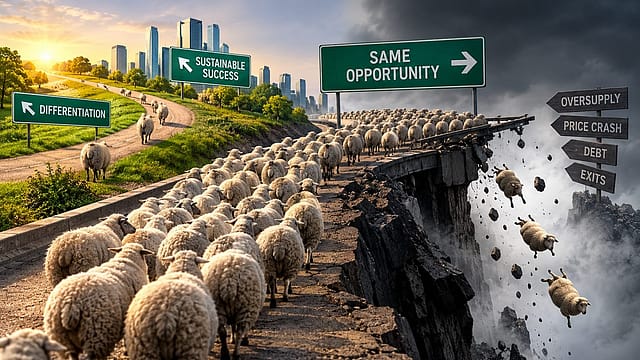
When everybody spots the same opportunity and starts building capacity, supply eventually exceeds demand, prices crash and margins disappear, leaving many players mired in debt.
It must also be remembered that while the pioneer may have created the market, first-mover advantage does not guarantee survival or success. Late entrants can emerge as the biggest winners.
Reliance Jio and IndiGo are examples of late entrants transforming industries and displacing established players.
Research also suggests that one reason a handful thrive, some survive and many fall by the wayside is that they imitate without differentiation. Copycat strategies don't always work.
The Ambanis have demonstrated time and again that a judicious blend of scale, capital, technology and pricing can tilt the scales in one's favour.
Incidentally, herd mentality is not confined to businesses. It is equally visible at the individual level, especially in the stock market during every bull cycle.
When bulls take charge, two kinds of herds emerge.
The first consists of retail investors rushing to buy shares blindly, often based on word-of-mouth tips. The second comprises promoters seeking to cash in on bullish sentiment by tapping the capital market through IPOs and rights issues.
When the market is in the grip of bulls, IPOs often attract overwhelming subscriptions. In the secondary market, even dud shares and penny stocks witness extraordinary investor interest.
In overheated markets, technical factors and sentiment often overshadow fundamentals.
History shows that every bull market brings a rush of companies tapping the capital market. Some create lasting shareholder wealth. Others disappoint investors, lose relevance or disappear altogether.
Yet, when the next bull market arrives, investors and promoters seem remarkably willing to repeat the cycle.
That's greed for you.
Is there a herd mentality even in 'gaming' the system?
Over the past decade, several businessmen have found themselves behind bars over alleged financial wrongdoing. When certain business practices appear to deliver easy money, others may be tempted to imitate them, particularly if they believe enforcement is weak.
Varinder Bansal, founder of Omkara Capital, made an interesting observation on X about the AI and data-centre boom. His central argument was that even a great structural opportunity could destroy shareholder wealth if companies became greedy, borrowed aggressively and kept adding capacity at the top of the cycle.
Eventually, the strongest businesses survive and consolidate the industry, while excessive leverage can destroy many of the others.
Finally, the herd may know where the grass is greener. What it seldom knows is how many can graze there profitably.