Of Civic Sense & Housekeeping: Why Does Mumbai Need VIPs To Look Clean?
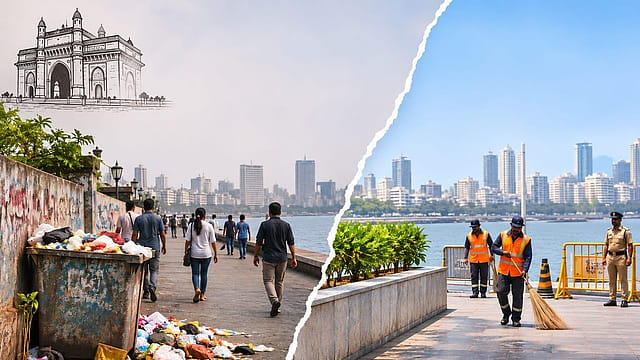
Mumbai, the city of hope, the city of gold, the city of opportunities, has transformed over the decades. Sadly, in many ways, from good to worse.
Some 40 years ago, it was a pleasure to walk from VT Station to Colaba, Marine Drive or Nariman Point. The roads were relatively clean, footpaths were in reasonably good condition and traffic discipline was much better. Even though hawkers lined the pavements, pedestrians could walk without much difficulty.
It was a joy to walk around Dalal Street, Mumbai University, Jehangir Art Gallery, the Prince of Wales Museum and Regal Cinema. South Mumbai had a certain charm and character.
I distinctly remember those days when people took pride in saying they worked in Fort, Colaba or Nariman Point. Nobody wanted to work in the suburbs. Today, that mindset has changed.

The Wealth Issue 2026
06 Nov 2026 - Vol 05 | Issue 45
Portraits of Dreamers and Doers under 35
Of course, Mumbai has grown enormously, starting with its population. We have new flyovers, expressways, the Coastal Road, Metro lines and towering skyscrapers. But what about the quality of everyday life?
Today, much of the city presents an ugly picture. Roads are dug up, construction materials lie unattended, buildings are covered with blue plastic sheets, garbage is strewn across streets with cows and dogs feeding on it, footpaths are encroached upon, sewage water flows in some places and traffic discipline has gone for a toss.
The soul of Mumbai seems to be slowly disappearing.
Against this backdrop, I was not surprised to read observations made by a bench of the Bombay High Court comprising Justices Girish S Kulkarni and Neela K Gokhale. The judges were hearing a plea concerning waste disposal at the Kanjurmarg landfill when the discussion turned to garbage and the overall cleanliness of Mumbai.
Their observations came in the wake of the Maharashtra government's efforts to spruce up parts of South Mumbai for the visit of Britain's Prince William and Catherine, Princess of Wales.
The bench orally remarked, “If the State Government and the BMC have a will to do, they can transform things in no time. And this we have learned through experiences. It can happen with lightning speed. So for all these important issues, you are going to be alive only when important personalities visit the city? It may not be appropriate. You have to act for the common man who is the permanent resident of this city.”
“We just observe, when some guests were coming, see Ballard Estate now, how shining and polished it is. If you want to do it, you do it, including painting, cleaning the streets with water… Do it for citizens. So instead of having this temporary show of two days, have a permanent show. Please have a permanent show in every possible ward. That is the message we want to give you,” the judges added.
Strong observations indeed!
The message was loud and clear. If the administration has the will, it can deliver. The problem, therefore, is not necessarily a shortage of money, manpower or machinery. It is the absence of sustained political and administrative will.
Interestingly, this debate took me back to an open letter I wrote in Firstpost in 2013 to Uddhav Thackeray, who had then taken over as president of the Shiv Sena.
The headline was An Open Letter To 'Loknayak' Uddhav Thackeray.
I had urged him to use the Shiv Sena's considerable organisational strength to improve the quality of life in Mumbai. My argument was simple: instead of dreaming of transforming Mumbai into Shanghai, why not first make Mumbai more livable and likeable?
I had suggested that the Sena turn its old slogan, Sundar Mumbai, Swach Mumbai, Harit Mumbai, into reality.
In that letter, I had listed 10 areas requiring urgent attention. These included proper hawking zones, better roads and flyovers, garbage collection three times a day, improved sanitation, cleaner municipal hospitals, pollution control and the removal of unauthorised political posters and hoardings.
I had specifically pointed out that housekeeping beneath flyovers was pathetic and that heaps of garbage at street corners presented an ugly picture of the city.
That was 2013.
Fast-forward to 2026. Thirteen years have passed. Political equations have changed, governments have come and gone, and Mumbai has witnessed massive infrastructure investments.
Yet, many of the same civic problems persist.
Why?
To my mind, there are two distinct but interconnected issues: civic housekeeping and civic sense.
The first is the responsibility of the government and municipal administration. The second is the responsibility of citizens.
Let us look at housekeeping first.
We Indians take enormous pride in maintaining our homes. We spend lakhs, sometimes crores, on interiors, Italian marble, modular kitchens and designer furniture. We want our homes to look spick and span.
But what happens outside our front doors?
The staircase may be dirty, the building facade unpainted, the compound cluttered and the pavement outside broken. Garbage may be lying just a few metres away.
Here, I am reminded of what the then Railway Minister Ram Naik said when he visited the Indian Express office in the late nineties for an informal chat with reporters. When a reporter asked him why railway platforms and trains were dirty and why tracks were littered with garbage, his counter-question said it all: “Who buys bottled water and chips? Poor people or educated people who can afford them?”
He was bang on!
Similarly, this fetish for spitting paan stains on city walls must be stopped. I have, through various fora, advocated a ban on kattha in paan — the ingredient responsible for the reddish stains defacing staircase corners and public walls.
We seem to believe that cleanliness is our responsibility only within the four walls of our homes. Beyond that, it becomes somebody else's problem.
The same mindset seems to prevail in government.
Political leaders love inaugurating new bridges, roads, Metro lines and beautification projects. There are photo opportunities, ribbon-cutting ceremonies and considerable publicity. And political posters, banners and hoardings add further to the ugliness.
But who gets credit for maintaining a clean pavement, repairing a broken drain, painting a flyover or ensuring that a public toilet remains usable?
There is glamour in creating new infrastructure. There is little glamour in maintaining existing assets.
That is where our housekeeping culture falls short.
Now consider civic sense.
Who throws plastic bottles, food wrappers and cigarette packets on the roads? Who spits on walls? Who dumps construction debris on pavements? Who drives on the wrong side or parks vehicles wherever convenient?
Surely, we cannot blame the BMC for every act of civic indiscipline.
Here is another interesting contradiction.
Many Indians who show little regard for civic rules at home bend over backwards to demonstrate how disciplined they are when they travel to Singapore, Dubai or London.
They do not casually litter, spit or violate traffic regulations. In fact, I have seen many Indians abroad going that extra mile — picking up somebody else's garbage and putting it in a bin.
Why?
Have they suddenly developed civic sense after landing at a foreign airport?
Not really. I think there are strong deterrents. Saying you are a VIP will not work. Indians abroad know there are consequences for breaking the law.
That raises another question: Is civic sense something we are born with, something we are taught, or something that can be enforced?
Perhaps it is a combination of all three.
Of course, governments must first provide adequate garbage collection, public toilets, walkable footpaths and functioning civic infrastructure. Without these facilities, merely penalising citizens will achieve little.
Equally, citizens must respect the infrastructure provided.
What Mumbai needs is not another grand beautification drive timed for a VIP visit. It needs a sustained, ward-by-ward housekeeping programme with clearly defined responsibilities and measurable results.
Clean roads, usable footpaths, well-maintained public spaces, functioning drains and proper garbage disposal should become everyday standards, not special arrangements.
The Bombay High Court has delivered a timely reminder.
Mumbai does not need a visiting monarch, a foreign president or an international summit to look clean and presentable.
It needs a civic administration that treats its citizens like VIPs and citizens who treat public spaces as extensions of their own homes.
After all, the true test of a world-class city is not how it looks when a VIP arrives, but how it looks when nobody important is watching.