From Yalta to Shenzhen
There were three of them, sure of victory over the Nazis in the denouement of World War II: freedom’s ardent advocate from America; his closest ally and freedom’s eloquent evangelist in power from Britain; and the dictator-in-chief from the Soviet Union, slayer of freedom at home but Hitler’s fiercest nemesis on the battlefield. When Franklin D Roosevelt (two months away from his death in office), Winston Churchill and Joseph Stalin met in the Crimean city of Yalta on the Black Sea in February 1945, the war-scarred Stalin’s help was crucial for a victory over Japan, the last hurdle for the Allies. It was a meeting of paradoxes in which ideology carved geography and, in diplomacy’s most compelling pas de trois, appeasement allowed the so-called sphere of influence to turn Eastern Europe into a Russian vassal, democracy’s craziest concession to tyranny’s biggest imperium. The conversation in Yalta resulted in the new order of global power where pragmatism legitimised moral copout. It would take another forty-five years for Stalin’s vassal states to overcome the Yalta betrayal, and for America, not more than a couple of months to put itself against the Yalta ally across the Iron Curtain.
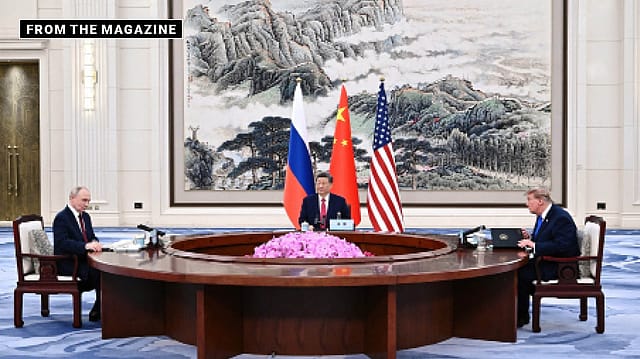
Shenzhen was not Yalta Updated, though the media was busy drawing parallels as Donald Trump, Xi Jinping and Vladimir Putin met in the Chinese city that was Deng’s flashiest special economic zone once. Eight decades on, the dramatis personae made a difference larger than the theme on the table. Then, as of now, the host was communism’s maximum leader. China’s sphere of influence today may not be as geographically marked as Stalin’s was during the Cold War, but the People’s Republic is the sole challenger to America’s supremacy in both economy and technology, and Xi is China’s Last Emperor consolidating his mandate for eternity.
Still, it was not China that was seeking concessions in Shenzhen. It was the Russian, who was not exactly Stalin at Yalta but pretty Stalinist in style. Putin came to Shenzhen as a different kind of warrior. In 1945, Stalin fought on the side of freedom despite banishing the idea at home. Putin took a leaf out of his idol’s war manual and launched the largest land invasion after World War II in Europe. Russia’s war, in Putin’s imagination, is a cultural correction and a shot at historical restoration, for independent Ukraine for him is a crime against the Slavic parentage of nationhood, which further shrinks the Russian imperium thriving in his mind. And the Ukrainian resistance to the legitimate Russian war for its civilisational rights, he believes, is sustained by a culturally degenerate West. Putin is not a communist, but it is the playbook of communism, the ideology to which he owes his carrier, that powers his nationalism. He was in Shenzhen for redress of his grievances against history. To add to the paradox, it was as if Hitler had gone to Yalta for chitchat.
Trump, in theory more equal than the others at the Shenzhen rendezvous, didn’t play FDR; he seemed at home with strongmen he could make deals with—and find in their motives a personal affinity, if not a political similarity. And that happens to be the biggest paradox. The leader of the free world, at this stage in the evolution of American power, does not see freedom under attack in Ukraine. He can only see out there a petulant little guy in a polo shirt refusing to be a loser in the face of Putin’s land grab when he could have easily made a deal with the necessary devil. At Yalta, FDR, despite his naïveté at the bargaining table, sat with Stalin because the Russians paid a higher prize for freedom on the battlefield. In Shenzhen, Trump sat with two dictators working hard to contain freedom. Trump was the dish at Shenzhen, and the two men with him, the inscrutable Chinese and the resentful Russian, could not have found in the American a threat to their “spheres of influence”. Concessions were easier to extract.
Trump, caught between Putin, suddenly worthy of being the third most consequential leader of the world and looking for immediate rewards from the American, and Xi, always playing the longer game without ever revealing his hand, looked smaller than his diminished domestic image. The lakeside set piece featuring two bona fide dictators and one autocrat in his autumn had only one message: they have made freedom small again in the new order.