The Art Of Saying NO: Why Smart Leaders Know When To Walk Away
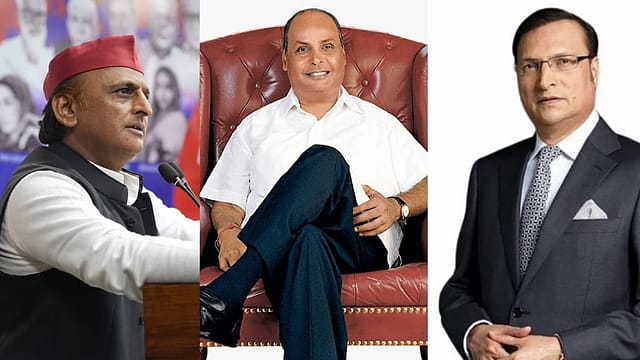
Unlike in Hindi movies, in real life, if you are smart, you will not pick a fight with an 800-pound gorilla. You will say NO to the fight and walk away. Does that mean you lack courage? Not really! You are being intelligent and realistic. The courage to say NO or the wisdom to retreat is not a sign of weakness. It is smart thinking. Basically, you are not allowing your ego to come in the way.
When is saying NO a sign of strength rather than weakness?
Let me elaborate. Last fortnight, Samajwadi Party chief Akhilesh Yadav challenged Uttar Pradesh chief minister Yogi Adityanath to contest from Ayodhya in the upcoming 2027 Assembly elections. Yogi responded by inviting Akhilesh to take him on directly. Akhilesh was smart enough not to accept the personal challenge. Instead, he backed his party's candidate.

The Era of Forever Wars
30 Oct 2026 - Vol 05 | Issue 44
Coping with an explosive Middle East
It was a prestige issue, but Akhilesh declined to turn it into a personal duel. Why should a party leader risk turning an entire state election into a battle between two individuals? By refusing to take on the popular CM directly, he may have made a strategically sound decision. Had he contested and lost, it could have damaged not just his personal standing but also the morale of his party cadres.
It would have put him in a spot like Mamata Banerjee who and her party Trinamool Congress was convincingly defeated by BJP in West Bengal assembly poll in 2026. When the leader loses, the cadres lose hope. Trinamool is a shining example, post her defeat the Trinamool has split into three distinct factions.
Another story of saying NO that comes to mind is that of Aap Ki Adalat fame Rajat Sharma, founder of India TV. It is well known that Sharma, whose hugely popular show won him friends in high places, was particularly close to former Prime Minister Atal Bihari Vajpayee. Their families were so close that they reportedly holidayed together. That was the kind of proximity Sharma enjoyed with Vajpayee, even when the latter was Prime Minister.
In an ANI podcast with Smita Prakash in March 2024, Sharma revealed that one night after dinner, Vajpayee told him that he was planning to bring him into the Rajya Sabha. On hearing this, Sharma immediately said NO. He told the Prime Minister that he had no interest in politics and that Vajpayee's affection was enough for him.
Vajpayee was surprised and apparently felt Sharma was playing hard to get. So, he asked Arun Jaitley, a close friend of Sharma, to find out what was going on. Sharma explained to Jaitley that he was not interested in political office. He was absolutely committed to journalism.
Imagine the guts it takes to say NO to the Prime Minister! A Rajya Sabha seat could have opened doors to an influential political career. But Sharma was clear about what he wanted. The influential journalist showed that he was made of a different mettle.
The third example is about the wisdom to retreat. And the man who demonstrated it was none other than the legendary Dhirubhai Ambani.
Reliance Industries was expanding rapidly, and Dhirubhai needed an engineering, procurement and construction (EPC) contractor to execute his group's ambitious projects. He zeroed in on engineering giant Larsen & Toubro (L&T) and began building a substantial stake in the company, with the support of financial institutions. On April 28, 1989, he took over as Chairman of L&T, while both his sons, Mukesh and Anil, joined the board.
Unfortunately for Ambani, there was a regime change. A new government headed by V P Singh came to power in late 1989. Singh had been a fierce critic of Reliance and its business practices. The change in political climate brought the Ambanis' growing influence over L&T under intense scrutiny.
What also complicated matters for Dhirubhai was the crusading campaign in The Indian Express, with S Gurumurthy playing a prominent role. The newspaper's relentless exposés raised questions about Reliance's dealings, institutional support and the circumstances surrounding its growing influence over L&T.
With political and institutional opposition mounting, Dhirubhai stepped down as Chairman of L&T in 1990. But he made a request to the government to let both his sons continue on the board of L&T. The VP Singh government agreed.
Eventually, in 2001, the Ambani family's stake in L&T was sold to the Aditya Birla Group.
For Dhirubhai, the bigger picture mattered. A strategic retreat seemed more sensible than a fight to the finish. The man who created the equity cult in India knew when to call it quits and when to fight another day.
Let me turn to some global examples.
This story has been told ad nauseam. In the early decades of the 20th century, when Pepsi was going through a rough patch, it reportedly approached Coca-Cola with an offer to sell the business. Coke said NO. In hindsight, that refusal is often cited as a spectacular missed opportunity, as Pepsi eventually emerged as one of Coca-Cola's fiercest competitors.
This next story is equally dramatic. In 2000, Netflix co-founders Reed Hastings and Marc Randolph approached Blockbuster with an offer to sell Netflix for approximately $50 million. Blockbuster declined.
What happened next is history. Netflix went on to transform entertainment distribution, while Blockbuster filed for bankruptcy protection in 2010.
Similarly, in 2008, Microsoft's Steve Ballmer made a $44.6-billion offer to acquire Yahoo. Yahoo resisted the offer, believing it undervalued the company. Microsoft subsequently explored a higher price but eventually withdrew its bid when the economics no longer made sense.
In 2017, Yahoo sold its core internet business to Verizon for approximately $4.48 billion — roughly one-tenth of Microsoft's original offer.
Ballmer did not turn the acquisition into an ego battle. He recognised that there is a price beyond which a good deal becomes a bad one. That is what separates the men from the boys.
Another interesting story is Comcast's $54-billion bid for Walt Disney in 2004. Comcast CEO Brian Roberts wanted to acquire the entertainment giant, but Disney's board refused to engage in negotiations. Rather than prolong an expensive and increasingly hostile takeover battle, Roberts withdrew his offer.
His statement at the time was profound: "Being disciplined means knowing when it is time to walk away. That time is now."
All these examples show that saying NO requires conviction. Retracing your steps requires wisdom. Knowing when to do either requires maturity, experience and judgement.
Generally, successful businessmen are celebrated for their aggression, ambition, risk-taking and ability to conquer markets. Very few are celebrated for walking away from an acquisition, abandoning a project, rejecting an attractive offer or conceding defeat.
Yet some of the greatest business decisions have involved precisely that.
To sum up, as management gurus have often reminded us, the real test of leadership is not merely knowing when to fight. It is knowing which battles are worth fighting, which opportunities are worth pursuing and, above all, when to walk away.
After all, winning every battle is meaningless if you end up losing the war.