Liberating Higher Education: It is time to allow for-profit institutions in the sector
THE LATE US President Ronald Reagan used to tell an apocryphal tale that perfectly illustrated the flawed Soviet economic model. It was about a man who went to buy a car. He pays the money at the dealer and is told to come back in 10 years to collect the car. The man asks the dealer whether he should come in the morning or afternoon? The dealer wonders what difference it would make 10 years hence. He replies, “Well, the plumber is coming in the morning.” It is the tale of an economic model which created scarcity.
For Indians of a certain vintage—Boomers and Gen X—Reagan’s story would ring familiar. Before the 1991 reforms, people waited years for a scooter, car, phone, and gas connections. Millennials and Gen Z have not seen scarcity of that kind. But they are dealing with a scarcity of another kind. Not in goods, but in a service—education.
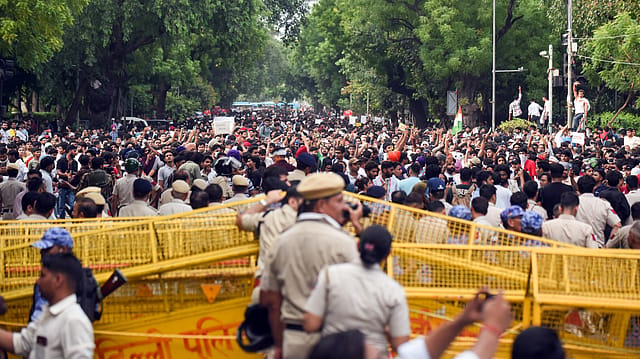
The NEET, which determines entrance to medical colleges, has been the subject of great controversy because of a paper leak. But hardly anyone sees a scandal in 22 lakh students sitting for an examination that can allocate a maximum of 1.3 lakh seats in medical colleges across India. Of these, only half are at government-run institutions (which are affordable). The other half is in private institutions not everyone can afford. It is not a scandal of corruption, but of scarcity. That many Indian students opt to study in medicines in places like Kazakhstan, Georgia and other former Soviet countries, hardly beacons of quality, shows the acuity of the problem.
The demand-supply imbalance is a feature of India’s higher education system, even beyond medicine. In addition, there is a problem of quality. Except for some elite institutions, the rest don’t really provide anywhere near a top-class education. The higher education scenario today is not unlike the general economic scenario before 1991—scarce goods of poor quality and high prices. And this is no accident. Because unlike the rest of the economy, which was unshackled in 1991, higher education remains under a regime of control, and hence, scarcity.
But plenty of private colleges exist. And the private sector existed in India’s economy in the period before the 1991 reforms as well. But they have no incentive to excel. Many of them, particularly in medicine and engineering, are owned by people with connections who can deal with the regulatory system in starting up. And then play the system by charging massive fees in a sector where for-profit institutions are banned. Of course, there are a handful of exceptions which have come up mostly under the aegis of legislation by state governments, which do provide quality education. But none of them are in the global league, not even in the league of elite public institutions.
It is time to end our moral farce and allow for-profit institutions in higher education. This will bring India’s best entrepreneurs, including startups, into this sector. They will compete and come up with innovative models which offer quality and affordability at the same time. After all, did this not happen in telecom and aviation after liberalisation? In addition, a deregulation of the sector, including the abolition of the University Grants Commission—which plays the conflicting roles of funding and regulating the sector—will also encourage philanthropists and international universities to set up new institutions in India.
The proliferation of quality universities and other institutes of higher learning will be good for students. It will also be good for creating massive jobs, not only of teachers but also administrative and other support staff. As an ancient centre of learning, and home (at least, originally) to some of the best academics in the world, India should not only educate its own but also those from other countries. For that, we need to move from scarcity to plenty.