What’s Your Company’s Hormuz?
Recently, Harsh Goenka, chairman of Mumbai-based RPG Enterprises, who is very active on social media, tweeted that the latest jargon to enter the corporate world is: “What’s your company’s Hormuz — the hidden dependency that can stop everything?”
Hormuz is the new term that has entered the B-school lexicon. For decades, B-schools have taught us terms like SWOT analysis, stick to your knitting, core competency and White Knight. Then came terms like Black Swan, disruption, VUCA, anti-fragility, burn rate, moat and elephant in the room. Newer and newer expressions like “I want white smoke” get coined by management gurus from time to time. For instance, during the Lehman Brothers crisis, terms such as stressed assets, decoupling and cash for clunkers became popular.
If one were to define Hormuz, it is that one dependency everyone ignores until it suddenly disappears.
Every business has its own Hormuz. To my mind, today the biggest risk is often not competition but the hidden choke point — something that was amply demonstrated during the Covid-19 pandemic and the U.S.-Israel war with Iran.
The Modi Years
02 Oct 2026 - Vol 05 | Issue 40
A Nation Rebuilt
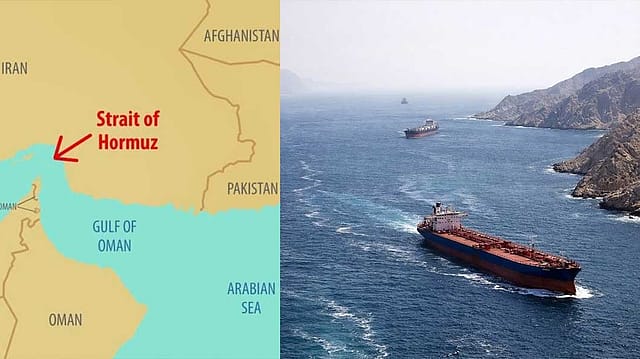
Ever since the war began between the U.S.-Israel and Iran, the global economy was hit at the solar plexus as the Strait of Hormuz was shut from February 28, 2026, to ships carrying crude oil, LNG, fertilizers and food. Under normal circumstances, around 20 million barrels of crude oil and petroleum products pass through the Strait daily. This constitutes nearly 20-25% of global petroleum consumption and maritime oil trade. With this important transit point choked, oil prices, which were ruling at around $72 per barrel before the war, peaked at $126.
Nobody talked about the Strait of Hormuz when ships sailed normally. The moment it was threatened, the entire global economy began to feel the impact. In our school days, we were taught about Constantinople (now Istanbul), which developed into a thriving port because of its strategic location between Europe and Asia and its natural harbour. Even then, its strategic location was leveraged by competing powers to drive home their point.
Thankfully, the Strait of Hormuz reopened after declarations of a ceasefire between the U.S. and Iran in mid-June. However, the situation continues to be fluid.
The Covid-19 lockdown in 2020 brought the world to a virtual standstill. Among other things, the supply of rare earths, APIs and solar panels from China was badly disrupted, affecting factories across continents. China had become the manufacturing Hormuz for the world, and Covid-19 exposed this brutally.
Let us take a look at the four Ms of business — Men, Machine, Market and Money — along with government policies, through the prism of Hormuz.
Men & Hormuz: In 1982, militant trade union leader Dr Datta Samant, who headed the Kamgar Aghadi Sena, gave a clarion call to two lakh textile workers in Mumbai to strike work. The 1982 Mumbai textile strike became the Hormuz for the city’s textile industry. Thousands of acres of mill land changed forever, and many textile giants never recovered. Unfortunately for the workers, the strike worked in favour of mill owners, who refused to budge and give in to Dr Samant’s demands. It reset Mumbai.
Sometimes, one individual can also become the Hormuz. Steve Jobs quit Apple in 1985, and we know what happened under CEO John Sculley. So too can the sudden death of a founder, like Tulsi Tanti of Suzlon or Ambareesh Murty of Pepperfry, expose a company’s dependence on one individual.
Machine & Hormuz: Reportedly, Toyota once had a supplier whose factory fire halted production across Japan because one small component was unavailable. One tiny missing part stopped the production of thousands of cars. That was Toyota’s Hormuz.
Market & Hormuz: U.S. President Donald Trump’s imposition of sweeping tariffs hit countries across the world. If Europe bans imports or China slows down production, then an entire market can become a Hormuz. Exporters can lose out big time.
Many Indian IT companies depend heavily on U.S. clients. When the Trump administration attempted to impose a sweeping $100,000 fee on new H-1B visa applications, arguing that the programme replaced American workers, it created considerable uncertainty, even though a U.S. District Judge struck it down. For Indian IT companies, America can be their Hormuz.
Money & Hormuz: During the 2008 financial crisis in the U.S., major investment bank Lehman Brothers filed for bankruptcy after losing 93% of its market value. It was the largest bankruptcy in U.S. history and created a ripple effect globally, affecting Indian companies too. In the U.S., many companies went belly-up, while in India, many companies put their expansion, diversification and fund-raising programmes on hold.
Sometimes, businesses don’t die because they are unprofitable; they die because cash stops flowing. Money is the oxygen.
Government Policies & Hormuz: Prohibition is an obvious example. Another case that comes to my mind is that of SM Dyechem, founded by SM Shetty. SM Dyechem, which manufactured specialty chemicals, surfactants and disinfectants, made a major investment in Mono Ethylene Glycol (MEG), setting up a plant at Kurkumbh, Maharashtra.
The feedstock — alcohol derived from molasses — was tightly regulated and inexpensive when the project was conceived. However, by the time the plant was ready, the government had decontrolled molasses prices, leading to a meteoric rise in costs. The business became unviable almost overnight, and SM Dyechem was declared a sick company.
One notification can change an industry overnight. Take, for instance, the cancellation of mining licenses or 2G telecom licenses by the Supreme Court.
With regard to Technology & Hormuz, one can think of Kodak, Nokia or BlackBerry. These brands were not simply destroyed by competitors. Technological change became their Hormuz.
Today, AI may become the Hormuz for many white-collar businesses.
Some companies depend on one customer for 50-60% of their revenue, particularly in sectors such as auto ancillaries. Lose that customer and the business can collapse. In such cases, the customer becomes your Hormuz.
Businesses spend enormous amounts of time analysing competitors. Now, perhaps, they will have to start identifying their own Hormuz. Here, one recalls Peter Drucker’s brilliant quote: “The greatest danger in times of turbulence is not the turbulence; it is to act with yesterday’s logic.”
Much as “Black Swan” came to represent unpredictable events, “Hormuz” can represent a hidden strategic choke point — the one dependency that no one notices until everything comes to a halt.
When I was digging around for information about how companies can become Hormuz-proof, AI suggested a simple “Hormuz Test.” It said every CEO should ask three questions:
1. What is the one thing that can stop our business tomorrow?
2. If it disappears for 30 days, can we still survive?
3. Do we have a credible alternative or backup plan?
If the answer to the third question is “No,” then they have found their Hormuz.