The Modi Years: A nation rebuilt by the struggles and sagacity of one man
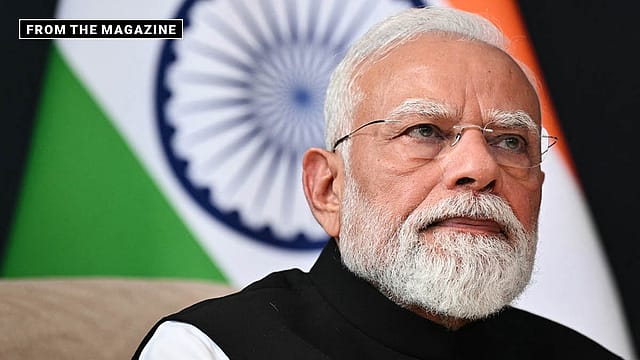
The day Narendra Modi took oath as the fourteenth chief minister of Gujarat on October 7 twenty-five years ago, it was not just ideology that paved his path to Gandhinagar. Biography infused a sense of inevitability into the moment. It was not the story of another apparatchik from the Parivar who suddenly courted glory on the Sabarmati on the strength of a dramatic career on the political right either. It was the quiet nationalist, his adult life shaped by the duties of a Hindu volunteer in a Motherland hurt by history, with a backstory of turning every adversity into a trial of conviction, mastering the first notation of power.
Today, in the commemorative aura of a quarter-of-a-century in power, ‘struggle’ is the motif that mythicises this milestone in Modi’s life. It is perhaps the only word that shifts the moral balance of power, and it is unlikely that any other politician in India has achieved what Modi did in making the struggle for power and the struggle against power an interchangeable fact of political life. It was on national display as he stormed into Delhi in 2014 after a bravura performance as “the chief minister of India”, a title he earned for maximising the dividends of power as a development model even the Central government of the day couldn’t match. Absolute power didn’t corrupt; it intensified the struggle for more, for power, he realised from the very beginning, alone brought change. There was no point being apologetic about it. There was much to be done in turning personal conviction in the uses of power into a national campaign for rebuilding India.
The struggle against power did not end with the summer thriller of 2014, which was the culmination of one of the longest campaigns—the struggle of conviction—in a democracy. The argument for a revised version of nation-building that began in 2014 was also a new campaign against the last vestiges of a false inheritance. Power, in the book of Modi, is a permanent struggle of the nationalist, and the India that elected him was ready for a cultural reinvention. The new struggle of India’s most powerful—and popular—politician was against the power of the still lingering ideas that continued to minimise the nation and exaggerate the cosmopolitanism of the Nehruvian New Man, whose updated variants, even if they didn’t mourn the death of the socialist state, dreaded the sight of the secular state shedding its inhibitions and indulging its Hindu identity. Modi could see 2014 only as the liberation of India, not merely a regime change.
He needed to play the three parts that would make a national statement India had not experienced before. First the moderniser. He came to Delhi with the reputation of a Hindu Deng who could build special economic zones in “vibrant” Gujarat. As prime minister, on a wider canvas, he didn’t follow the same brushstrokes. Even as he let entrepreneurial India dream, in an unequal country like India, he could not afford a state without compassion, and that was probably one reason some of the early Modi enthusiasts on the right felt let down by his not playing a Reagan or a Thatcher. Even as he let aspirations flourish in a country where to be rich was glorious again, he didn’t forget that India was the countryside, which was pretty obvious to someone who didn’t require the aid of borrowed isms to know his country. That India stood steady in global turbulence was confirmation that a gradualist with a better reading of his country could free the market and sustain growth.
And as a globalist, he had to unlearn a lot in an India that was once the patron saint of Third Worldism, which meant a pronounced Soviet bias and mandatory anti-Americanism. Even after the fall of the Berlin Wall, India refused to discard the lens of Third Worldism. Things started to change during the Vajpayee years, but India gained the confidence to survey the world without the ideological baggage it had been carrying since the high noon of non-alignment only when Modi, who was by now arguably the most popular leader in a democracy, became the wise man from the East. He never allowed national interest to be subordinated to group affiliations. To maintain the principled pragmatism of an emerging power required a different kind of struggle on the world stage: balancing internationalism with nationalism.
It was the struggle of the cultural restorer that added a civilisational content to his modernisation project. As the prime minister led the rites of a god’s homecoming in Ayodhya, it was not that the state was swaying to the sacred. It was the prime minister playing out the obligations of a nationalist indebted to the grievances of the Hindu. The cultural symbolism of the temple only clarifies the nature of power in the Modi age: identity needs a reminder in an India where the question Who Are We? has become redundant. And the question has always resonated in Modi’s struggle against (and for) power.
Modi is still asking questions and letting the world’s most unforgiving democracy answer them. India is a nation redeemed by its own confidence; conservatism is getting comfortable with a Hindu adjective at a time when the political right elsewhere is in search of leaders who are worthy of a tradition that celebrates the virtues of the familiar; and democracy is still romancing its most imaginative Indian politician—all because of the relentlessness of being Modi in power.