India Leaves India, But India Comes Along
Konstantin was waiting at the Burger King in Belorussky Station for morning coffee. It was about as glamorous as our meeting deserved, but more importantly, it was cool. An unseasonal heat wave struck the Russian capital on Monday with temperatures hitting 35 degrees by mid-afternoon. As I stepped off the sleeper train from Minsk, it was already 26 and still not 7am.
“He,” Konstantin said conspiratorially, leaning across the table towards me, “is from Tamil Nadu, you know it?” I said yes, looking at the man in a brown shirt and trousers cleaning burger wrappers from tables. “Paid five hundred bucks a month [$500}, it costs a couple of grand to get him to Moscow. Stayed for a year, then sent home.”

Zeroing In on ECI
09 Oct 2026 - Vol 05 | Issue 41
Constitutional legitimacy versus political opportunism
Konstantin works now for a top technical university in Moscow, having worked for a year in my former department from 2021. He recruits international students, but wrote his Master’s thesis on “Labour migration to Russia from 2010-15.” He was confirming my personal fears and biases over sharp-tasting lattes.
From Central to Southern Asia, Russia’s Quest for Cheap Labour
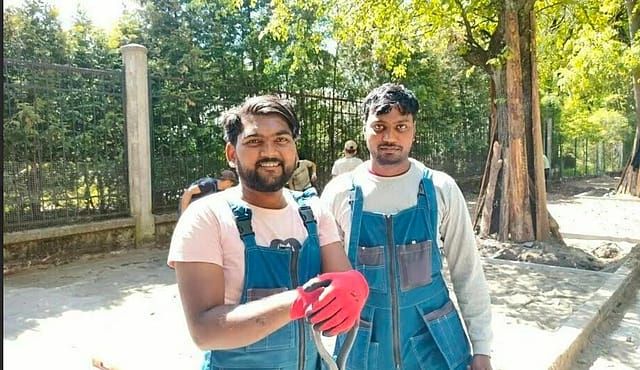
Tens of thousands of Indians have appeared in Russia since late-2024 to work on single-year contracts. Previously, Central Asians, the vast majority Russian-speaking, fulfilled the bulk of menial labour, industrial, and construction job needs for the country. The COVID-19 pandemic saw between 20-35% return home, according to Rosstat [Russia’s state statistics agency], and not be replaced. Russia, however, got by and, as the former rector of the Russian State Social University Natalia Pochinok said, if there “are no more global shocks, it will self-correct.”
Then came the escalation of the conflict in Ukraine in 2022 and Central Asian men, who had previously yearned for Russian citizenship, figured they might wait this one out at home for fear of being conscripted. There was suddenly a workforce deficit and bodies needed to fill those roles previously occupied by Central Asians.

“It’s cost-effective and practical. Many of these Indian migrant workers are making multiples per month of what they [are] at home,” said an employment agency talking head on Kommersant FM this March, adding that it was only “temporary” and that “helps both countries long term.”
She might be right, though according to Konstantin and others I spoke with, there are costs to be paid for hiring from India. Costs that are “disturbing” the workflow, the operations manager for 8 Burger King restaurants told me earlier this year.
Russian breakwaters between ‘groups’
“How can it be that, I will be clear, in the kitchen production line, a skilled chef’s product cannot be handled directly by the guy working the cash or service?” Karina, an experienced operations manager in the fast food industry told me on Monday evening.
She was describing how one Indian worker refused to have contact with another “due to caste, they say,” she told me in a food court next to one of her establishments in the elite Europiski Shopping Centre. “I’ve spoken with the agencies who bring us workers and they say – just put a Russian between them, problem solved.”
This same issue I heard raised in Ulyanovsk’s UAZ vehicle plant. There, Indians refuse to share a dormitory building with fellow citizens, demanding to have their own place to live. And production was also a difficult matter, until they put Russians or non-Indians as breakwaters between workers from the sub-continent.
“I know the caste system is gone, I’ve read it, heard it. Yet it seems to operate in Russia and is of genuine concern,” Konstantin told me. “This guy,” he pointed again to the man from Tamil Nadu, “is collecting rubbish as he speaks no English and can’t work in the kitchen or serving. You go to construction sites, production lines, the same. Speak no English, you do grunt work.”
Caste or Class?
One former diplomat from the Indian mission to the Russian Federation, who was my neighbour in the Ministry of Foreign Affairs compound on Kutuzovsky Prospect, wanted to explain. Anil, not his real name, told me on Monday night that in Russia there is a divide between Indians based not only on caste, but language, religion, and region.
“What you are saying, breakwaters, low pay jobs, all you have told me, the Embassy can confirm almost all. Many of the people who go to Russia are just bringing their homes [attitudes] with them. The British call it snobbery, I think this is more appropriate. Why would a skilled engineer from, I can say, Delhi, want to be associated with some day worker from AP [Andhra Pradesh], just because they’re both Indian?”
Anil’s view does resonate with me, as I experienced the same “snobbery” in the Irish community in Moscow. Though it was more based on the job/status than where the person came from. I pushed him on the caste issue and what I’d heard in Ulyanovsk.
“I would say, to be honest, it is more a class divide thing than caste. We both know of the case you brought to me of the university hostel and the uproar over one Indian refusing to share a room with another. It wasn’t caste, it was a girl from a good family not willing to live with a poor girl from a village background.”
Case study in Caste, or Class
On that point, I will briefly explain. It was 2020, one girl from Maharashtra beat a girl from Bihar with a sweeping brush the day after they were put into the same room at our university hostel. The measure was taken, by the then pro rector, as COVID-19 lockdowns came into force and students had to move from other dorms into the sole functioning building. As Director of the International Office, I had to travel across the locked down city to resolve the issue.
“Filthy Dalit, I’m not sharing my space with her. Get her out, or I’ll punish her,” the 3rd year Media Studies student screamed at me. As she vented, I Googled “Dalit” and sank into my chair with sadness. The object of her ire sat silently, downcast, and trying not to cry.
“We have no space, you know this. The world is in bad shape and we have to make do with what we have. So, you have a choice, you behave, or you find yourself another place to stay,” I said after her monologue.
“Why should I move? I am not sharing with this,” she paused, for a moment I thought she was going to calm or relent, “thing.”
At that moment I was snookered, there was no option to move students between rooms due to Ministry of Higher Education regulations and there was no free space. Also, we could not move students to another university’s dorm. Indeed, I was trying to find a spot for one Angolan girl who was being released from quarantine. As always, when most needed, inspiration appears.
I told the Bihar girl to go to the room, pack up her belongings and meet me on the 5th floor. The student from Mumbai beamed with victory, though I’m told her glee disappeared when the student from Angola was moved into the room that evening.
“We just deal with it”
Karina wasn’t bothered by internal Indian culture differences. For her, getting the best staff for jobs was most important.
“We’ve hired many foreign students through the years, especially since 2021. We have more contract Indian workers now, which means our HR have to adjust a little.”
Like building breakwaters? “We just deal with it. If the person doesn’t like it, they can find another employer.”
After meeting with Konstantin, I took the metro and met dozens of Indians going to work in Moscow City [high rise business district]. I struck up a conversation with a group from Telangana, who had little English, no Russian, but seemed happy to meet a smiling face.
“Cleaning, sir,” answered 29-year-old Shivin to my question of what their job was.
“3 month, sir,” Taje, who told me that they all come from Mancherial and that they “very like” Moscow. They all nodded and agreed Moscow is “top, top.”
“And the cold?” I asked. They laughed and Taje said that they “very not like.”
We parted ways at Kievskaya with handshakes and smiles. All of us visitors to a foreign land, with locals passing us by, oblivious of our struggle. And us of theirs.
So what of the girl from Bihar, who I told to pack her stuff and move out? She had been sharing a room in a block, 2 rooms with 2 students in each, which was considered a luxury in the university. However, she was moved into a single room block, complete with shower, toilet and kitchen. Her roommate was a Serbian Master’s student, now an associate professor in Belgrade. She encouraged her new roomie to continue her path in higher education and the Indian girl is now studying for a PhD in Sociology, in Germany.
The Mumbai girl? She graduated with 3rd class honours and, according to her Instagram, is back home and creating ‘content’ for her 114 followers.