Corporate Scandals: Why Are CEOs Held Accountable While the Rest of the C-Suite Escapes?
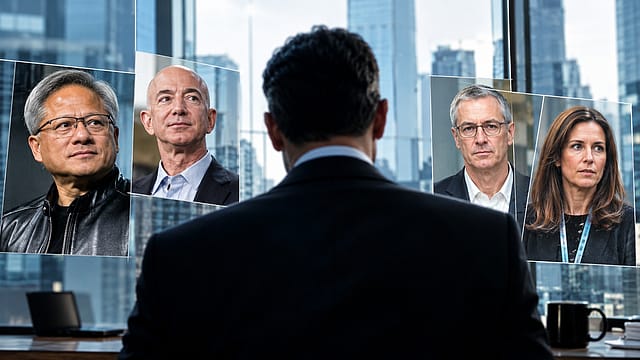
The CEO gets caught. The board gets nervous. The PR agency gets a call. Someone drafts a statement about values, integrity and the company's unwavering commitment to its people. There is usually an investigation, a few carefully worded apologies and, occasionally, a resignation. The internet gets its entertainment. The company gets a headache.
Welcome to the modern corporate scandal. The CEO is the star, the board is the supporting cast and everyone else is apparently on a coffee break.
Jensen Huang, until November 12 the chief executive of Nvidia, has just had a rather spectacular exit. The man who helped turn a chipmaker into one of the most powerful businesses of the AI age resigned after admitting infidelity and facing reports of multiple relationships, including one with an Nvidia employee. Another relationship involved a businesswoman whom US intelligence reportedly suspects of having links to Chinese intelligence. Those allegations remain under investigation. Nvidia has said it has no reason to believe its secrets or national security were compromised.

The Wealth Issue 2026
06 Nov 2026 - Vol 05 | Issue 45
Portraits of Dreamers and Doers under 35
It is quite a fall for a man whose leather jacket had become corporate shorthand for the artificial intelligence revolution. Huang was not simply selling chips. He was selling a vision of the future, usually from a brightly lit stage, in a leather jacket and with the confidence of someone who knew exactly where the world was going.
Now the board has a different problem. His CFO, Colette Kress, has taken over as interim CEO. The company must convince the world that Nvidia is bigger than the man who became its face.
But before we get to the marketing lessons, a more basic question: why is the CEO always the main character?
Jeff Zucker at CNN, Jeff Shell at NBCUniversal, Bernard Looney at BP, Andy Byron at Astronomer and Laurent Freixe at Nestlé. Different companies, different circumstances, different allegations. Yet the story keeps returning to the person at the top.
What about the CHRO? The CMO? The CTO? The CFO? The people who supposedly run the machinery of corporate life?
Apparently, the CEO is responsible for everything, including the headlines. The rest of the C-suite can sometimes get away with being a footnote.
The chief executive and the chief everything
A CEO does not run a company alone. That is the fantasy sold at conferences and in corporate biographies. In reality, there are people responsible for hiring, firing, workplace culture, technology, finances, compliance and reputation.
The CHRO is supposed to know what is happening inside the workplace. The CMO is supposed to understand how the company is perceived outside it. The CTO is entrusted with technology and sensitive information. The CFO watches the money. The board watches management.
So when a CEO has an undisclosed relationship with a subordinate, some fairly obvious questions arise. Who knew? Did HR know? Were complaints raised? Was there preferential treatment? Did the board investigate? Did anyone think to ask whether the company's policies applied to the person who wrote them?
These are not minor administrative questions. They are the actual business of governance.
Take Astronomer. Its CEO Andy Byron and chief people officer Kristin Cabot became global internet celebrities after a Coldplay concert camera caught them embracing. Both eventually left. The chief people officer, whose professional responsibility involved workplace culture, was now part of a workplace controversy. That does not automatically establish a breach of her professional duties, but it does make the case for independent oversight rather obvious.
When the people responsible for enforcing the rules become part of the story, who investigates them?
The CEO is the brand. Until he isn't.
There is another problem here, and marketers should pay attention.
Companies have spent years turning executives into walking brand assets. Steve Jobs had his black turtleneck. Richard Branson had his adventurous billionaire act. Jensen Huang had his leather jacket. Elon Musk has, well, Elon Musk.
The personality becomes the product. The CEO becomes the company. Investors listen to him, employees follow him and customers recognise him. It is an efficient marketing strategy, until the person at the centre becomes a liability.
Nvidia has spent years making Huang the public face of its technological ambition. His presentations were events. His opinions carried weight. His personal brand became part of the company's larger story.
Now Nvidia has to sell something else: continuity without its most recognisable salesman.
This is the danger of building a company around a personality. A CEO can be an asset, but should not become a single point of failure. A brand that cannot survive its founder's departure has a branding problem, not merely a succession problem.
The marketing department can produce a beautifully worded statement. It cannot Photoshop a governance failure out of the company's history.
And what if the CEO were a woman?
Here is where things get interesting.
Imagine a woman running Nvidia. Imagine she admitted to an affair with an employee and found herself at the centre of questions about workplace power, corporate conduct and her judgement.
Would the coverage remain focused on governance? Or would we get a long discussion about her character, her family, her ambition and whether women are really suited to positions of power?
Women CEOs are still relatively rare. But the media scrutiny they face is worth examining. A 2025 Russell Reynolds Associates study of more than 20,000 media articles found that women CEO departures were 1.7 times more likely to receive coverage than men's. Negative sentiment appeared in 28 per cent of coverage of women's departures, compared with 18 per cent for men.
A man's professional failure can remain his own. A woman's can become an examination of women in leadership.
That is not an argument for giving women executives special treatment. It is an argument for giving them the same treatment. If a woman CEO abuses her authority, investigate her. If a male CEO does the same, investigate him. Do not turn one man's conduct into a verdict on an entire gender, while treating a woman's conduct as evidence against all women.
And the women already involved in these scandals should not be reduced to supporting characters. Allison Gollust was CNN's chief marketing officer. Kristin Cabot was Astronomer's chief people officer. They had professional responsibilities of their own. Their actions deserve scrutiny, as do the actions of the men involved. But power matters. A CEO and a direct subordinate do not occupy the same position in an organisation.
Whoever gets caught?
Perhaps the most uncomfortable question is whether corporate accountability is really about misconduct or simply about getting caught.
Affairs have existed in boardrooms long before smartphones, LinkedIn and viral videos. Powerful men have not suddenly discovered romance. What has changed is the speed at which private conduct can become public spectacle.
A camera at a Coldplay concert can do in 30 seconds what an internal investigation might take months to establish. A newspaper report can force a board to act. An employee complaint can sit in a system for weeks.
Some executives resign after investigations establish breaches of company policy. Others leave amid allegations that remain unproven. Some are protected by their commercial importance. Others are dispensable. The board's appetite for accountability can be remarkably elastic.
An affair, by itself, is not necessarily a corporate scandal. Nobody appointed shareholders as marriage counsellors. But a relationship involving a subordinate, preferential treatment, conflicts of interest or sensitive business information is another matter entirely.
So no, spare the CEOs? Not really. They are paid extraordinarily well to take responsibility. But spare us the idea that the CEO is the only person in the building with a duty to behave.
The CHRO cannot outsource workplace culture. The CMO cannot outsource reputation. The CTO cannot outsource technology security. And the board cannot outsource oversight.
A company is not a man in a leather jacket delivering a keynote. It is an institution, built by thousands of people and governed by an entire leadership team.
The CEO may get caught. The CEO may get fired. But the really interesting question is who else knew, who looked away and who is still collecting a salary.